Why SaaS Compliance Matters More Than Ever in 2026


Introduction
Software as a Service (SaaS) applications have revolutionized how businesses operate. From customer relationship management to financial planning, cloud-based solutions drive modern productivity. However, this convenience brings a critical responsibility: ensuring SaaS compliance.
As organizations move data and operations to the cloud, they navigate increasingly complex regulations and security requirements. A single compliance failure can trigger devastating consequences; substantial fines, legal battles, reputational damage, and lost customer trust. Regulatory bodies worldwide are tightening controls on data handling, making compliance non-negotiable for survival and growth.
SaaS compliance is an ongoing commitment to protecting customer data, maintaining operational integrity, and meeting evolving regulatory standards. Whether you're launching your first SaaS product or managing dozens of applications, understanding compliance is essential. The digital economy demands accountability, transparency, and robust security measures that only proper compliance can deliver.
The biggest challenge is that frameworks constantly change and vary across industries and regions. What works in one jurisdiction may not satisfy another. Healthcare providers navigate HIPAA, financial institutions manage SOC 2 and PCI DSS, while European operations require GDPR compliance. Each framework brings unique requirements, documentation standards, and audit processes. This guide demystifies SaaS compliance, breaking down major frameworks, outlining practical achievement steps, and showing how specialized solutions simplify your journey while reducing costs and accelerating time-to-market.
What is SaaS Compliance?
SaaS compliance ensures cloud-based applications adhere to laws, regulations, industry standards, and security frameworks governing data protection, privacy, and operational security. It demonstrates your platform handles sensitive information responsibly while maintaining security and privacy standards.
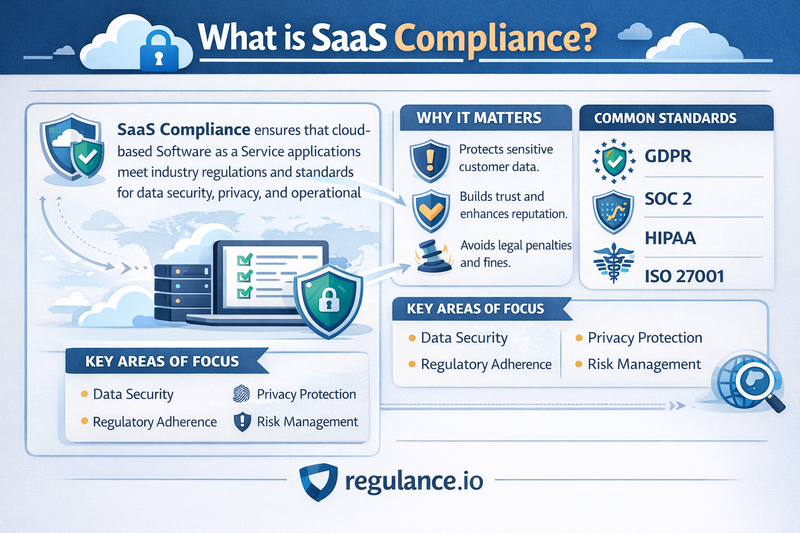
SaaS compliance encompasses critical dimensions: data protection through encryption and secure storage, privacy compliance ensuring proper handling of personal data per regulations like GDPR or CCPA, and security standards preventing breaches and unauthorized access. These interconnected elements form a comprehensive security posture that protects both your business and your customers.
The shared responsibility model makes SaaS compliance particularly challenging. Unlike traditional on-premise software where companies control everything, SaaS providers and customers share compliance responsibilities. Providers handle infrastructure and platform security, while customers manage configuration, access controls, and data handling.
SaaS compliance extends beyond technical controls to include documentation, regular audits, incident response procedures, employee training, and data handling policies. For providers, compliance certifications differentiate products and attract enterprise customers. For customers, vendor compliance protects against penalties and reputational harm. Compliance becomes the foundation of trust in digital business relationships.
Major SaaS Compliance Frameworks and Regulations
Understanding major compliance frameworks is essential for navigating the regulatory landscape.
General Data Protection Regulation (GDPR)
GDPR governs any organization processing personal data of EU residents, regardless of location. Requirements include explicit consent for data collection, data protection by design, the right to be forgotten, mandatory breach notifications within 72 hours, and Data Protection Officers for certain organizations. Non-compliance brings fines up to €20 million or 4% of global revenue.
SOC 2 (Service Organization Control 2)
Developed by the American Institute of CPAs, SOC 2 evaluates cloud service provider controls across five principles: security, availability, processing integrity, confidentiality, and privacy. Type I examines controls at one point, while Type II assesses effectiveness over 6-12 months. SOC 2 is often a prerequisite for B2B SaaS enterprise sales.
ISO 27001
This international standard specifies requirements for Information Security Management Systems (ISMS). ISO 27001 covers 114 controls across 14 domains including access control, cryptography, physical security, and incident management. It's globally recognized and particularly valued in Europe and Asia.
HIPAA (Health Insurance Portability and Accountability Act)
For SaaS providers handling protected health information (PHI) in the United States, HIPAA compliance is mandatory. It requires administrative, physical, and technical safeguards including access controls, audit logs, PHI encryption, and Business Associate Agreements with third-party vendors.
PCI DSS (Payment Card Industry Data Security Standard)
Any SaaS application processing, storing, or transmitting credit card information must comply with PCI DSS. This framework includes 12 requirements covering secure networks, cardholder data protection, vulnerability management, access controls, network monitoring, and information security policies.
CCPA (California Consumer Privacy Act)
CCPA grants California residents rights including knowing what data is collected, deleting personal information, opting out of data sales, and non-discrimination. Many SaaS companies implement CCPA practices organization-wide for operational simplicity.
FedRAMP (Federal Risk and Authorization Management Program)
For SaaS providers targeting U.S. federal agencies, FedRAMP compliance is essential. This standardized approach ensures cloud services meet federal security requirements through continuous assessment and monitoring.
Which frameworks apply depends on your industry, customer base, geographic operations, and data types you handle.
5 Essential Steps to Achieving SaaS Compliance
Achieving and maintaining SaaS compliance might seem daunting, but breaking it down into manageable steps makes the process more approachable. Here's a practical roadmap:
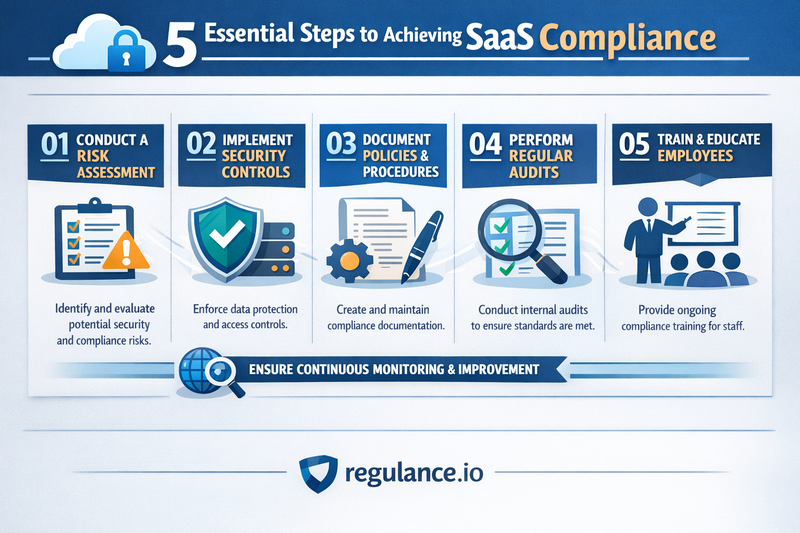
Step 1: Identify Applicable Compliance Requirements
Understanding which regulations and frameworks apply requires analyzing several critical factors: your industry (healthcare, finance, education), geographic footprint (where you operate and where customers are located), data types you collect and process (personal information, health records, payment data), and target market (B2C consumers, small businesses, or enterprise clients).
Conduct a thorough compliance gap analysis. Map all data flows in your application; where data originates, how it's processed, where it's stored, and who has access. Identify which regulations govern each data type. For instance, collecting email addresses from EU residents triggers GDPR requirements. Processing payments requires PCI DSS compliance. Targeting enterprise customers typically necessitates SOC 2 certification.
Create a comprehensive compliance matrix documenting all applicable requirements, their priority based on business impact, implementation deadlines, and estimated resources needed. This matrix becomes your strategic roadmap, guiding efforts and helping allocate resources effectively. Consider both immediate compliance needs for current operations and future requirements as you scale into new markets or industries.
Step 2: Establish Security Controls and Policies
Once you know requirements, implement necessary controls and policies through technical and organizational measures.
Technically, implement multi-factor authentication, role-based access control, and least privilege principles. Encrypt sensitive data at rest and in transit. Establish comprehensive logging and monitoring for user activities and security events. Conduct regular vulnerability scanning and penetration testing. Set up automated backup systems with tested recovery procedures.
Organizationally, develop security policies covering password management, acceptable use, incident response, and data retention. Create documented procedures for security incidents, risk assessments, and access management. Establish change management processes ensuring all system changes are reviewed and documented. Implement vendor risk management to assess third-party providers.
Step 3: Document Everything
Documentation proves your controls are consistently followed and effective. Create comprehensive documentation including system architecture diagrams, data flow maps, policies and procedures, risk assessments, vendor agreements, incident response plans, training records, and audit logs.
Implement document control ensuring regular reviews, tracked changes, stakeholder accessibility, and proper retention policies. Good documentation simplifies audits and ongoing compliance management.
Step 4: Conduct Regular Audits and Assessments
Compliance requires continuous verification. Schedule quarterly internal audits to review controls, test effectiveness, and identify improvements. Engage independent auditors for formal assessments, annual SOC 2 audits, ISO 27001 surveillance audits, or penetration testing.
Conduct vulnerability assessments regularly using automated scanning and periodic penetration testing. Perform risk assessments when significant changes occur. Monitor compliance continuously using automated tools tracking control effectiveness in real-time.
Step 5: Implement Continuous Monitoring and Improvement
Regulatory landscapes evolve constantly. Establish continuous control monitoring using automated tools alerting you to configuration changes, policy violations, or suspicious activities. Implement change management processes assessing compliance impact before implementation.
Stay informed about regulatory updates through industry newsletters, compliance communities, and legal counsel. Establish a compliance steering committee reviewing metrics, discussing risks, and making strategic decisions. Conduct regular training ensuring all employees understand their compliance role. Create feedback loops incorporating lessons from incidents and audits into policies.
How Can Regulance Help You Stay Compliant?
Navigating SaaS compliance complexity becomes simpler with Regulance, a specialized platform designed to streamline your compliance journey.
Automated Compliance Management
Regulance transforms manual, spreadsheet-driven compliance into an automated, efficient process. The platform continuously monitors infrastructure, applications, and policies against relevant frameworks, providing real-time compliance visibility. Automated evidence collection eliminates tedious manual gathering, creating a complete audit trail always ready for review.
Multi-Framework Support
Rather than juggling multiple tools, Regulance provides unified platform support for SOC 2, ISO 27001, GDPR, HIPAA, PCI DSS, and more. Control mapping across frameworks eliminates redundant work when pursuing multiple certifications, saving time and ensuring consistency.
Continuous Monitoring and Expert Guidance
Regulance provides continuous security control monitoring, immediately alerting you to configuration changes or policy violations. Real-time dashboards give stakeholders visibility into compliance metrics and audit readiness. Access to compliance experts provides guidance through framework requirements and audit preparation.
Streamlined Audits and Scalability
The platform generates audit-ready reports automatically and provides auditors secure evidence access. What traditionally takes weeks of preparation happens in days. Whether you're a startup pursuing first certification or an enterprise managing complex requirements, Regulance scales with your needs while integrating seamlessly with existing tools like AWS, Azure, Okta, GitHub, and monitoring solutions.
FAQs
Q: How long does it take to achieve SaaS compliance?
Timeline varies based on framework, current security posture, and resources. SOC 2 Type I typically takes 3-6 months, while Type II requires 6-12 months demonstrating controls over time. ISO 27001 certification usually takes 6-12 months. GDPR implementation might take 3-6 months initially. Starting early and maintaining momentum throughout is key.
Q: What's the difference between SOC 2 Type I and Type II?
SOC 2 Type I assesses whether controls are properly designed at one point in time,a snapshot. Type II evaluates operational effectiveness over 6-12 months, demonstrating controls are consistently followed. Most enterprise customers require Type II for greater assurance.
Q: Do small SaaS companies need compliance certifications?
While smaller companies face less regulatory pressure, certifications build customer trust, differentiate from competitors, provide security frameworks, and prepare for enterprise sales. Many find SOC 2 or ISO 27001 accelerates growth by opening doors to compliance-requiring customers.
Q: How much does SaaS compliance cost?
Costs vary widely. SOC 2 external audits range from $10,000 to $50,000+. ISO 27001 certification can cost $15,000 to $100,000+. Internal costs include staff time, security tools, and infrastructure changes. Compliance platforms like Regulance significantly reduce costs through automation.
Q: Can we handle compliance in-house or hire consultants?
This depends on internal expertise and bandwidth. Companies with experienced professionals might handle it in-house using platforms like Regulance. Others benefit from consultants providing expertise and acceleration. Hybrid approaches often work well using platforms for daily management while engaging consultants for initial framework selection and audit preparation.
Q: How do we maintain compliance as our product evolves?
Integrate compliance into development through "compliance by design" principles. Use change management to assess compliance impact. Leverage continuous monitoring for configuration drift. Regular internal assessments catch issues early. Compliance platforms make ongoing management significantly easier.
Take Control of Your SaaS Compliance Journey Today
Ready to simplify your compliance journey?
Regulance is here to help you navigate the complex world of SaaS compliance with confidence. Our platform automates the tedious aspects of compliance management, provides expert guidance when you need it, and scales with your business as you grow.
Don't let compliance challenges hold your business back. Schedule a demo with Regulance today and discover how we can help you achieve compliance faster, maintain it easier, and build the trust your customers demand.
Your compliance journey starts now. Let Regulance be your guide.