Why Do Software Vulnerabilities Matter for Regulatory Compliance?


Introduction
Every day, businesses of all sizes trust their digital systems to store sensitive data, process transactions, and keep operations running smoothly. But lurking beneath the surface of even the most well-designed software are cracks, weaknesses that hackers can exploit to steal data, disrupt services, or hold organizations hostage. These cracks are known as software vulnerabilities, and understanding them is a business survival skill.
Software vulnerabilities are more common than most people think. According to industry reports, thousands of new vulnerabilities are discovered and catalogued every year. Some go unpatched for months. Others are exploited within hours of being disclosed. What makes this particularly alarming is that the consequences extend far beyond the breach itself; regulatory penalties, reputational damage, and legal liability can follow a company for years.
What's often overlooked is the direct connection between software vulnerabilities and compliance. Whether you're operating under HIPAA, PCI-DSS, ISO 27001, SOC 2, or GDPR, your compliance posture is only as strong as your ability to identify and remediate software weaknesses. A single unpatched vulnerability can be enough to trigger a compliance audit failure or worse, a reportable data breach.
This article breaks down everything you need to know about software vulnerabilities: what they are, how they're categorized, why they happen, how they affect compliance, and most importantly, what you can do about them.
What Are Software Vulnerabilities?
A software vulnerability is a flaw, weakness, or unintended behavior in a software system that can be exploited by an attacker to gain unauthorized access, cause damage, or disrupt normal operations. Think of it like a cracked lock on the back door of your office even if the front entrance is fortified, that one weak point is all a determined intruder needs.
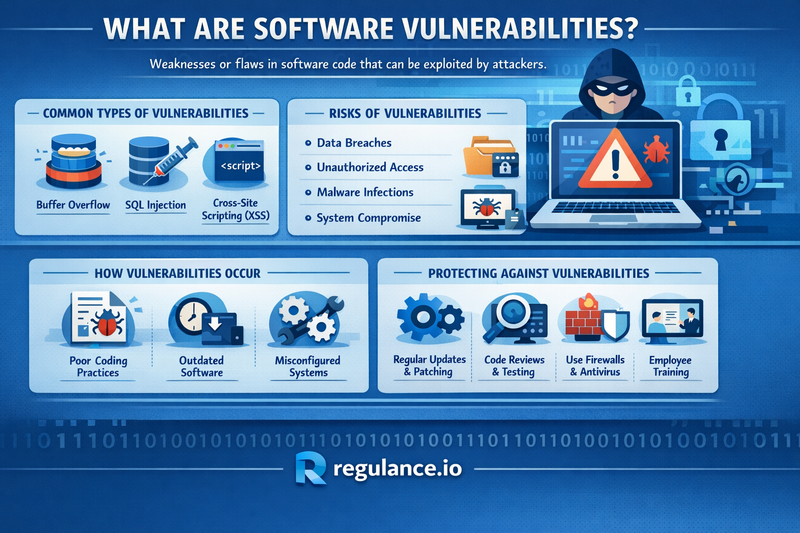
Vulnerabilities can exist in operating systems, web applications, APIs, third-party libraries, firmware, and even the configurations of software tools. They're not always the result of sloppy coding, sometimes they emerge from complex interactions between systems, outdated dependencies, or changes in the threat landscape that render previously safe code suddenly exploitable.
The vulnerability lifecycle typically looks like this: a flaw exists in software, a researcher or hacker discovers it, a patch or workaround is developed (hopefully), and then organizations race to apply the fix before attackers can take advantage. The window between discovery and patching known as the "exposure window" is often where the real danger lies.
From a compliance standpoint, software vulnerabilities matter because most major regulatory frameworks require organizations to actively identify, assess, and remediate security weaknesses. Failing to do so puts your compliance certification, your contracts, and sometimes your customers at legal risk too.
Major Categories of Software Vulnerabilities
Not all software vulnerabilities are created equal. They come in different forms, each with its own attack surface and potential for damage. Here are the most significant categories:
Injection Flaws are among the oldest and most dangerous vulnerability types. SQL injection, command injection, and LDAP injection allow attackers to insert malicious input into a system, tricking it into executing unintended commands. These flaws can expose entire databases and are frequently cited in compliance violations.
Broken Authentication occurs when applications fail to properly manage session tokens, passwords, or identity verification. Attackers can hijack accounts, bypass login controls, or escalate privileges all without needing to crack encryption.
Security Misconfigurations are surprisingly common and often overlooked. Default credentials left unchanged, unnecessary services left running, open cloud storage buckets, these are all misconfigurations that create easy entry points. Many high-profile breaches have resulted from nothing more sophisticated than an unsecured S3 bucket.
Insecure Dependencies and Third-Party Components represent a growing threat. Most modern applications rely heavily on open-source libraries and external packages. If any of these components contain vulnerabilities and many do, the risk flows directly into your application. The Log4Shell vulnerability in 2021 is a perfect example of how a single dependency flaw cascaded across millions of systems worldwide.
Cross-Site Scripting (XSS) allows attackers to inject malicious scripts into web pages that other users see, potentially stealing session cookies or redirecting users to phishing sites.
Insecure APIs have become a prominent concern as organizations increasingly rely on APIs to connect services. Poorly designed or unprotected APIs can expose sensitive data or allow unauthorized actions.
Zero-Day Vulnerabilities are perhaps the most feared, these are flaws that are unknown to the software vendor and therefore have no patch available. They're particularly dangerous because there's no defense other than robust monitoring and behavioral detection.
Key Causes and Risks Behind Software Vulnerabilities
Understanding why software vulnerabilities exist is just as important as knowing what they are. The root causes are often a mix of human error, process gaps, and technological complexity.
Poor coding practices remain a leading cause. Developers under pressure to ship fast sometimes skip input validation, overlook error handling, or take shortcuts that introduce weaknesses. Without mandatory code reviews and security testing baked into the development process, these mistakes make it into production.
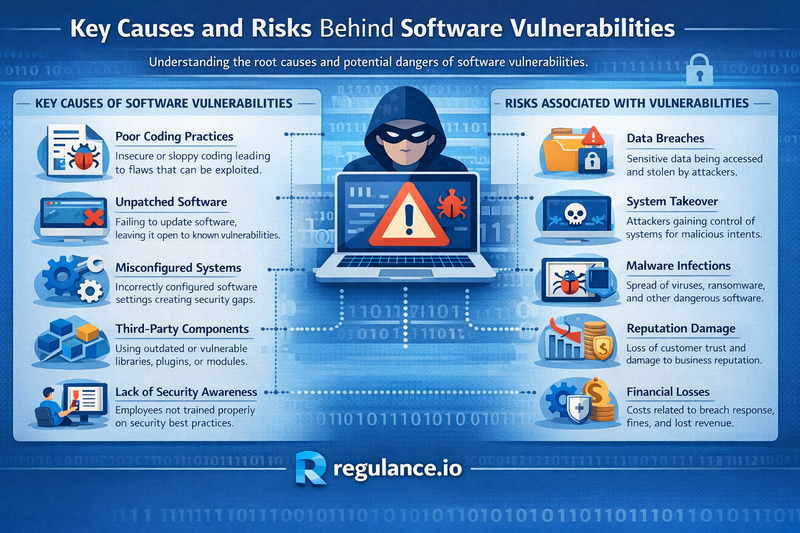
Outdated software is another major driver. When vendors stop supporting legacy systems, security patches stop coming. Organizations that continue running end-of-life software are essentially operating with known, unpatched holes in their defenses.
Complexity breeds vulnerability. As software systems grow more interconnected with microservices, cloud integrations, and sprawling third-party ecosystems, the attack surface expands. More connections mean more potential entry points, many of which don't receive adequate security scrutiny.
Lack of security awareness training means that even well-intentioned developers may not know what a vulnerable coding pattern looks like. Without ongoing education, the same mistakes get repeated across teams and projects.
The risks these vulnerabilities create are significant: unauthorized data access, ransomware attacks, system downtime, financial fraud, and supply chain compromises. And for regulated industries, these risks translate directly into compliance failures and regulatory penalties.
Business and Security Consequences of Software Vulnerabilities
The fallout from exploited software vulnerabilities can be devastating and the effects are rarely limited to IT departments.
From a financial perspective, the average cost of a data breach continues to climb year over year. Organizations face costs related to incident response, legal fees, regulatory fines, credit monitoring for affected customers, and lost business. Regulatory penalties alone can reach millions of dollars, particularly under GDPR, which can impose fines of up to 4% of annual global turnover.
Compliance failures represent one of the most direct consequences. Frameworks like PCI-DSS require regular vulnerability scanning and patching. HIPAA mandates risk assessments that include identifying security weaknesses. SOC 2 requires evidence of ongoing security monitoring. When an audit reveals unpatched vulnerabilities or inadequate controls, organizations can lose their certifications making it impossible to work with certain clients or operate in regulated markets.
Reputational damage is harder to quantify but just as real. Customers who discover their data was exposed due to a known, unpatched vulnerability don't just leave, they tell others. Trust, once broken by a breach, takes years to rebuild.
Operational disruption is another consequence that's often underestimated. Ransomware attacks frequently initiated through software vulnerabilities can bring entire organizations to a standstill. Recovery can take weeks, and during that time, the business may be unable to serve customers at all.
How to Reduce the Risk of Software Vulnerabilities
The good news is that while software vulnerabilities can't be eliminated entirely, their risk can be dramatically reduced through a combination of proactive practices and smart tooling.
Regular Vulnerability Scanning and Patching is the most fundamental step. Organizations should run automated scans against their systems on a regular cadence, prioritize critical findings, and apply patches promptly. A well-defined patch management policy removes ambiguity about who is responsible and how quickly fixes must be deployed.
Secure Development Lifecycle (SDLC) integration ensures that security is baked into the software development process from the start not bolted on at the end. This includes threat modeling during design, static analysis during coding, and penetration testing before release.
Dependency Management means actively tracking all third-party libraries and packages your applications depend on, using tools like software composition analysis (SCA) to detect vulnerable components and update them before they become a liability.
Access Controls and Least Privilege limit the blast radius of a successful exploit. If attackers do gain access through a vulnerability, strong access controls prevent them from moving freely through the system.
Continuous Monitoring using security information and event management (SIEM) tools, intrusion detection systems, and anomaly detection ensures that suspicious behavior is caught quickly even when vulnerabilities aren't yet known.
Employee Security Training creates a security-conscious culture where developers, admins, and end-users all understand their role in keeping systems secure.
Common Obstacles in Software Vulnerability Prevention
Even organizations with strong intentions face real barriers to effective vulnerability management. Recognizing these obstacles is the first step toward overcoming them.
Patch fatigue is a genuine problem. Security teams receive an overwhelming volume of vulnerability alerts, and prioritizing which ones to fix first especially when many are marked "critical" becomes cognitively exhausting. Without a risk-based prioritization framework, teams can end up either overwhelmed or complacent.
Legacy system constraints create situations where patching simply isn't possible. Older systems may not support modern security updates, and replacing them requires significant budget and planning that organizations aren't always prepared for.
Siloed teams between development, operations, and security mean that vulnerability data doesn't always reach the people responsible for fixing the underlying code. Without clear ownership and communication channels, findings sit unaddressed.
Resource limitations especially in small and mid-sized businesses mean that dedicated security staff may not exist. Vulnerability management gets deprioritized in favor of shipping products or keeping the lights on.
Shadow IT, where employees or departments use software tools that haven't been approved or inventoried by IT, creates blind spots that never get scanned or patched.
Emerging Trends in Software Vulnerability Management
The landscape of software vulnerability management is evolving rapidly, shaped by new technologies and an increasingly sophisticated threat environment.
AI-powered vulnerability detection is changing what's possible. Machine learning tools can now analyze codebases at scale, identify patterns that suggest vulnerabilities, and even predict where new weaknesses are likely to emerge before attackers find them.
DevSecOps has moved from buzzword to mainstream practice. By embedding security tools and checks directly into CI/CD pipelines, organizations can catch vulnerabilities during development rather than after deployment. Shift-left security is no longer optional for organizations serious about risk reduction.
The Software Bill of Materials (SBOM) has gained traction, particularly following U.S. executive orders on software supply chain security. An SBOM is essentially an ingredient list for your software; a detailed inventory of all components and dependencies that enables faster, more precise vulnerability tracking.
Automated compliance reporting is another growing trend. Rather than scrambling to assemble evidence during audits, forward-looking organizations are using platforms that continuously collect and correlate compliance data, including vulnerability management metrics, and generate reports on demand.
Zero Trust Architecture, where no user, device, or system is implicitly trusted; is increasingly being adopted as a way to limit the damage that exploited vulnerabilities can cause, even when they can't be immediately patched.
FAQs
What is the difference between a software vulnerability and a software bug?
All vulnerabilities are bugs, but not all bugs are vulnerabilities. A bug might cause an application to crash or produce incorrect output. A vulnerability is specifically a flaw that can be exploited to compromise security to gain unauthorized access, steal data, or disrupt services.
How do software vulnerabilities affect GDPR compliance?
Under GDPR, organizations are required to implement "appropriate technical and organizational measures" to protect personal data. Unpatched software vulnerabilities that lead to a breach can constitute a failure of this obligation, triggering mandatory breach notification and potentially significant fines.
How often should vulnerability scans be conducted? Most security frameworks recommend at minimum quarterly scans, with continuous or weekly scanning considered best practice for organizations with significant risk exposure. Critical systems in regulated industries often require continuous monitoring.
What is a CVE, and why does it matter?
CVE stands for Common Vulnerabilities and Exposures; a publicly maintained list of known software vulnerabilities, each assigned a unique ID and severity score. CVEs allow organizations and security tools to track specific vulnerabilities across systems and prioritize patching.
Can small businesses be affected by software vulnerabilities?
Absolutely. In fact, small businesses are often targeted precisely because attackers assume their defenses are weaker. Cybercriminals use automated tools that scan the internet indiscriminately, company size is no protection.
What's the fastest way to improve vulnerability management compliance?
Start with a comprehensive asset inventory and vulnerability assessment to understand your current exposure. Then adopt a risk-based patching approach, establish clear ownership and SLAs for remediation, and use a compliance management platform to track and evidence your progress.
Ready to Strengthen Your Security Compliance?
Regulance is purpose-built for organizations that take security compliance seriously. From continuous vulnerability monitoring to automated compliance reporting across frameworks like SOC 2, ISO 27001, HIPAA, and PCI-DSS, Regulance gives your team the visibility and evidence you need without the manual overhead.
Don't wait for an audit to reveal your gaps. Start your compliance journey with Regulance today and transform your vulnerability management from a reactive scramble into a proactive, documented, and audit-ready program.