Which Trends Will Define Cybersecurity in 2026 and How Can Businesses Prepare Now?


Introduction
As we approach 2026, cybersecurity has transformed from a back-office IT concern into a boardroom priority that directly impacts business survival, customer trust, and regulatory compliance. Cybercrime damages are projected to exceed $10 trillion annually by 2025, making it one of the world's largest economies if it were a country. Meanwhile, the average cost of a data breach has climbed to unprecedented levels, with organizations facing not just financial losses but reputational damage that can take years to recover from.
What makes 2026 particularly critical is the convergence of several transformative forces: artificial intelligence is reshaping both attack and defense strategies, quantum computing threatens to upend traditional encryption methods, and remote work has permanently expanded the attack surface that organizations must defend. At the same time, regulatory frameworks are becoming more stringent, with governments worldwide implementing stricter data protection laws and hefty penalties for non-compliance.
This article explores the top cybersecurity trends that will define 2026, examining how they'll impact businesses, what compliance challenges they'll create, and most importantly, how organizations can prepare today for tomorrow's threats. Whether you're a CISO, IT professional, business owner, or simply someone concerned about digital security, understanding these trends is essential for survival in an increasingly connected world.
What is Cybersecurity?
Cybersecurity is the practice of protecting computer systems, networks, programs, and data from digital attacks, unauthorized access, damage, or theft. It is the digital equivalent of a comprehensive security system for your home, but infinitely more complex because the threats are constantly evolving and can come from anywhere in the world at any time.
Cybersecurity encompasses several key dimensions. First, there's network security, which involves protecting the infrastructure that connects devices and enables communication. Then there's application security, focused on keeping software and devices free from vulnerabilities that attackers could exploit. Information security protects the integrity and privacy of data both in storage and in transit, while operational security covers the processes and decisions for handling and protecting data assets.
The field also includes disaster recovery and business continuity planning, which define how an organization responds to cybersecurity incidents and maintains operations during attacks. End-user education is equally crucial because humans often represent the weakest link in the security chain, even the most sophisticated technical defenses can be undermined by an employee clicking a phishing link.
Modern cybersecurity operates on several fundamental principles. Confidentiality ensures that information is accessible only to authorized individuals. Integrity guarantees that data remains accurate and unaltered except by authorized parties. Availability ensures that systems and data are accessible when needed by legitimate users. Together, these three principles form what's known as the CIA triad, the foundation of information security.
What makes cybersecurity particularly challenging is its adversarial nature. Unlike other IT disciplines where you're solving technical problems, cybersecurity requires you to think like an attacker, anticipating creative and often unexpected ways that malicious actors might compromise your defenses. It's a constant cat-and-mouse game where yesterday's cutting-edge defense becomes tomorrow's vulnerability, demanding continuous learning, adaptation, and investment to stay ahead of threats that never sleep.
Top 10 Cybersecurity Trends to Expect in 2026
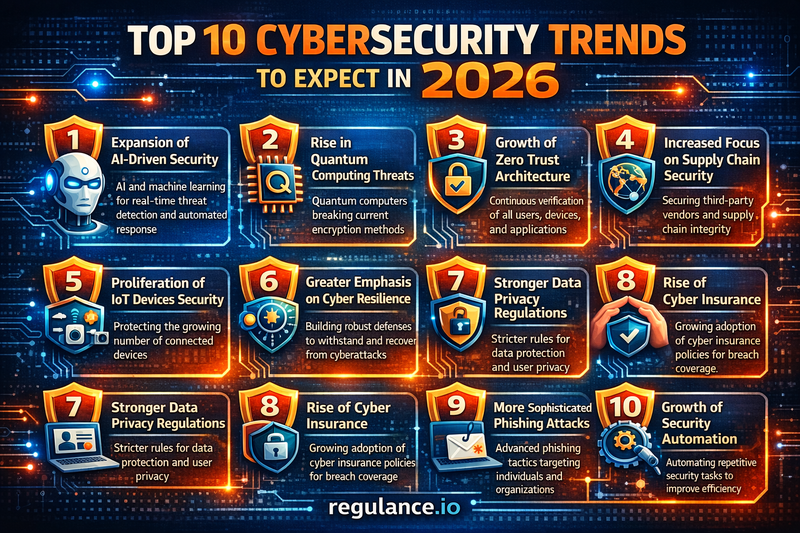
1. AI-Powered Cyber Attacks and Defense
Artificial intelligence is fundamentally reshaping the cybersecurity battlefield in both directions. On the attack side, cybercriminals are leveraging AI to create more sophisticated phishing campaigns that can mimic writing styles, generate deepfake videos for social engineering, and automatically identify vulnerabilities in systems at scale. AI-powered malware can adapt its behavior to evade detection, learning from each defensive measure it encounters.
Fortunately, defenders are fighting fire with fire. AI-driven security systems in 2026 will analyze massive datasets in real-time, identifying anomalous patterns that human analysts would miss. Machine learning algorithms will predict potential attack vectors before they're exploited, while automated response systems will contain threats in milliseconds rather than the hours or days traditional methods require. The organizations that master AI-augmented security will have a significant advantage over those still relying solely on human analysis.
2. Zero Trust Architecture Becomes Standard Practice
The traditional security model of trusting everything inside the corporate network perimeter is dead. Zero Trust Architecture operates on the principle of "never trust, always verify," requiring authentication and authorization for every access request regardless of where it originates. By 2026, implementing Zero Trust won't be a competitive advantage, it'll be table stakes.
This approach involves micro-segmentation of networks, continuous verification of user identities and device health, least-privilege access principles, and assuming breach as a default state. Organizations are moving away from VPNs toward more sophisticated solutions like Software-Defined Perimeters and ZTNA (Zero Trust Network Access) that provide granular control over who can access what resources under which conditions. The shift requires both technological investment and cultural change, but the security benefits are undeniable.
3. Quantum Computing and Post-Quantum Cryptography
Quantum computing represents both an existential threat and an opportunity for cybersecurity. These powerful machines, expected to become more practical by 2026, can potentially break current encryption methods that protect everything from banking transactions to state secrets. The threat is so significant that organizations need to start preparing now for what's called "harvest now, decrypt later" attacks, where adversaries steal encrypted data today to decrypt it once quantum computers become available.
The response is post-quantum cryptography, new encryption algorithms designed to resist quantum computer attacks. NIST has already begun standardizing these algorithms, and forward-thinking organizations are implementing crypto-agility, the ability to quickly switch between cryptographic algorithms. By 2026, we'll see widespread adoption of hybrid encryption schemes that combine classical and quantum-resistant methods, ensuring security during the transition period.
4. Enhanced Cloud Security and Multi-Cloud Complexity
As organizations continue migrating to cloud environments and adopting multi-cloud strategies, the security challenges multiply exponentially. Each cloud provider has different security models, tools, and configurations, creating a complex landscape where misconfigurations remain a leading cause of breaches. By 2026, Cloud Security Posture Management (CSPM) and Cloud-Native Application Protection Platforms (CNAPP) will be essential tools rather than nice-to-haves.
We'll see increased adoption of confidential computing, where data remains encrypted even while being processed, and more sophisticated Identity and Access Management systems that work seamlessly across multiple cloud environments. Container security will mature as Kubernetes and similar technologies become ubiquitous. Organizations will also invest heavily in cloud security orchestration to maintain visibility and control across their distributed infrastructure.
5. Extended Detection and Response (XDR) Integration
The days of managing separate security tools for endpoints, networks, emails, and cloud services are ending. Extended Detection and Response (XDR) platforms integrate security data from multiple sources into a unified view, providing better threat detection and faster response capabilities. By 2026, XDR will evolve from simple data aggregation to intelligent correlation engines that understand the relationships between different security events across the entire technology stack.
These platforms will leverage AI to automatically investigate alerts, determine which are genuine threats versus false positives, and even orchestrate responses across multiple security tools without human intervention. The result is not just faster response times but also relief for overstretched security teams drowning in alerts from disparate systems.
6. Supply Chain and Third-Party Risk Management
Recent high-profile supply chain attacks have demonstrated that you're only as secure as your weakest vendor. In 2026, organizations will implement much more rigorous third-party risk management programs, requiring detailed security assessments, continuous monitoring of vendor security postures, and contractual obligations around security standards and breach notifications.
We'll see the rise of Software Bill of Materials (SBOM) requirements, where organizations demand transparency about all components in the software they use. Supply chain security platforms will automatically scan for vulnerabilities in open-source components and dependencies, while blockchain technology may be employed to create immutable records of software provenance. The concept of "security by design" will extend beyond internal development to encompass the entire supply chain ecosystem.
7. Privacy-Enhancing Technologies and Compliance Automation
With data privacy regulations proliferating globally, organizations face an increasingly complex compliance landscape. Privacy-enhancing technologies (PETs) like differential privacy, homomorphic encryption, and secure multi-party computation will become mainstream in 2026, allowing organizations to derive insights from data while preserving individual privacy.
Compliance automation tools will use AI to continuously monitor security controls, automatically generate audit reports, and even predict regulatory changes that might affect the organization. These systems will map security measures to multiple regulatory frameworks simultaneously, reducing the burden of demonstrating compliance with GDPR, CCPA, HIPAA, and other standards. The integration of GRC (Governance, Risk, and Compliance) platforms with security operations will become seamless.
8. Identity-First Security and Passwordless Authentication
Identity has become the new perimeter in our cloud-first, remote-work world. By 2026, identity-first security approaches will dominate, with Identity and Access Management (IAM) systems serving as the central control point for all security policies. We'll see widespread adoption of passwordless authentication methods including biometrics, hardware security keys, and cryptographic certificates that are both more secure and more user-friendly than traditional passwords.
Continuous authentication will monitor user behavior patterns and risk signals throughout sessions, dynamically adjusting access privileges based on context. Decentralized identity systems leveraging blockchain may emerge for certain use cases, giving individuals more control over their digital identities while maintaining security. The combination of strong authentication, least-privilege access, and continuous verification will significantly reduce credential-based attacks.
9. Cybersecurity Skills Gap and Security Automation
The cybersecurity workforce shortage is projected to remain critical through 2026, with millions of positions unfilled globally. Organizations will respond by heavily investing in security automation and orchestration, allowing smaller teams to manage more complex environments. Routine tasks like patch management, threat hunting, and incident triage will be increasingly handled by AI-powered systems.
We'll also see innovative approaches to building security capabilities, including citizen developer programs where non-security staff receive training to handle basic security functions, partnerships with Managed Security Service Providers (MSSPs), and increased use of Bug Bounty programs to tap into the global security research community. Organizations will focus on retaining talent through better compensation, career development opportunities, and reducing burnout through automation.
10. Regulatory Technology (RegTech) and Continuous Compliance
The convergence of regulation and technology is creating a new category called RegTech, technology specifically designed to help organizations meet compliance requirements efficiently. By 2026, continuous compliance will replace periodic audits as the standard approach, with automated systems constantly monitoring security controls and immediately flagging deviations from required standards.
These platforms will integrate with security infrastructure to collect evidence automatically, maintain audit trails, and demonstrate compliance in real-time to regulators and stakeholders. As regulatory requirements become more prescriptive about specific security controls and reporting timelines, organizations that haven't invested in RegTech solutions will find compliance increasingly burdensome and expensive. The most sophisticated implementations will use predictive analytics to anticipate compliance gaps before they become violations.
How Will New Cybersecurity Trends Impact Compliance in 2026?
The cybersecurity trends emerging in 2026 are fundamentally reshaping the compliance landscape, creating both challenges and opportunities for organizations navigating an increasingly complex regulatory environment.
First and foremost, regulators are becoming more technically prescriptive about security requirements. Gone are the days of vague mandates to implement "reasonable security measures." New regulations specify exact controls; multi-factor authentication timelines, encryption standards, incident response procedures, and data retention policies. The adoption of Zero Trust Architecture and XDR platforms directly addresses many of these specific requirements, making compliance more achievable for organizations that invest in modern security infrastructure.
The shift toward continuous compliance monitoring represents a paradigm change. Traditional annual audits are giving way to real-time verification, with some regulatory frameworks requiring organizations to demonstrate security posture continuously rather than at a single point in time. This trend aligns perfectly with the automation and AI-powered security tools emerging in 2026, which can collect compliance evidence automatically and maintain audit trails without manual intervention. However, it also means that organizations can no longer "prepare for the audit"; they must maintain compliance continuously, increasing operational pressure but ultimately creating more robust security programs.
Privacy-enhancing technologies are becoming compliance enablers rather than just security tools. As regulations like GDPR, CCPA, and emerging AI governance frameworks impose stricter requirements on data handling, technologies like differential privacy and homomorphic encryption allow organizations to use data for legitimate business purposes while meeting privacy obligations. We're seeing regulators not just permit but encourage the use of these technologies, potentially offering safe harbor provisions for organizations that implement them properly.
Third-party risk management is transitioning from a best practice to a legal obligation. Recent regulations explicitly hold organizations accountable for the security practices of their vendors and supply chain partners. The supply chain security trends emerging in 2026 including SBOM requirements and continuous vendor monitoring directly respond to these compliance mandates. Organizations will need detailed contracts specifying security requirements, regular assessments of vendor security postures, and clear incident response protocols that include supply chain partners.
The quantum computing threat is also influencing regulatory thinking. Some government agencies and financial regulators are beginning to require organizations to develop quantum-readiness plans, specifying timelines for migrating to post-quantum cryptography. Forward-thinking organizations are addressing this now, but laggards may find themselves scrambling to meet regulatory deadlines as quantum computers become more practical.
Cross-border data transfer regulations continue to complicate compliance for global organizations. The trends toward cloud security and multi-cloud architectures must be implemented with data sovereignty requirements in mind. Organizations need clear visibility into where data resides, how it moves across borders, and which regulatory frameworks apply to each dataset, challenges that modern cloud security platforms are designed to address.
Finally, the cybersecurity skills gap is creating compliance risks. Many regulations implicitly assume organizations have adequate security expertise, but the workforce shortage means many don't. Regulators are beginning to recognize this, with some frameworks explicitly requiring security training programs, third-party assessments, or MSSP partnerships as compensating controls for smaller organizations that can't afford full security teams.
The bottom line is that compliance is becoming inseparable from cybersecurity. Organizations that view them as separate functions will struggle, while those that integrate compliance requirements into their security architecture from the beginning will find both more manageable and more effective.
How to Prepare for the Change
Preparing for the cybersecurity landscape of 2026 requires strategic planning, investment, and cultural transformation. Here's a comprehensive roadmap for organizations looking to get ahead of these trends rather than scrambling to catch up.
Conduct a Comprehensive Security Assessment
Start by understanding your current security posture honestly and thoroughly. This means going beyond compliance checklists to identify actual vulnerabilities in your environment. Engage third-party experts to conduct penetration testing and security audits. Map your entire attack surface, including cloud services, remote endpoints, third-party connections, and supply chain touchpoints. Identify your most critical assets and the pathways attackers might use to reach them. This baseline assessment will inform all subsequent investments and initiatives.
Develop a Multi-Year Security Roadmap
The trends emerging in 2026 can't be addressed overnight. Create a phased implementation plan that prioritizes based on your risk profile and resource constraints. Quick wins might include implementing multi-factor authentication and endpoint detection and response tools. Medium-term projects could involve Zero Trust architecture implementation and XDR platform deployment. Long-term initiatives might include quantum-ready cryptography and comprehensive supply chain security programs. Ensure your roadmap aligns with business objectives and has executive buy-in with dedicated budget allocations.
Invest in Security Automation and AI
Given the workforce shortage and increasing threat sophistication, security automation isn't optional. Start by automating routine tasks, patch management, log analysis, basic threat hunting, and compliance reporting. Gradually expand to more sophisticated AI-powered tools for threat detection and response. The goal isn't to replace human analysts but to augment them, allowing your team to focus on strategic threats rather than drowning in alerts. Ensure that any AI systems you implement are transparent and auditable, with human oversight for critical decisions.
Implement Zero Trust Principles Incrementally
Zero Trust is a journey, not a destination. Begin by inventorying all assets and data, understanding who needs access to what. Implement strong identity and access management as your foundation. Deploy micro-segmentation to limit lateral movement if attackers breach the perimeter. Require verification for every access request and continuously validate trust throughout sessions. Start with your most critical systems and expand gradually, recognizing that full Zero Trust implementation may take years but provides security benefits at each stage.
Build a Cloud Security Center of Excellence
As cloud adoption accelerates, dedicate resources specifically to cloud security. This team should develop cloud security standards, provide guidance to development teams, implement Cloud Security Posture Management tools, and maintain visibility across all cloud environments. They should work closely with DevOps teams to integrate security into CI/CD pipelines, ensuring that security doesn't slow innovation but enables it through secure-by-design practices.
Strengthen Third-Party Risk Management
Update your vendor management processes to include rigorous security assessments before onboarding new vendors and continuous monitoring of existing ones. Require vendors to complete detailed security questionnaires, provide evidence of security controls, and contractually commit to security standards and breach notification timelines. Consider implementing a vendor risk rating system that informs decisions about what data and access different vendors receive. For critical vendors, conduct on-site assessments or require independent security audits.
Prepare for Quantum Computing Threats
While practical quantum computers may still be years away, preparation must begin now. Inventory all cryptographic systems in your environment and identify which algorithms will be vulnerable to quantum attacks. Develop a crypto-agility strategy that allows you to swap cryptographic algorithms quickly. Begin testing post-quantum cryptography algorithms in non-critical systems. For highly sensitive data with long-term confidentiality requirements, consider implementing hybrid encryption schemes today.
Invest in Your People
Technology alone won't solve your security challenges. Invest heavily in security awareness training for all employees, going beyond generic phishing simulations to role-specific training that addresses real threats your organization faces. For security team members, provide continuous learning opportunities, certifications, and conference attendance to stay current with evolving threats. Create career development paths that encourage retention. Consider partnerships with universities or bootcamps to develop your own talent pipeline.
Integrate Compliance into Security Operations
Stop treating compliance as a separate annual exercise. Implement RegTech platforms that continuously monitor your compliance posture and automatically collect audit evidence. Map your security controls to multiple regulatory frameworks simultaneously, identifying where a single control satisfies multiple requirements. Work with legal and compliance teams to understand upcoming regulatory changes and build them into your security roadmap before they become mandatory.
Test Your Incident Response Capabilities
The best preparation is practice. Conduct regular tabletop exercises that simulate different attack scenarios, involving not just technical teams but also executives, legal, communications, and other stakeholders. Test your backup and recovery procedures under realistic conditions. Develop runbooks for common incident types. Establish relationships with external incident response firms before you need them. Document lessons learned and continuously refine your processes based on exercises and real incidents.
Partner with Experts
You don't have to do everything in-house. Consider partnerships with Managed Security Service Providers for 24/7 monitoring, specialized expertise in emerging areas, or capacity during peak times. Engage with industry groups and Information Sharing and Analysis Centers (ISACs) to learn from peers about threats and effective defenses. Work with legal counsel experienced in cybersecurity and data privacy to navigate the regulatory landscape. The most successful organizations build ecosystems of trusted partners who complement internal capabilities.
The key to successful preparation is treating cybersecurity as an ongoing transformation rather than a project with an end date. The threat landscape will continue evolving beyond 2026, and organizations that build adaptive, learning security programs will thrive while those seeking one-time solutions will perpetually struggle to keep pace.
FAQs
What is the most significant cybersecurity threat in 2026?
There's no single threat that dominates all others, but AI-powered attacks represent a qualitative shift in the threat landscape. Unlike traditional attacks that require significant human effort to scale, AI enables attackers to personalize phishing campaigns, identify vulnerabilities, and adapt malware at machine speed. The democratization of these AI tools means even low-skill attackers can launch sophisticated campaigns. Organizations must respond with equally sophisticated AI-powered defenses and strong fundamentals like security awareness training and Zero Trust architecture.
How much should companies budget for cybersecurity in 2026?
Industry benchmarks suggest organizations should allocate 10-15% of their IT budget to cybersecurity, though this varies significantly by industry, company size, and risk profile. Heavily regulated industries like finance and healthcare often spend more. Rather than focusing on a specific percentage, organizations should conduct risk assessments to determine what level of investment adequately protects their critical assets and maintains compliance. Underspending on security often proves far more expensive when breaches occur, with average breach costs far exceeding annual security budgets for most organizations.
Is Zero Trust Architecture only for large enterprises?
Absolutely not. While large enterprises with complex networks face unique implementation challenges, Zero Trust principles apply to organizations of all sizes. Small and medium businesses can implement Zero Trust incrementally through cloud-based solutions that don't require extensive infrastructure investments. Many modern SaaS security tools incorporate Zero Trust principles by default. The key is starting with strong identity and access management and applying least-privilege principles regardless of organization size. In fact, smaller organizations may find Zero Trust easier to implement because they have less legacy infrastructure to work around.
How do I address the cybersecurity skills shortage in my organization?
Organizations are tackling the skills gap through multiple strategies. First, maximize your existing team's effectiveness through security automation that handles routine tasks, allowing analysts to focus on strategic work. Second, invest in training and development to upskill current employees, including non-security staff who can take on basic security responsibilities. Third, consider partnerships with Managed Security Service Providers who can provide expertise and 24/7 monitoring. Fourth, create compelling work environments that attract and retain talent through competitive compensation, career development opportunities, and modern tools that reduce tedious manual work. Finally, engage the broader security community through bug bounty programs and industry partnerships.
What are the first steps toward implementing AI in cybersecurity?
Begin by identifying high-volume, repetitive tasks that consume significant analyst time, log analysis, alert triage, threat hunting, and compliance reporting are excellent candidates. Start with AI-powered tools in these areas, ensuring they integrate with your existing security infrastructure. Choose solutions that provide transparency into their decision-making processes so analysts can understand and verify results. Implement human-in-the-loop workflows initially, where AI recommends actions but humans approve them. As confidence grows, gradually increase automation for routine decisions. Continuously evaluate AI systems for bias, false positives, and effectiveness. Most importantly, ensure that implementing AI doesn't create a new dependency, humans should understand the underlying security principles even when AI handles execution.
How will quantum computing affect my current security infrastructure?
Quantum computers pose a future threat to current public-key cryptography algorithms used for secure communications, digital signatures, and key exchange. However, symmetric encryption algorithms like AES remain relatively quantum-resistant with adequate key lengths. The timeline for practical quantum computers that can break current encryption remains uncertain, possibly 5-15 years but organizations with long-term confidentiality requirements should begin preparation now. Start by inventorying all cryptographic systems, understanding which are quantum-vulnerable, and developing crypto-agility so you can transition to post-quantum algorithms when standards are finalized. For most organizations, this isn't an immediate crisis but does require strategic planning today.
Do I need to implement all these trends to be secure in 2026?
Security is about managing risk, not achieving perfection. Not every organization needs to implement every trend immediately. Prioritize based on your specific risk profile, industry requirements, and resource constraints. However, certain fundamentals, strong identity and access management, regular patching, security awareness training, incident response capabilities, and continuous monitoring are non-negotiable regardless of organization size or industry. Build from these fundamentals toward more advanced capabilities like AI-powered security and Zero Trust architecture based on your maturity level and threat landscape. The key is continuous improvement rather than attempting to implement everything at once.
Conclusion
The cybersecurity landscape of 2026 presents both unprecedented challenges and remarkable opportunities. The trends we've explored from AI-powered attacks and defense to quantum-ready cryptography, from Zero Trust architecture to continuous compliance represent fundamental shifts in how organizations must think about security.
What's clear is that cybersecurity is no longer just a technical issue relegated to IT departments. It's a business imperative that affects customer trust, competitive advantage, regulatory compliance, and ultimately, organizational survival. The cost of inaction continues to rise, while the tools and strategies to defend against evolving threats become more sophisticated and accessible.
The organizations that will thrive in 2026 and beyond share common characteristics. They treat security as a continuous journey rather than a destination, investing consistently in people, processes, and technology. They embrace automation and AI to overcome resource constraints while maintaining human judgment for critical decisions. They implement Zero Trust principles that assume breach and verify continuously. They integrate compliance seamlessly into security operations rather than treating it as a separate burden. And perhaps most importantly, they foster cultures where security awareness permeates every level of the organization.
For those feeling overwhelmed by the pace of change, remember that you don't need to implement every trend immediately. Start with an honest assessment of your current posture, prioritize based on your specific risks, and build incrementally with a clear roadmap. Leverage partnerships and expertise when internal capabilities fall short. Focus on fundamentals first, then expand toward more advanced capabilities as your maturity grows.
Ready to Transform Your Compliance and Security Posture? Contact Regulance today for a complimentary security assessment and discover how we can help you turn cybersecurity from a cost center into a competitive advantage.
Your security is our mission. Let's build it together.