What Separates a TIA from a TRA in GDPR and How Can You Meet Each Requirement Efficiently?


Introduction
If your business sends personal data across borders, you've probably encountered two confusing acronyms: TIA and TRA. You're not alone in wondering what they mean or why they matter. Since the 2020 Schrems II court ruling shook up international data transfers, these assessments have become non-negotiable for companies operating under GDPR.
On the flipside, moving data from Europe to other countries isn't as simple as signing a contract anymore. It doesn't matter if you're storing customer information in US-based cloud servers, outsourcing payroll to providers in India, or managing employee records across global offices, GDPR demands that you prove the data remains protected even after crossing borders.
That's where TIA (Transfer Impact Assessment) and TRA (Transfer Risk Assessment) come in. They are your compliance toolkit for international data transfers. A TIA digs deep into specific transfers, examining whether the destination country's laws might compromise data protection. A TRA, on the other hand, maps out your entire data transfer landscape, helping you spot risks before they become problems.
The confusion between these two assessments costs businesses time, money, and sometimes hefty regulatory fines. Some organizations conduct the wrong assessment, while others skip them entirely, assuming their contracts offer enough protection. They don't.
This guide breaks down everything you need to know about TIA and TRA. You'll discover what each assessment involves, when you need them, how they relate to GDPR requirements, and what happens if you get it wrong. More importantly, you'll learn how to implement these assessments without drowning in complexity, so your business can transfer data confidently and compliantly.
What is TIA?
A Transfer Impact Assessment (TIA) is a detailed evaluation that organizations must conduct before transferring personal data from the EEA to a third country that lacks an adequacy decision from the European Commission. The TIA framework was introduced following the landmark Schrems II ruling in July 2020, which invalidated the EU-US Privacy Shield and fundamentally changed how organizations approach international data transfers.
The primary purpose of a TIA is to assess whether the laws and practices in the destination country provide an adequate level of protection for personal data. A TIA requires organizations to examine the legal landscape of the receiving country, particularly focusing on government surveillance laws, data access requirements, and the legal remedies available to data subjects.
When conducting a TIA, organizations must consider several key factors. First, they need to understand the content of the data being transferred, is it basic contact information or sensitive personal data like health records or financial information? Second, they must evaluate the purpose and duration of the transfer. Third, and perhaps most critically, they need to assess whether the laws in the destination country might allow government authorities to access the data in ways that would be incompatible with EU fundamental rights.
The TIA process involves examining the specific circumstances of each transfer, including the nature of your business relationship with the data recipient, the technical and organizational measures in place, and whether supplementary measures beyond Standard Contractual Clauses (SCCs) are necessary to ensure adequate protection.
A properly conducted TIA should result in a documented decision about whether the transfer can proceed safely, whether additional safeguards are needed, or whether the transfer should be suspended or alternative solutions explored. This documentation is crucial not only for demonstrating compliance but also for providing transparency to data subjects and supervisory authorities.
What is TRA?
A Transfer Risk Assessment (TRA) takes a broader, more strategic approach to evaluating data transfers. While a TIA focuses specifically on the legal environment in the receiving country and its impact on a particular transfer, a TRA examines the overall risks associated with international data transfers across your entire organization.
TRA is the enterprise-wide view of your data transfer landscape. It involves mapping all the international data flows within your organization, categorizing them by risk level, and developing a comprehensive strategy for managing those risks. This assessment looks at your data transfer ecosystem holistically rather than examining each transfer in isolation.
A TRA typically begins with data mapping, identifying where personal data is collected, how it moves through your systems, and where it ultimately ends up. This mapping exercise often reveals data flows that organizations weren't fully aware of, particularly when dealing with complex technology stacks involving multiple vendors and subprocessors.
The risk assessment component of a TRA evaluates various factors including the volume of data being transferred, the sensitivity of that data, the number of third countries involved, the security measures in place, and the potential impact on data subjects if something goes wrong. It also considers business risks, such as the reputational damage that could result from a data breach or the operational disruption that might occur if a transfer mechanism is suddenly invalidated.
One of the key outputs of a TRA is a risk register that prioritizes your data transfers based on their risk profile. This allows organizations to allocate resources efficiently, focusing their most rigorous assessments and protective measures on the highest-risk transfers. For lower-risk transfers, a lighter-touch approach may be appropriate, though all transfers still require some level of scrutiny under GDPR.
A TRA also informs your organization's data transfer strategy going forward. It might reveal opportunities to minimize transfers, localize data storage, or implement technical solutions like encryption that reduce the risks associated with international data flows. In this sense, a TRA is a strategic tool for data governance.
Does an Organisation Need to Complete a TIA or TRA if It Is Already Using SCCs or IDTA?
This is one of the most common questions organizations face when navigating GDPR's transfer requirements, and the answer might surprise you: yes, you still need to conduct these assessments even when using Standard Contractual Clauses (SCCs) or the International Data Transfer Agreement (IDTA).
Let's be clear about what SCCs and IDTA actually are. These are standardized contractual terms approved by data protection authorities that establish legally binding obligations on both the data exporter and the data importer. They're designed to ensure that personal data transferred outside the EEA receives protection equivalent to that provided within the EEA. The IDTA, developed by the UK's Information Commissioner's Office (ICO), serves a similar purpose for UK GDPR compliance.
However, the Schrems II ruling made it abundantly clear that simply putting SCCs or IDTA in place is not enough. These contractual mechanisms are necessary but not always sufficient on their own. The European Data Protection Board (EDPB) has emphasized that organizations must assess whether these clauses can be effective in practice, given the legal environment in the destination country.
This is where the TIA becomes essential. Even with SCCs or IDTA in place, you need to evaluate whether the laws in the receiving country might undermine the protections these agreements are supposed to provide. If government authorities in the destination country have broad powers to access data without adequate safeguards, your contractual protections might not hold up in practice.
For example, if you're transferring data to a cloud service provider in a country with extensive surveillance laws, the provider might be legally obligated to grant government access to the data, potentially overriding the protections in your SCCs. In such cases, you'll need to implement supplementary measures, such as technical solutions like encryption, pseudonymization, or data minimization to ensure adequate protection.
The TRA complements this by helping you understand which of your many data transfers present the highest risk and therefore require the most thorough TIA. It's not practical for most organizations to conduct an equally detailed TIA for every single data transfer, so the TRA helps you prioritize and allocate your compliance resources effectively.
It is important to note that SCCs and IDTA are the foundation of your compliance framework, but TIA and TRA are the quality assurance processes that ensure that foundation is actually solid and fit for purpose in each specific context.
What is the Difference Between TIA and TRA?
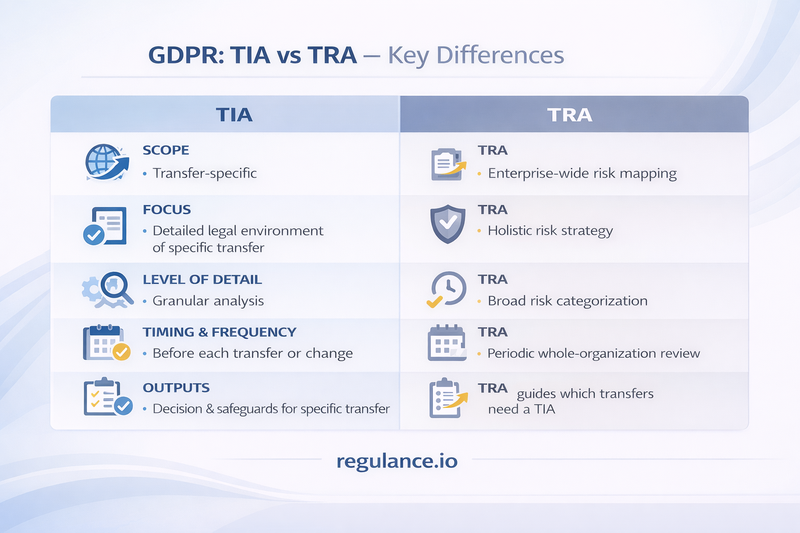
While TIA and TRA are closely related and often confused, they serve distinct purposes in your GDPR compliance framework. Understanding these differences is crucial for implementing the right assessment at the right time.
Scope and Focus
The most fundamental difference lies in scope. A TIA is transfer-specific, examining the details of a particular data flow to a particular destination. It's a deep dive into one transfer scenario. A TRA, by contrast, is organization-wide, providing a bird's-eye view of all your international data transfers and the relative risks they present.
Level of Detail
TIAs are highly detailed and granular. They require you to examine the specific legal framework in the destination country, analyze whether your data could be subject to government access, and determine whether supplementary measures beyond SCCs are necessary. TRAs are broader and more strategic, focusing on categorizing and prioritizing transfers rather than examining the legal minutiae of each destination country.
Timing and Frequency
TIAs are typically conducted before implementing a new data transfer or when circumstances change significantly such as when a new law is passed in the destination country that might affect data protection. TRAs are usually performed periodically as part of your broader data governance practices, often annually or when your business undergoes significant changes like acquisitions, new vendor relationships, or expansion into new markets.
Methodology
A TIA follows a structured methodology that includes analyzing the destination country's laws, assessing whether those laws could lead to access that violates GDPR principles, evaluating existing safeguards, and determining whether supplementary measures are needed. A TRA involves data mapping, risk categorization, impact analysis, and the creation of a risk register that informs your overall data transfer strategy.
Outputs
The primary output of a TIA is a documented decision about whether a specific transfer can proceed and under what conditions. It might conclude that additional technical measures are needed, that certain types of data shouldn't be transferred, or that alternative solutions must be explored. A TRA produces a comprehensive overview of your transfer landscape, a prioritized risk register, and a strategic action plan for managing data transfer risks across your organization.
Relationship to Each Other
Here's how they work together: Your TRA identifies which transfers exist and their relative risk levels. This then determines which transfers require a detailed TIA. High-risk transfers flagged in your TRA will need comprehensive TIAs with rigorous analysis. Lower-risk transfers might require only a streamlined assessment. In this sense, the TRA guides where you invest your resources in conducting TIAs.
Regulatory Expectations
While the EDPB has provided detailed guidance on conducting TIAs (particularly in its Recommendations 01/2020), the concept of a TRA is less formally defined in regulatory guidance. However, supervisory authorities increasingly expect organizations to demonstrate that they have a systematic approach to understanding and managing their data transfer risks, which is essentially what a TRA provides.
What's Their Relationship with GDPR?
Both TIA and TRA are firmly rooted in GDPR's requirements, particularly Chapter V, which governs international data transfers. Understanding this relationship helps clarify why these assessments are not optional extras but core compliance obligations.
GDPR's Transfer Restrictions
GDPR Article 44 establishes the fundamental principle: personal data can only be transferred outside the EEA if the controller and processor comply with the conditions laid out in Chapter V. This includes using appropriate transfer mechanisms like adequacy decisions, SCCs, or Binding Corporate Rules, and ensuring that the level of protection guaranteed by GDPR is not undermined.
Article 46, which covers transfers subject to appropriate safeguards, requires that additional safeguards be put in place when adequacy decisions aren't available. This is where TIA becomes essential, it's the mechanism for assessing whether your chosen safeguards (like SCCs) are actually effective in the specific context of your transfer.
The Schrems II Impact
The Court of Justice of the European Union's Schrems II decision fundamentally shaped how we approach TIA and TRA today. The court invalidated the EU-US Privacy Shield and clarified that organizations cannot blindly rely on SCCs without assessing whether they can be effective given the legal regime in the destination country. This ruling made TIAs not just a best practice but a legal necessity for most international transfers.
Accountability Principle
GDPR's accountability principle, enshrined in Article 5(2), requires organizations to demonstrate compliance with data protection principles. Conducting and documenting TIAs and TRAs is a key way to demonstrate this accountability. If a supervisory authority asks how you ensure your international transfers are compliant, your TIA and TRA documentation provides concrete evidence of your due diligence.
Data Protection Impact Assessments
While distinct from TIAs and TRAs, the Data Protection Impact Assessment (DPIA) required under Article 35 for high-risk processing shares conceptual similarities. All three assessments reflect GDPR's risk-based approach to data protection. In some cases, particularly for high-risk international transfers, elements of a TIA might be incorporated into a broader DPIA.
Rights of Data Subjects
GDPR's emphasis on data subject rights also connects to TIA and TRA. Article 13 and 14 require organizations to inform individuals when their data will be transferred to third countries and the safeguards in place. Your TIA provides the information needed to make these disclosures accurate and meaningful. Additionally, if your TIA reveals that adequate protection cannot be ensured, you may need to rely on specific derogations under Article 49, which requires informing individuals and obtaining their explicit consent in certain situations.
Supervisory Authority Powers
Supervisory authorities have extensive powers under Chapter VI of GDPR to investigate data processing activities and require evidence of compliance. When authorities conduct audits or investigations, they increasingly scrutinize international transfers and may request your TIA and TRA documentation. Organizations that cannot demonstrate they've properly assessed their transfers face significant enforcement risk.
The relationship between TIA, TRA, and GDPR is not bureaucratic formality—it's a practical framework for ensuring that the fundamental rights to privacy and data protection travel with personal data across borders. These assessments operationalize GDPR's principles in the complex reality of global data flows.
What Are the Consequences of Non-Compliance?
The consequences of failing to properly conduct TIAs and TRAs or proceeding with data transfers that don't meet GDPR standards can be severe, affecting your organization legally, financially, and reputationally.
Financial Penalties
GDPR's enforcement provisions include some of the strictest penalties in data protection law. Violations of Chapter V transfer requirements can result in administrative fines of up to €20 million or 4% of annual global turnover, whichever is higher. Supervisory authorities across Europe have demonstrated their willingness to impose substantial fines for transfer violations, particularly following Schrems II.
Several organizations have already faced enforcement action specifically related to inadequate transfer assessments. These cases send a clear message that regulators are actively monitoring compliance with transfer requirements and that inadequate TIAs or failure to implement supplementary measures will result in consequences.
Transfer Suspensions
Perhaps even more disruptive than fines is the possibility that a supervisory authority may order you to suspend or ban problematic data transfers. This can have immediate operational impacts, particularly if you rely on cloud services, overseas suppliers, or global internal data flows for core business functions. Emergency changes to technical infrastructure or vendor relationships are typically costly and disruptive.
In some high-profile cases, regulators have ordered organizations to cease using certain services or to repatriate data to the EEA, forcing businesses to rapidly restructure their technology operations. The cost and complexity of such migrations often far exceed any potential fine.
Legal Liability
Beyond regulatory enforcement, organizations face potential civil liability. Data subjects whose information is transferred in violation of GDPR have the right to compensation for damages under Article 82. While these individual claims might be modest, class action mechanisms in some jurisdictions could result in significant aggregate liability.
Additionally, organizations might face contractual disputes with partners or customers who require GDPR compliance as a contractual obligation. Failure to conduct proper transfer assessments could constitute a breach of contract, leading to disputes, termination of agreements, or claims for losses.
Reputational Damage
In an era where data protection is increasingly important to consumers and business partners, non-compliance can severely damage your reputation. Enforcement actions are typically public, and news of regulatory sanctions or data transfer violations can erode customer trust, impact investor confidence, and make your organization a less attractive business partner.
For organizations operating in sectors where trust is paramount such as healthcare, financial services, or professional services, reputational damage can have long-lasting business impacts that far exceed the immediate financial penalties.
Competitive Disadvantage
As data protection compliance becomes a differentiator in the marketplace, organizations that cannot demonstrate robust transfer assessments may find themselves at a competitive disadvantage. Procurement processes increasingly include detailed assessments of vendors' data protection practices, and inadequate TIA or TRA processes can disqualify organizations from tender opportunities.
Operational Disruptions
Even without formal enforcement action, inadequate transfer assessments create operational vulnerabilities. If you discover mid-contract that a transfer doesn't meet GDPR standards, you may need to renegotiate agreements, implement expensive technical solutions, or migrate to alternative providers. These unplanned changes are invariably more costly and disruptive than conducting proper assessments upfront.
Personal Liability
While GDPR primarily targets organizations, individuals within those organizations particularly those with data protection responsibilities can face personal consequences. In extreme cases of negligence or willful non-compliance, company officers might face personal sanctions or could become targets in civil litigation.
Proper TIA and TRA processes are not optional compliance exercises but essential risk management practices. The investment in conducting these assessments thoroughly is invariably smaller than the potential costs of getting them wrong.
How Often Can Your Business Re-assess TIA and TRA?
The question of frequency for TIA and TRA reviews is crucial for maintaining ongoing compliance. Unlike some compliance activities that follow a fixed annual schedule, transfer assessments require a more dynamic approach that responds to both internal and external changes.
Recommended Baseline Frequency
As a general best practice, organizations should conduct a comprehensive TRA at least annually. This yearly review ensures you have an up-to-date picture of your data transfer landscape and can identify new transfers that have been established throughout the year. For larger organizations with complex, frequently changing data flows, semi-annual reviews may be more appropriate.
For TIAs, there isn't a one-size-fits-all timeline. High-risk transfers should be reviewed annually at minimum, while lower-risk transfers might be reviewed every two to three years if circumstances remain stable. However, this baseline schedule should be adjusted based on triggers discussed below.
Trigger-Based Reassessments
More important than calendar schedules are the specific events that should trigger immediate reassessment of your TIA or TRA. These include:
Legal Changes in Destination Countries: When the country receiving your data enacts new surveillance laws, data access legislation, or changes to privacy protections, you must reassess affected TIAs. The challenge here is staying informed about legal developments in potentially dozens of jurisdictions, a task that requires dedicated resources or specialized legal monitoring services.
Changes in Data Processing: If the nature, scope, or purpose of your data transfer changes significantly such as transferring additional categories of data, processing data for new purposes, or significantly increasing the volume of transferred data you need to reassess. What was once a low-risk transfer of basic contact information might become high-risk if you begin transferring sensitive personal data.
New Vendors or Service Providers: Each time you engage a new third-party provider that involves international data transfers, you need to conduct a TIA for that specific relationship. Your TRA should also be updated to reflect these new data flows.
Regulatory Guidance Updates: When supervisory authorities issue new guidance on international transfers, or when court rulings affect the interpretation of transfer requirements (as Schrems II did dramatically), you should review your existing assessments to ensure they align with current expectations.
Security Incidents: If your organization or a data recipient experiences a security incident involving international transfers, this should trigger a reassessment to determine if your risk evaluation remains accurate and whether additional safeguards are needed.
Business Changes: Significant organizational changes like mergers, acquisitions, restructuring, or expansion into new markets should trigger a comprehensive reassessment of your entire transfer landscape through an updated TRA, followed by any necessary TIA updates.
Building a Sustainable Review Process
The most effective approach combines scheduled baseline reviews with a responsive trigger-based system. This requires:
Monitoring Mechanisms: Establish processes for tracking legal changes in countries where you transfer data. This might involve subscribing to legal monitoring services, maintaining relationships with local counsel, or using specialized compliance technology.
Internal Change Controls: Implement governance processes that require data protection input before new transfers are established, ensuring new vendors or processing activities are assessed before data flows begin.
Documentation Practices: Maintain clear records of when each TIA and TRA was conducted and when the next review is due. This documentation should also note the factors considered, decisions made, and any supplementary measures implemented.
Resource Allocation: Recognize that continuous monitoring and assessment require dedicated resources. This might involve hiring specialized data protection staff, engaging external consultants for specific assessments, or investing in compliance technology that helps automate monitoring.
Practical Considerations
For organizations with hundreds or thousands of international data transfers, conducting a full TIA for every transfer annually would be impractical. This is where risk-based prioritization becomes essential. Your TRA should categorize transfers by risk level, allowing you to focus the most rigorous and frequent reviews on the highest-risk transfers while applying a lighter touch to lower-risk scenarios.
Remember that reassessment doesn't always mean starting from scratch. If circumstances haven't changed significantly, updating an existing TIA might involve reviewing and confirming that previous conclusions remain valid rather than conducting an entirely new analysis.
Ultimately, the question isn't just "how often should we reassess?" but "how do we build sustainable processes that ensure our transfer assessments remain current and accurate as our business and the legal landscape evolve?" Organizations that embed these assessments into their broader data governance frameworks, rather than treating them as isolated compliance exercises, find it easier to maintain ongoing compliance.
FAQs
What's the main difference between a TIA and a TRA in simple terms?
Think of a TRA as the map of your entire international data transfer landscape; it shows all your transfers and their relative risks. A TIA is the detailed investigation of a specific transfer route on that map, examining whether it's safe to send data along that particular path.
Do small businesses need to conduct TIA and TRA?
Yes, if you transfer personal data outside the EEA, these assessments apply regardless of your organization's size. However, small businesses with limited, low-risk transfers can apply proportionate approaches. A small company using a major cloud provider with standard services will have a simpler assessment than a multinational corporation with complex data flows.
Can I use template TIAs or do they need to be customized?
While templates can provide helpful structure and ensure you address all necessary elements, simply filling in a template without genuine analysis isn't sufficient. Your TIA must reflect the specific circumstances of your transfer, the particular destination country's laws, and your actual data processing activities. Templates are starting points, not substitutes for proper assessment.
What are supplementary measures and when are they needed?
Supplementary measures are additional technical, contractual, or organizational protections beyond SCCs that you implement when the destination country's laws might undermine those clauses. Examples include end-to-end encryption, data pseudonymization, minimizing the data transferred, or splitting data across multiple jurisdictions. You need them when your TIA reveals that SCCs alone won't provide adequate protection given the legal environment.
Do I need separate TIAs for transfers to different states within the same country?
Generally, no. Since laws governing government access to data typically apply at the national level, you conduct your TIA based on the country as a whole. However, if different states or regions within a country have significantly different legal frameworks affecting data protection, separate assessments might be appropriate.
What happens if my TIA concludes that a transfer can't be made safely?
You have several options: implement supplementary measures that could make the transfer safe, restructure your processing to avoid the transfer (such as using local service providers), rely on specific derogations under Article 49 if applicable (though these are limited), or suspend the transfer. The key is that you cannot proceed with a transfer your TIA has determined is unsafe.
Are there any countries where I don't need a TIA?
You generally don't need a TIA for transfers to countries with an adequacy decision from the European Commission, which includes countries like the UK (under the UK GDPR), Switzerland, Japan, Canada (for commercial organizations), and several others. However, adequacy decisions can be challenged or revoked, so monitoring their status remains important.
How do I know if government surveillance laws in a destination country are problematic?
Your TIA should examine whether the country's laws allow government access to data in ways that lack adequate safeguards, oversight, or remedies. Red flags include broad intelligence powers without judicial authorization, requirements for service providers to grant backdoor access, lack of notification requirements, or absence of meaningful legal remedies for data subjects. The EDPB's guidance provides frameworks for this analysis.
Can our organization conduct TIA and TRA internally or do we need external help?
Whether you need external help depends on your internal expertise and resources. Conducting these assessments requires understanding GDPR requirements, familiarity with the legal frameworks in destination countries, and ability to evaluate technical safeguards. Many organizations benefit from external legal counsel for complex TIAs, particularly for transfers to countries with challenging legal environments, while handling simpler assessments internally.
How detailed should TIA documentation be?
Your TIA documentation should be sufficiently detailed to demonstrate to a supervisory authority that you've conducted a genuine, thorough assessment. This means documenting the data being transferred, the destination country's relevant laws, your analysis of potential conflicts with GDPR, the safeguards in place, any supplementary measures needed, and your ultimate decision. However, avoid creating unnecessarily lengthy documents and focus on substance over volume.
Conclusion
Navigating international data transfers in the post-Schrems II world requires diligence, expertise, and a systematic approach. Understanding the difference between TIA and TRA is fundamental to building a compliant and sustainable data transfer framework that protects both your organization and the individuals whose data you process.
A Transfer Impact Assessment provides the detailed, case-specific analysis needed to ensure individual transfers are safe and compliant, examining the legal landscape of destination countries and determining whether supplementary measures beyond contractual safeguards are necessary. A Transfer Risk Assessment gives you the strategic overview of your entire transfer ecosystem, helping you prioritize resources and identify where the most rigorous assessments are needed.
Together, these assessments form complementary pillars of your GDPR compliance framework. They're not merely bureaucratic exercises but practical tools for managing real risks legal, financial, operational, and reputational. In a regulatory environment where supervisory authorities are actively enforcing transfer requirements and where the legal landscape continues to evolve, organizations that invest in robust TIA and TRA processes position themselves not just to avoid penalties but to build trust with customers, partners, and stakeholders.
The complexity of these requirements shouldn't be underestimated. They require ongoing attention, legal expertise, technical understanding, and organizational commitment. But neither should they be viewed as insurmountable obstacles. With the right approach, tools, and expertise, organizations of all sizes can develop transfer assessment processes that are both compliant and proportionate to their specific circumstances.
As data protection regulations continue to evolve globally and as international data flows remain essential to modern business, the importance of proper transfer assessments will only grow. Organizations that embed these practices into their data governance frameworks now will be better positioned to adapt to future changes and to demonstrate their commitment to protecting privacy across borders.
Don't navigate these complex requirements alone, contact Regulance today to protect your organization and the personal data you process with confidence.
Visit Regulance to learn more about our data protection compliance services and schedule a consultation with our specialists.