What Is CRI Cyber Profile and Why Does It Matter for Your Organization?


Introduction
Cybersecurity threats are no longer a distant concern for financial institutions; they are a daily reality. From ransomware attacks crippling banking operations to sophisticated phishing campaigns targeting customer data, the financial sector sits squarely in the crosshairs of cybercriminals worldwide. A single breach can cost millions, destroy customer trust, and trigger regulatory consequences that last for years. That's where the CRI Cyber Profile comes in.
The CRI Cyber Profile, developed by the Cyber Risk Institute (CRI), is a cybersecurity framework purpose-built for financial institutions. Unlike broad, one-size-fits-all frameworks, the CRI Cyber Profile was designed with the unique complexity and regulatory landscape of the financial sector in mind. It draws from globally recognized standards including the NIST Cybersecurity Framework, ISO 27001, and the FFIEC Cybersecurity Assessment Tool and consolidates them into a single, streamlined profile that institutions can actually use.
The CRI Cyber Profile acts as a cybersecurity roadmap. It tells financial organizations exactly where they stand, what gaps exist in their defenses, and what steps they need to take to strengthen their security posture. Whether you're a community bank, a global investment firm, or a financial technology company, the CRI Cyber Profile offers a structured path to demonstrable cyber resilience.
In this article, we'll break down everything you need to know about the CRI Cyber Profile: what it is, how it works, who needs it, and how organizations like Regulance can help you navigate compliance with confidence.
What is the CRI Cyber Profile?
The CRI Cyber Profile is a standardized cybersecurity assessment framework created by the Cyber Risk Institute, a non-profit coalition of financial trade associations and firms. Its primary purpose is to help financial institutions assess, manage, and communicate their cybersecurity risk in a consistent, measurable way.
The CRI Cyber Profile functions as a diagnostic tool. It maps an organization's cybersecurity practices against a set of defined diagnostic statements, grouped into categories and sub-categories that cover the full spectrum of cyber risk management; from governance and risk management to incident response and supply chain security.
The framework is based on five core functions adapted from the NIST Cybersecurity Framework: Identify, Protect, Detect, Respond, and Recover. Within each function, the CRI Cyber Profile provides specific diagnostic statements that organizations use to evaluate their current cybersecurity posture and identify where improvements are needed.
What makes the CRI Cyber Profile particularly valuable in the financial services space is its ability to serve as a regulatory consolidation tool. Financial institutions often operate under a patchwork of overlapping cybersecurity regulations from NYDFS Cybersecurity Regulation and GLBA to international standards like the EU's DORA (Digital Operational Resilience Act). The CRI Cyber Profile maps to these regulatory requirements, meaning that demonstrating compliance with the CRI Cyber Profile helps organizations satisfy multiple regulatory obligations simultaneously.
It is also widely recognized by regulators and examiners, making it a credible, defensible framework when institutions are subject to supervisory review.
The CRI Cyber Profile Maturity Levels
One of the most practical features of the CRI Cyber Profile is its tiered maturity model. Rather than treating cybersecurity as a pass/fail exercise, the framework acknowledges that organizations are at different stages of their security journey and provides a structured progression path.
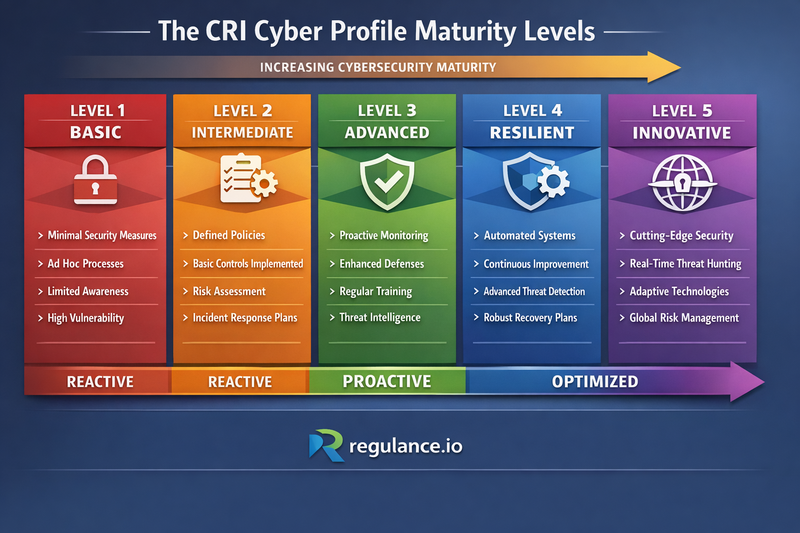
The CRI Cyber Profile organizes maturity into baseline tiers, which help institutions benchmark their current capabilities and plan realistic improvements. Here's how the maturity levels generally break down:
Baseline (Tier 1): This represents the foundational level of cybersecurity. Organizations at this tier have the essential controls in place; basic risk management processes, some access controls, and minimal incident response capabilities. While this level provides a starting point, it is generally insufficient for institutions exposed to significant cyber risk.
Evolving (Tier 2): At this level, organizations have moved beyond ad hoc processes and established more structured, repeatable practices. Risk assessments are performed more regularly, cybersecurity policies are documented, and there is greater awareness across the organization. Many mid-sized financial institutions operate at this tier.
Intermediate (Tier 3): Institutions here have robust, formally defined cybersecurity programs. Controls are consistently applied, monitored, and tested. Incident response plans are regularly exercised, and there is meaningful engagement with third-party risk management.
Advanced (Tier 4): This tier reflects a sophisticated, adaptive cybersecurity program. Advanced institutions conduct continuous monitoring, use threat intelligence proactively, and have deeply integrated cybersecurity into their overall enterprise risk management framework.
Innovative (Tier 5): The highest level of maturity, this tier represents organizations that are at the cutting edge of cybersecurity practice. They actively contribute to sector-wide threat intelligence sharing, continuously improve their capabilities, and anticipate emerging threats with a forward-looking strategy.
Understanding where your institution falls on this maturity spectrum is the first step toward meaningful, targeted improvement and the CRI Cyber Profile gives you exactly that visibility.
Who Needs to Comply with the CRI Cyber Profile?
The CRI Cyber Profile was designed specifically for the financial services sector, which means its primary audience includes a broad range of institutions operating in that space.
Banks and credit unions of all sizes are natural candidates for CRI Cyber Profile adoption. Community banks that may lack dedicated cybersecurity teams benefit from the framework's structured guidance, while larger institutions use it to standardize their cybersecurity assessments across complex, multi-entity organizations.
Investment firms, asset managers, and broker-dealers also fall within the framework's intended scope. These organizations handle vast amounts of sensitive financial data and are increasingly targeted by sophisticated threat actors, making a structured cybersecurity framework not just advisable but essential.
Insurance companies are another key constituency. Given the sensitive personal and financial data they manage, insurers face significant cyber risk and regulatory scrutiny and the CRI Cyber Profile helps them demonstrate a systematic approach to managing that risk.
Financial technology (FinTech) companies are increasingly expected to align with the CRI Cyber Profile, particularly as they enter into partnerships and integrations with regulated financial institutions. A FinTech operating as a third-party vendor to a bank, for example, may be required to demonstrate compliance as part of the bank's third-party risk management program.
Finally, any organization that is subject to the NYDFS Cybersecurity Regulation, FFIEC guidance, or similar financial sector regulations will find that the CRI Cyber Profile provides a direct, efficient path to demonstrating regulatory compliance.
Key Benefits of CRI Cyber Profile Compliance
Organizations that commit to aligning with the CRI Cyber Profile gain more than just a compliance checkbox. The benefits extend across risk management, regulatory efficiency, and institutional credibility.
Regulatory Efficiency is perhaps the most immediately practical benefit. Because the CRI Cyber Profile maps to multiple regulatory frameworks and standards simultaneously, institutions can satisfy several regulatory requirements through a single, unified assessment process, saving time, reducing duplication of effort, and simplifying examiner interactions.
Improved Risk Visibility is another significant advantage. The CRI Cyber Profile's diagnostic approach gives organizations a clear, granular view of their cybersecurity posture. This visibility enables better-informed decision-making at the board and executive level, ensuring that cybersecurity investments are directed where they will have the greatest impact.
Credibility with Regulators and Business Partners is increasingly important in today's environment. Demonstrating alignment with a recognized, sector-specific framework signals to regulators, clients, and partners that your organization takes cybersecurity seriously and manages it systematically.
Stronger Incident Response Preparedness flows naturally from the framework's comprehensive coverage of response and recovery capabilities. Organizations that work through the CRI Cyber Profile's diagnostic statements are better equipped to detect, respond to, and recover from cyber incidents when they occur.
Enhanced Third-Party Risk Management is a benefit that compounds over time. As institutions use the CRI Cyber Profile to assess their own posture, they also develop a clearer picture of the cybersecurity risks posed by their vendors and partners; enabling more effective supply chain security.
Steps to Achieve CRI Cyber Profile Compliance
Achieving CRI Cyber Profile compliance is a structured process, but it doesn't have to be overwhelming. Breaking it down into clear steps makes the journey manageable.
Step 1 — Conduct a Baseline Assessment. The starting point is understanding where you currently stand. Using the CRI Cyber Profile's diagnostic statements, evaluate your existing cybersecurity practices across all five core functions. Document your current state honestly; this assessment is the foundation for everything that follows.
Step 2 — Determine Your Target Maturity Tier. Based on your institution's size, risk profile, and regulatory obligations, determine the appropriate maturity tier you need to achieve. Not every institution needs to reach Tier 5; the goal is the right tier for your context.
Step 3 — Identify and Prioritize Gaps. Compare your current state against your target tier and identify the gaps. Prioritize remediation efforts based on the severity of the gaps and the risk they represent to your institution.
Step 4 — Develop and Implement a Remediation Plan. Build a concrete action plan to address the identified gaps. This typically involves updating policies, implementing new controls, improving monitoring capabilities, and strengthening governance structures.
Step 5 — Train and Educate Staff. Cybersecurity is a people problem as much as a technology problem. Ensure that staff across the organization understand their roles in maintaining cybersecurity, and provide targeted training for those with specific cybersecurity responsibilities.
Step 6 — Conduct Ongoing Assessments and Continuous Improvement. CRI Cyber Profile compliance is not a one-time event. Cyber threats evolve, and your cybersecurity program needs to evolve with them. Schedule regular reassessments to track progress and identify new gaps as they emerge.
Key Challenges in CRI Cyber Profile Compliance
Despite its benefits, achieving and maintaining CRI Cyber Profile compliance is not without challenges. Understanding these obstacles in advance helps organizations prepare more effectively.
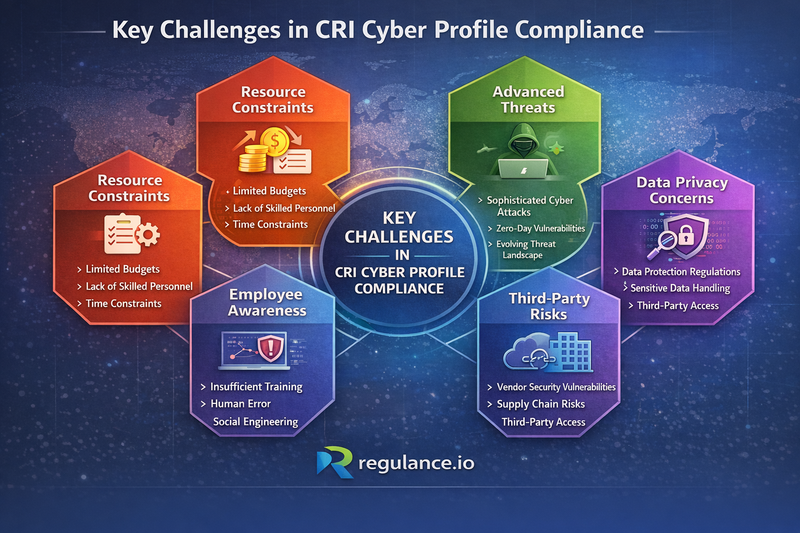
Resource Constraints are a common hurdle, particularly for smaller institutions. Conducting a thorough CRI Cyber Profile assessment, implementing remediation measures, and sustaining a mature cybersecurity program requires investment in people, technology, and time; resources that community banks and smaller FinTechs may have in limited supply.
Complexity of the Framework can be daunting at first glance. The CRI Cyber Profile contains hundreds of diagnostic statements spanning multiple domains, and understanding how they map to existing regulatory requirements requires expertise and careful analysis.
Keeping Up with Updates presents an ongoing challenge. The CRI Cyber Profile is periodically updated to reflect evolving threats and regulatory changes. Organizations must track these updates and adjust their programs accordingly, which requires continuous monitoring of the framework and its evolution.
Third-Party Risk Management adds another layer of complexity. Financial institutions rely on numerous vendors and partners, and managing the cybersecurity risk across that extended ecosystem while demonstrating it through the CRI Cyber Profile lens requires robust third-party risk management processes that many organizations are still building.
Board and Executive Engagement is sometimes difficult to secure. Without meaningful buy-in from leadership, cybersecurity programs often lack the resources and strategic priority they need to mature. Translating the CRI Cyber Profile's technical requirements into language that resonates with boards and C-suite leaders is a critical and sometimes underestimated challenge.
FAQs
Q: Is the CRI Cyber Profile mandatory? While the CRI Cyber Profile is not universally mandated by law, it is strongly encouraged by financial regulators and is increasingly referenced in supervisory examinations. Some regulatory frameworks and examiner guidance explicitly reference it as an accepted approach to cybersecurity risk management.
Q: How often should we update our CRI Cyber Profile assessment? At a minimum, organizations should reassess annually. However, assessments should also be triggered by significant changes to the IT environment, new regulatory requirements, or after a cybersecurity incident.
Q: How does the CRI Cyber Profile relate to NIST CSF? The CRI Cyber Profile is built on the foundations of the NIST Cybersecurity Framework, adapting and extending it specifically for the financial sector. It incorporates diagnostic statements from NIST CSF alongside other relevant frameworks, making it more targeted for financial institutions.
Q: Can small financial institutions use the CRI Cyber Profile? Absolutely. The maturity tier model allows institutions of all sizes to adopt the framework at a level appropriate to their risk profile. Smaller institutions typically target lower tiers and use the framework to structure their cybersecurity programs systematically.
Q: What is the difference between the CRI Cyber Profile and the FFIEC CAT? The FFIEC Cybersecurity Assessment Tool (CAT) was retired in 2023. The CRI Cyber Profile has emerged as the preferred successor framework for many institutions, offering broader regulatory mapping and a more comprehensive, updated set of diagnostic statements.
Ready to Simplify CRI Cyber Profile Compliance?Contact Regulance today to learn how we can help your institution achieve and sustain regulatory compliance with confidence and reduce cyber risks.