What Is Automated Evidence Collection and How Can It Transform Your Compliance Process?


Introduction
Compliance audits don't have to feel like a fire drill. Yet for most organizations, that's exactly what they are: a sudden, stressful scramble to locate screenshots, pull access logs, chase down system owners, and assemble documentation from a dozen different platforms, all under the pressure of a fast-approaching deadline.
Manual evidence gathering was never designed for the volume, velocity, and complexity of modern compliance requirements. And as regulatory frameworks like SOC 2, ISO 27001, HIPAA, GDPR, and PCI DSS continue to evolve demanding more evidence, more frequently, across more systems, the cracks in manual processes are widening.
This is where automated evidence collection changes everything.
Automated evidence collection is the practice of using purpose-built software to continuously and automatically gather, organize, and store the documentation that proves your security controls are working and your compliance obligations are being met. No more last-minute exports. No more hunting for the right screenshot. No more praying that the evidence you gathered three months ago still accurately reflects your current control environment. With automated evidence collection, the work happens in the background quietly, consistently, and reliably every single day.
Automated evidence collection is a strategic transformation. Organizations that implement automated evidence collection build compliance programs that are fundamentally more trustworthy, more scalable, and more aligned with how their business actually operates.
According to industry research, companies that automate their compliance workflows reduce audit preparation time by up to 80 percent. That's not a minor efficiency gain. That's weeks of reclaimed productivity, redirected toward work that actually moves your business forward.
In this guide, we'll walk you through everything you need to know about automated evidence collection: what it is, why manual methods are failing modern compliance teams, the concrete benefits of making the switch, how to evaluate the right solution for your organization, and answers to the questions compliance professionals ask most.
What Is Automated Evidence Collection for Compliance?
Automated evidence collection is the process of using software tools to automatically pull, capture, and store evidence that demonstrates an organization's compliance with regulatory frameworks or security standards. Rather than manually exporting reports, taking screenshots, or chasing down colleagues for documentation, automation handles this work continuously and systematically.
Think of it this way: every time a user logs into a system, a patch gets applied, an access review is completed, or a vulnerability scan runs, there's an event happening that could serve as compliance evidence. Automated evidence collection tools are designed to capture these events in real time, link them to the relevant controls in your compliance framework, and store them in a centralized, auditor-ready repository.
These tools typically integrate with the systems and platforms your organization already uses; cloud providers like AWS, Azure, and Google Cloud, identity providers like Okta, HR platforms, ticketing systems like Jira, CI/CD pipelines, endpoint management tools, and more. Through API integrations, they continuously pull relevant data, creating a living, up-to-date body of evidence that can be accessed and presented at any time.
In a modern compliance program, automated evidence collection sits at the intersection of technology and governance. It gives compliance teams real-time visibility into their control environment, ensures that evidence is never missing or outdated, and dramatically reduces the burden of audit preparation. The result is a more confident, more efficient compliance function, one that's built to handle the scale and complexity of today's regulatory landscape.
The Challenges of Manual Evidence Collection for Compliance
To truly appreciate the value of automated evidence collection, it helps to understand just how painful the manual alternative really is. For teams that are still gathering compliance evidence by hand, the challenges are familiar, frustrating, and persistent.
It's massively time-consuming. Compliance teams can spend weeks, sometimes months collecting evidence for a single audit. Every control needs documentation. Every policy needs to be tied to proof. That means pulling reports, exporting data, tracking down system owners, and compiling everything into formats that auditors can actually use. In larger organizations, this process can demand hundreds of hours of labor per audit cycle.
Human error is inevitable. When people are manually gathering evidence from multiple systems, mistakes happen. Screenshots get taken out of context. The wrong date range gets selected. Evidence gets saved in the wrong folder or named inconsistently. These errors might seem minor, but in an audit context, they can raise red flags or require time-consuming rework that derails the whole process.
Evidence goes stale quickly. Compliance is an ongoing state. But with manual collection, evidence is often gathered in a burst right before an audit and reflects a narrow snapshot in time. If a control broke down six months ago and there's no documentation of what happened and how it was resolved, that's a gap that could cost you your certification.
It doesn't scale. As organizations grow, add new tools, or adopt multiple compliance frameworks, the volume of required evidence multiplies fast. Manual processes that worked reasonably well for a 50-person startup fall apart entirely at 500 employees or when you're managing SOC 2, ISO 27001, and HIPAA simultaneously.
It's a morale killer. Ask any engineer or IT professional who's been pulled away from meaningful work to gather audit evidence. Manual compliance prep breeds resentment, especially when it feels like busywork disconnected from real strategic value. Over time, this creates resistance to compliance initiatives across the organization making the next audit even harder.
Benefits of Automated Evidence Collection
The shift from manual to automated evidence collection involves fundamentally transforming how your compliance program operates.
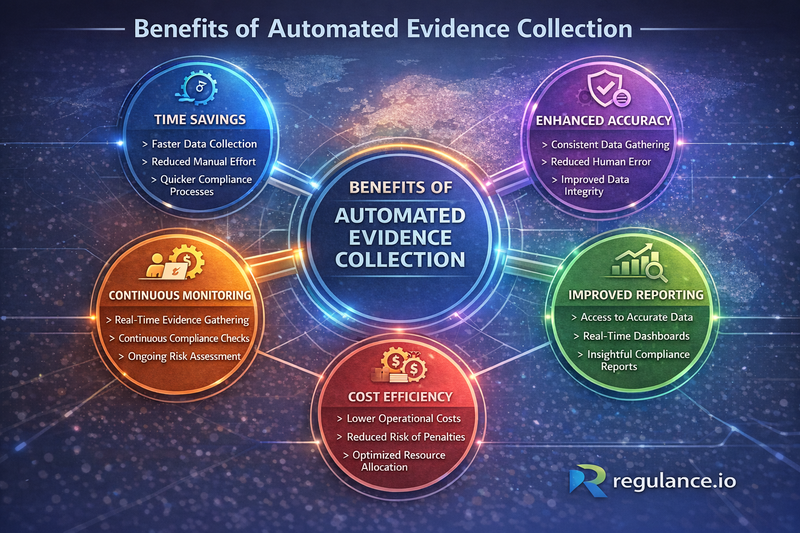
Continuous compliance monitoring. Instead of preparing for compliance in reactive bursts before audits, automated evidence collection enables a continuous compliance posture. Evidence is gathered every single day, giving you a real-time view of whether your controls are working as intended. Problems are identified early, not during an auditor's review when it's too late to course-correct gracefully.
Dramatic time savings. Organizations that adopt automated evidence collection consistently report cutting audit preparation time by 60 to 80 percent. That's weeks of work eliminated, time that can be redirected toward strengthening your actual security posture rather than simply documenting it.
Fewer errors, more consistency. Automated systems collect evidence the same way every time. There's no risk of capturing the wrong data, missing a required artifact, or mislabeling a file. This consistency is something auditors genuinely appreciate, it makes the evidence trail clean, credible, and easy to follow without requiring a guided tour.
Centralized, auditor-ready evidence repository. Rather than digging through email threads and shared drives, all evidence lives in one organized, searchable place. When an auditor asks for documentation of your access reviews or patch management process, you can provide it immediately and confidently.
Cross-framework efficiency. Automated evidence collection platforms typically support multiple compliance frameworks and can map the same evidence to multiple controls across different standards. This is invaluable for organizations managing several frameworks at once, collect once, and satisfy many.
Stronger audit outcomes. When evidence is complete, consistent, and well-organized, audits go faster and smoother. Fewer requests for additional documentation, fewer findings related to missing evidence, and significantly more confidence heading into every review.
Tips for Evaluating Automated Evidence Collection Solutions
Not all automated evidence collection tools are created equal. Here's what to focus on when evaluating your options.
Integration depth and breadth. The best tools connect seamlessly with the systems you already use. Before committing to any platform, verify that it integrates with your specific tech stack, your cloud environments, identity providers, HR systems, ticketing tools, and development pipelines. A tool that covers 60 percent of your environment still leaves you doing manual work for the rest.
Framework coverage. Confirm that the solution supports the compliance frameworks most relevant to your organization today and the ones you're likely to pursue in the future. If you're currently focused on SOC 2 but plan to pursue ISO 27001 down the road, you want a tool that can grow with you and ideally one that maps controls across frameworks to reduce duplication.
Genuine automation vs. configuration-heavy tools. Look for a solution that's truly automated out of the box, not one that requires heavy configuration or ongoing manual input to function. The goal is to reduce manual work, not simply shift it from one task to another.
Evidence quality and context. Collected evidence should be meaningful and contextual not just raw data dumps. Good platforms label, organize, and link evidence directly to the relevant controls, so auditors can follow the thread without needing extensive explanation from your team.
User experience for everyone involved. If the platform is difficult to navigate or requires deep training to use, adoption will suffer across your team. Look for intuitive dashboards, clear workflows, and collaborative features that make it easy for compliance, security, and engineering teams to work together without friction.
Vendor support and compliance expertise. Compliance is nuanced. Choose a vendor with deep expertise in the frameworks you're targeting and a support team that can help you interpret requirements, not just use their software. The best vendors are partners in your compliance journey, not just technology providers.
FAQs
Q: Is automated evidence collection only for large enterprises? Not at all. Some of the biggest gains are seen by smaller organizations and startups that don't have dedicated compliance teams. Automated evidence collection allows a lean team to manage a rigorous compliance program without adding headcount or burning out existing staff.
Q: Will automated evidence collection replace our auditors? No. Auditors still play a critical role in evaluating whether your controls are effective. What automation does is make the auditor's job easier and yours. It ensures evidence is available, organized, and credible, so the audit conversation can focus on substance rather than documentation logistics.
Q: How secure is the evidence stored by these platforms? Reputable automated evidence collection platforms are built with security as a priority and often hold their own compliance certifications. Always review a vendor's security posture, data handling policies, and encryption standards before entrusting them with sensitive compliance data.
Q: How long does setup take? Timelines vary by platform and the complexity of your environment, but many modern solutions are designed for rapid deployment. With the right tool, organizations can have core integrations live and evidence flowing within days.
Q: Can it handle multiple frameworks at once? Yes and this is one of the most powerful aspects of a well-built automated evidence collection platform. By mapping evidence to multiple frameworks simultaneously, you can pursue SOC 2, ISO 27001, and HIPAA in parallel without doubling your workload.
Conclusion
Compliance is not going away and neither is the pressure to demonstrate it more frequently, more transparently, and across more frameworks than ever before. The organizations that will thrive in this environment are the ones that treat compliance as a continuous, systemic function rather than a periodic scramble.
Automated evidence collection is the engine that makes continuous compliance possible. It removes the manual burden from your team, reduces the risk of errors and gaps, and ensures that when an auditor walks in or sends their first request, you're ready. Not just ready, but genuinely confident.
Ready to Transform Your Compliance Program? Try Regulance.
Stop spending weeks on audit prep and start building a compliance program that actually works for you. Regulance helps modern organizations automate evidence collection, manage multiple compliance frameworks, and walk into every audit with complete confidence. From seamless integrations to continuous monitoring and hands-on expert guidance, Regulance is built for the way your team works.
👉 Visit Regulance today and see how effortless compliance can be.