What Is a Trust Centre and Why Does Your Business Need One?


Introduction
In the recent hyper-connected digital world, trust has become a mandatory business asset. Customers, partners, investors, and regulators are asking harder questions than ever before: How do you handle my data? Are you compliant with industry regulations? What security measures do you have in place? And they want answers that are clear, accessible, and verifiable.
Trust centre is one of the most powerful yet underutilised tools in modern business transparency. It is your organisation's public-facing compliance and security hub, a dedicated space where stakeholders can find everything they need to feel confident doing business with you.
We've all experienced the frustration of trying to find a company's privacy policy buried three clicks deep in a footer, or hunting down a security whitepaper that may or may not be current. A trust centre solves all of that. It consolidates your compliance credentials, security practices, data protection policies, certifications, and audit reports into a single, searchable, always-updated resource.
The rise of regulations like GDPR, SOC 2, ISO 27001, HIPAA, and CCPA has made transparency not just ethical but legally expected. Businesses that proactively demonstrate compliance are winning deals faster, passing vendor assessments more smoothly, and retaining customers longer.
If you're a fast-growing SaaS startup, a healthcare provider, or a multinational enterprise, a trust centre signals one thing loudly: we take your trust seriously. This guide breaks down everything you need to know about trust centres: what they are, why they matter, and how to build one that actually works.
What Is a Trust Centre?
A trust centre is a centralised, publicly accessible (or access-controlled) portal where an organisation documents and communicates its security posture, compliance status, data privacy practices, and operational policies to customers, partners, and regulators.
A trust centre is about radical transparency. Rather than waiting for a prospect to send over a lengthy security questionnaire or a regulator to request documentation, you proactively make that information available and easy to navigate. It functions almost like a living document, one that grows and updates as your compliance landscape evolves.
Unlike a static privacy policy page, a trust centre is dynamic. It can include real-time security status updates, downloadable compliance reports, certification badges, sub-processor lists, and even a request portal for more sensitive documents shared under NDA.
Major technology companies were among the first to popularise trust centres. Salesforce, Microsoft, Google, and AWS all operate robust trust centres that serve millions of enterprise customers navigating complex procurement and vendor risk processes. But the concept has since scaled down and across industries, making it relevant for organisations of every size.
In practical terms, when a sales prospect asks your team "Are you SOC 2 compliant?" instead of having your security team scramble to compile a 40-page PDF response, you simply direct them to your trust centre. The answer is already there, documented, verified, and professional.
A well-built trust centre is equal parts security documentation, compliance showcase, and brand credibility tool.
Types of Trust Centres
Not all trust centres are built the same, and the right type depends on your organisation's industry, size, and audience. Here are the most common formats:
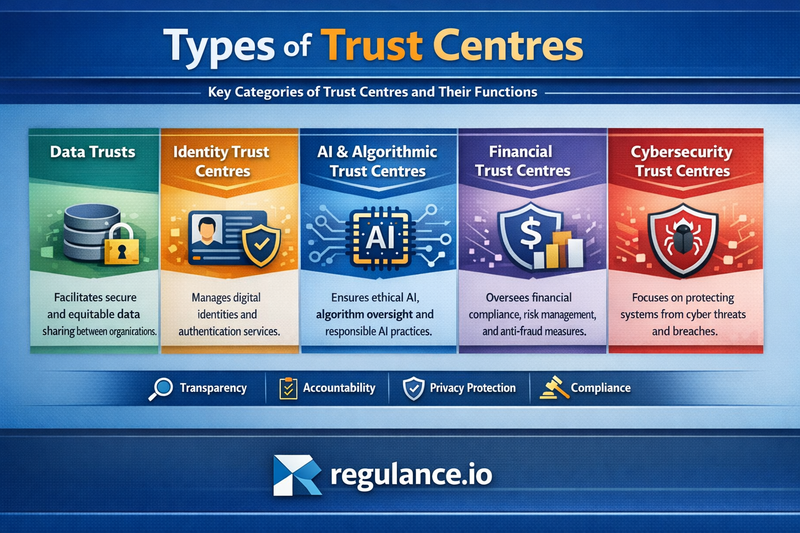
Public Trust Centres are fully open to anyone without authentication. These are ideal for SaaS companies and tech vendors who want to reduce friction in the sales cycle and demonstrate openness. All core compliance and security information is visible, though sensitive reports may require a request.
Gated Trust Centres require visitors to submit basic contact information or sign an NDA before accessing certain documents. This is the middle-ground approach maintaining transparency while protecting sensitive operational details.
Customer-Only Trust Centres are accessible exclusively to existing clients after login. These are more common in regulated industries like finance or healthcare, where detailed audit reports and penetration testing results are shared only with verified stakeholders.
Vendor/Partner Trust Centres are specifically designed to support third-party vendor risk assessments. They're structured around the questions procurement and security teams typically ask during due diligence, making them highly practical B2B tools.
Regulatory Trust Centres are built with a compliance-first lens, primarily designed to demonstrate adherence to specific frameworks and jurisdictions. Government agencies, healthcare organisations, and financial institutions often lean toward this model.
Many modern trust centres blend several of these types publicly sharing high-level compliance information while gaining access to deeper technical documentation.
Benefits of Having a Trust Centre
The business case for investing in a trust centre goes well beyond just "looking transparent." The tangible benefits are real, measurable, and strategic.
Accelerated Sales Cycles are perhaps the most immediate win. Security reviews and vendor assessments can add weeks or months to a deal. When prospects find a comprehensive trust centre, they get answers instantly, reducing back-and-forth and moving deals forward faster.
Reduced Security Team Burden is another major advantage. Security and compliance teams are constantly pulled into answering repetitive questionnaires. A trust centre automates a significant portion of this, freeing up skilled professionals to focus on actual security work rather than documentation requests.
Stronger Customer Retention follows naturally from transparency. When customers can see that you take their data seriously, that certifications are current, and that your incident response processes are documented, loyalty increases. Trust is an incredible retention mechanism.
Competitive Differentiation matters more than ever in crowded markets. A polished trust centre signals maturity and reliability qualities that tip the scales during competitive procurement processes.
Regulatory Readiness is a benefit that pays dividends quietly but consistently. When an audit or regulatory inquiry arrives, your documentation is already organised, current, and accessible. The chaos of last-minute compliance scrambles simply disappears.
Improved Brand Reputation rounds out the benefits. Organisations with trust centres are increasingly viewed as thought leaders in data responsibility, a reputation that attracts quality talent, investors, and customers alike.
Who Does a Trust Centre Apply To?
SaaS and Technology Companies are the most natural fit. They handle customer data at scale and face constant security reviews from enterprise buyers. A trust centre is practically table stakes in this space.
Healthcare Providers and Health Tech Companies must navigate HIPAA compliance, patient data privacy, and complex partner relationships. A trust centre helps communicate compliance clearly to patients and business associates.
Financial Services Firms deal with PCI-DSS requirements, anti-money laundering frameworks, and heavy regulatory scrutiny. Transparency around these obligations builds institutional confidence.
E-commerce and Retail Businesses collecting payment data and customer personal information benefit from demonstrating GDPR or CCPA compliance publicly especially as consumer awareness of data rights grows.
Professional Services Firms: legal, accounting, consulting often hold highly sensitive client information. A trust centre positions them as responsible stewards of that data.
Government Contractors and Public Sector Organisations face some of the strictest compliance requirements and benefit enormously from having documentation centralised and audit-ready.
Essentially, if your organisation collects, stores, or processes personal data and nearly every modern business does a trust centre is relevant to you.
What Is Included in a Trust Centre?
A high-quality trust centre typically contains several categories of information, each serving a different type of stakeholder.
Security Policies and Practices form the backbone covering areas like encryption standards, access controls, vulnerability management, endpoint security, and network architecture at a level appropriate for public sharing.
Compliance Certifications and Frameworks are prominently featured. This includes certifications like SOC 2 Type II, ISO 27001, ISO 27701, HIPAA attestations, PCI-DSS compliance, GDPR alignment documentation, and any industry-specific frameworks applicable to your sector.
Privacy Documentation covers your privacy policy, data processing agreements (DPAs), cookie policies, and data retention schedules. For GDPR-conscious audiences, including information on lawful bases for processing is particularly valuable.
Sub-processor and Vendor Lists are increasingly expected, especially by GDPR-regulated customers who need to understand who has access to their data and under what conditions.
Penetration Testing Summaries offer sanitised versions of testing results, demonstrating proactive security validation without exposing sensitive findings.
Incident Response and Business Continuity Policies reassure customers that you have structured processes for handling security events, outages, and disasters.
System Status and Uptime Information sometimes integrated directly into the trust centre, gives customers real-time visibility into operational health.
Document Request Portals allow visitors to formally request more sensitive documentation, like full audit reports, under controlled conditions.
Frequently Asked Questions pre-empt the questions your customers and prospects always ask, reducing friction and demonstrating self-awareness about what stakeholders care about.
What Do You Consider When Building a Trust Centre?
Building a trust centre is both a strategic and operational exercise. Several key considerations will shape whether it truly delivers value or simply becomes another static webpage nobody visits.
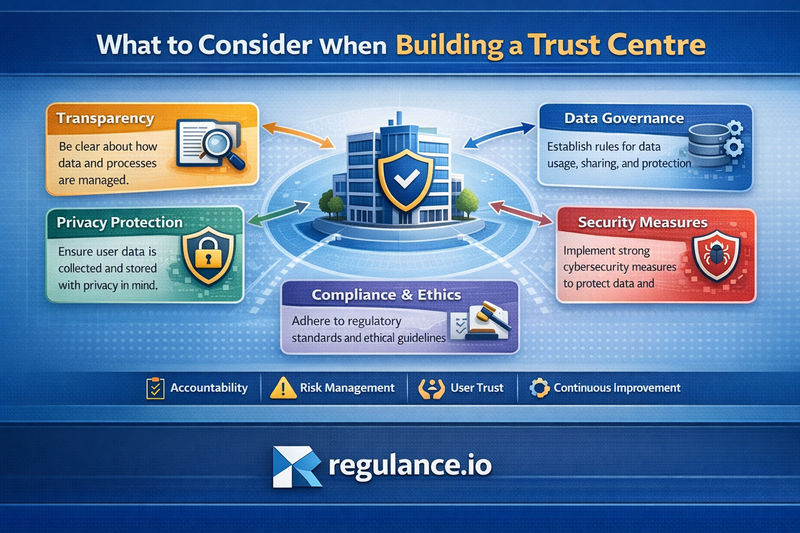
Audience-First Design should be your starting point. Consider who will actually use your trust centre, security teams conducting vendor assessments, legal teams reviewing DPAs, procurement managers checking certifications, or end customers evaluating your privacy practices. Each audience has different needs, and your structure should accommodate all of them intuitively.
Keeping It Current is perhaps the most critical ongoing commitment. An outdated trust centre is worse than none at all; it erodes rather than builds trust. Build workflows to update certifications as they renew, refresh policies as regulations change, and maintain accurate sub-processor lists.
Access Control Architecture requires careful thought. Decide which content is fully public, which requires basic registration, and which demands an NDA or authenticated login. Striking the right balance protects sensitive information while removing unnecessary friction from the stakeholder experience.
Integration With Sales and Support Workflows ensures your trust centre actually gets used. Train your sales team to reference it proactively. Integrate it into security questionnaire responses. Link to it from your website footer, onboarding emails, and contract documentation.
Scalability matters particularly for growing organisations. Your trust centre needs to accommodate new frameworks, geographies, and regulations as your business expands.
Professional Presentation communicates the same credibility as the content itself. A well-designed, easy-to-navigate trust centre reinforces the message that your organisation approaches security and compliance with the same rigour it applies to everything else.
FAQs
Is a trust centre the same as a privacy policy? No. A privacy policy is a legal document explaining how personal data is processed. A trust centre is a broader hub that includes the privacy policy alongside security documentation, compliance certifications, vendor lists, and much more.
Do small businesses need a trust centre? If you handle customer data and want to compete for enterprise contracts or operate in regulated industries, yes. Trust centres are increasingly expected, regardless of company size.
How often should a trust centre be updated? At minimum, whenever certifications renew, policies change, sub-processors are added or removed, or significant security updates are made. Many organisations review their trust centres quarterly.
Can a trust centre help with GDPR compliance? Absolutely. A trust centre is an excellent way to demonstrate GDPR accountability housing your DPAs, data retention policies, sub-processor lists, and privacy documentation in a single transparent location.
What's the difference between a trust centre and a security questionnaire response? A security questionnaire is a reactive, one-off response to a specific request. A trust centre is a proactive, always-available resource that reduces the need for individual questionnaires.
Ready to Build Your Trust Centre?
Regulance helps organisations build comprehensive, professional trust centres that turn compliance documentation into a genuine business asset. From structuring your security policies to managing certifications and keeping your trust centre current, Regulance provides the expertise and platform support you need to project confidence to every stakeholder at every stage of your growth.
Get started with Regulance today and make trust your competitive advantage.