Top Data Security Trends for 2026: How Can You Protect Your Digital Assets?


Introduction
Data security has become the defining challenge of our digital age. Every day, organizations worldwide face an onslaught of cyberattacks that grow more sophisticated by the hour. In 2026, the question is no longer whether your business will be targeted, but when and whether you'll be ready when it happens.
The numbers tell a sobering story. Global cybercrime damages are projected to exceed $10 trillion annually, making it more profitable than the entire illegal drug trade. The average data breach now costs companies $4.5 million in direct expenses alone, but that figure barely scratches the surface. When you account for lost customers, damaged reputation, regulatory fines, and months of operational chaos, the true cost can devastate even well-established businesses. Small and medium-sized enterprises face particularly dire consequences, with 60% of companies that suffer major data breaches closing their doors within six months.
Organizations that treat data security as a strategic priority rather than an afterthought are not only surviving but thriving. They're winning customer trust in markets where privacy concerns drive purchasing decisions. They're operating with confidence in regulated industries where compliance failures mean existential risk. They're innovating faster because robust security enables rather than blocks digital transformation.
The data security landscape of 2026 looks radically different from even two years ago. Artificial intelligence has fundamentally altered both attack and defense strategies. Quantum computing threatens to upend encryption standards that have protected data for decades. Remote work has permanently dissolved traditional security perimeters. This comprehensive guide examines the ten most critical data security trends shaping how forward-thinking organizations protect their digital assets today and prepare for tomorrow's threats.
What is Data Security?
Data security encompasses the practices, technologies, and policies organizations implement to protect digital information from unauthorized access, corruption, theft, or loss throughout its entire lifecycle. At its heart, data security is about ensuring three fundamental principles: confidentiality, integrity, and availability often called the CIA triad.
Confidentiality means that sensitive information remains accessible only to authorized individuals. Whether it's customer credit card details, employee health records, or proprietary business intelligence, confidentiality ensures this data doesn't fall into the wrong hands through breaches, insider threats, or accidental exposure.
Integrity ensures data remains accurate, complete, and trustworthy throughout its lifecycle. This means protecting information from unauthorized modification, whether malicious or accidental. When you access your bank account balance, integrity guarantees that the number you see reflects reality and hasn't been tampered with during transmission or storage.
Availability means authorized users can access information when they need it. Even perfectly confidential and intact data becomes worthless if ransomware locks it away or a denial-of-service attack prevents access. Availability requires robust infrastructure, backup systems, and disaster recovery capabilities.
Modern data security extends across multiple layers. Physical security protects the hardware where data resides. Network security controls how information travels between systems. Application security ensures software properly handles and protects data. Endpoint security defends the devices people use to access information. Cloud security addresses the unique challenges of data stored off-premises. Identity and access management controls who can reach what data under which circumstances.
Data security also encompasses the policies and processes that govern human behavior. The strongest technical controls fail if employees fall for phishing scams, use weak passwords, or accidentally share sensitive files. Effective data security requires a comprehensive approach that addresses technology, people, and processes in an integrated framework that adapts to evolving threats.
Top 10 Data Security Trends to Expect in 2026
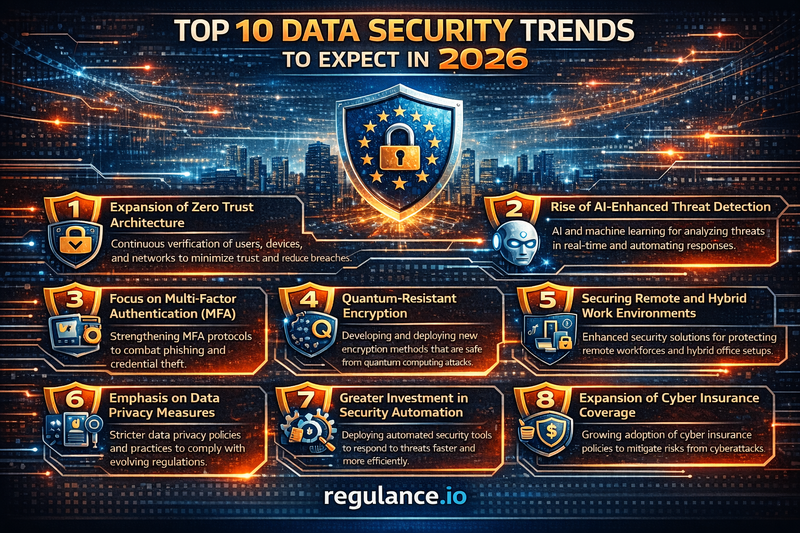
1. AI-Powered Security Operations
Artificial intelligence has fundamentally transformed how organizations approach data security. Traditional security operations centers struggled to keep pace with the sheer volume of threats, generating alert fatigue that allowed genuine attacks to slip through. In 2026, AI-powered security operations use machine learning to analyze millions of events per second, identifying subtle patterns that indicate compromise while filtering out false positives that waste analyst time.
These AI systems learn normal behavior patterns for your network, applications, and users, enabling them to spot anomalies that suggest attacks in progress. When someone accesses data they don't typically touch, at unusual hours, from an unexpected location, AI flags this instantly. Advanced systems can automatically respond to certain threats, isolating infected endpoints, blocking suspicious IP addresses, or revoking compromised credentials faster than any human could react.
However, this trend cuts both ways. Cybercriminals now wield the same AI technologies to launch more sophisticated attacks. AI-powered malware adapts its behavior to evade detection. Deepfake technology creates convincing impersonations for social engineering. Automated vulnerability scanning and exploitation occurs at machine speed. The security landscape has become an AI arms race, making adoption of these technologies essential rather than optional.
2. Zero Trust Architecture Becomes Standard
The traditional security model of building strong perimeters while trusting everything inside has collapsed under the weight of cloud computing, remote work, and sophisticated attacks. Zero trust architecture operates on a simple principle: trust nothing, verify everything. Every access request, from any user or device to any resource, requires authentication and authorization before proceeding.
In 2026, zero trust has evolved from a buzzword to standard practice for security-conscious organizations. Implementation focuses on several key elements. Continuous verification means not just checking credentials once but constantly evaluating risk throughout a session. Least privilege access grants users only the minimum permissions necessary for their specific tasks. Microsegmentation divides networks into small zones, limiting lateral movement by attackers who breach initial defenses. Device trust assessment evaluates the security posture of endpoints before allowing network access.
Organizations implementing zero trust see tangible benefits. When attackers compromise one system or credential, they can't freely roam the network accessing whatever they want. Instead, they hit walls at every turn, requiring additional authentication and authorization that triggers security alerts. This approach proves particularly valuable for hybrid work environments where employees access corporate resources from personal devices and home networks.
3. Quantum-Resistant Cryptography Preparation
The quantum computing threat to current encryption standards is an approaching reality that demands immediate attention. Quantum computers operate fundamentally differently from traditional computers, with the potential to break widely-used encryption algorithms that currently protect everything from financial transactions to military communications.
While practical, large-scale quantum computers don't yet exist, security-minded organizations understand the "harvest now, decrypt later" threat. Adversaries can capture encrypted data today and store it, waiting for quantum computers capable of breaking the encryption to emerge. For information that must remain confidential for decades; government secrets, healthcare records, financial data, this represents a significant threat.
In response, 2026 sees accelerating adoption of quantum-resistant cryptography, also called post-quantum cryptography. These algorithms, based on mathematical problems that even quantum computers struggle to solve, provide protection against both current and future threats. The US National Institute of Standards and Technology has standardized several quantum-resistant algorithms, and forward-thinking organizations are beginning migrations to these new standards.
This transition represents a massive undertaking. Organizations must inventory everywhere they use cryptography, assess which systems face the highest risk, prioritize migration efforts, and test extensively to ensure new algorithms don't break existing functionality. Starting this journey now rather than waiting for quantum computers to become practical provides a crucial head start.
4. Extended Detection and Response (XDR) Integration
Security teams have long struggled with tool sprawl, dozens of disconnected products generating alerts in isolation, forcing analysts to manually correlate information and piece together attack narratives. Extended Detection and Response (XDR) platforms solve this problem by integrating security data across email, endpoints, servers, cloud workloads, and networks into unified visibility and response capabilities.
XDR platforms in 2026 excel at connecting the dots. When an employee receives a phishing email, clicks a malicious link, downloads malware, and that malware begins communicating with a command-and-control server, XDR sees the entire attack chain rather than isolated events across separate tools. This comprehensive visibility enables faster detection and more effective response.
Modern XDR platforms leverage AI and automation extensively. They automatically investigate suspicious activities, pulling relevant context and historical information to assess threat severity. For confirmed threats, XDR can orchestrate response actions across multiple security tools quarantining the infected endpoint, blocking the malicious domain at the firewall, searching for other systems exhibiting similar indicators, and alerting analysts with complete attack context rather than fragmented alerts.
Organizations implementing XDR report dramatic reductions in time to detect and respond to threats, fewer false positives overwhelming security teams, and improved ability to identify sophisticated attacks that span multiple systems and attack vectors.
5. Privacy-Enhancing Technologies Gain Traction
Growing privacy regulations and consumer awareness have created tension between legitimate data use for business purposes and privacy protection. Privacy-enhancing technologies (PETs) resolve this tension by enabling organizations to extract value from data while minimizing privacy risks.
Homomorphic encryption allows computation on encrypted data without decrypting it first. Organizations can analyze sensitive information, train machine learning models, or run complex queries while data remains encrypted throughout. Differential privacy adds carefully calibrated noise to datasets, enabling accurate statistical analysis while making it mathematically impossible to identify specific individuals. Secure multi-party computation allows multiple organizations to jointly analyze data while each keeps their information private from the others.
Synthetic data generation creates artificial datasets that preserve the statistical properties of real data without containing actual personal information. Organizations use synthetic data for software testing, machine learning model development, and sharing with third parties without privacy concerns. Federated learning trains AI models across decentralized data sources without moving data from where it originates, addressing both privacy and data localization requirements.
These technologies enable business use cases previously considered too risky from a privacy perspective. Healthcare organizations can collaborate on research without sharing patient records. Financial institutions can jointly analyze fraud patterns without exposing customer data. Retailers can gain insights from combined customer data while respecting individual privacy.
6. Cloud-Native Security Architecture
As organizations complete their migrations to cloud infrastructure, data security strategies have evolved from attempting to replicate on-premises approaches in the cloud to embracing cloud-native security architectures purpose-built for cloud environments.
Cloud-native security leverages the unique capabilities and characteristics of cloud platforms. Infrastructure as code enables security controls to be defined, versioned, and deployed alongside applications rather than applied manually after deployment. Immutable infrastructure means servers are never modified after creation, updates require replacing instances entirely, eliminating configuration drift and persistent compromises. Containerization isolates applications and enables security policies to travel with workloads regardless of where they run.
Cloud security posture management tools continuously monitor cloud configurations, identifying misconfigurations that create security risks. Common issues like publicly accessible storage buckets, overly permissive access policies, or unencrypted data stores can be detected and remediated automatically before attackers exploit them. Cloud workload protection platforms secure applications running in cloud environments, providing runtime protection, vulnerability management, and compliance monitoring tailored for cloud characteristics.
The shared responsibility model in cloud environments requires organizations to clearly understand which security aspects they own versus what their cloud providers handle. In 2026, mature organizations have moved beyond confusion about these boundaries to implementing comprehensive controls for their responsibilities while effectively leveraging provider-managed security capabilities.
7. Identity-Based Security Perimeters
With remote work firmly established and corporate data scattered across devices, applications, and clouds, the traditional network perimeter has essentially dissolved. Identity has become the new security perimeter; who you are matters more than where you are or what network you're on.
Modern identity-based security implements several sophisticated capabilities. Risk-based authentication evaluates multiple factors; user behavior, device posture, location, accessed resource sensitivity to determine required authentication strength. Routine access from known devices may require just a password, while unusual access to sensitive data demands multi-factor authentication. Passwordless authentication eliminates passwords, the weakest link in security in favor of biometrics, hardware tokens, or cryptographic keys.
Privileged access management has evolved to provide just-in-time elevation of privileges only when needed, for only as long as necessary, with comprehensive monitoring. Rather than granting standing administrative access, modern systems provide temporary elevation for specific tasks, automatically revoking privileges afterward. Identity governance ensures appropriate access throughout the employee lifecycle, automatically provisioning access for new hires, adjusting permissions when roles change, and immediately revoking all access upon departure.
Behavioral analytics continuously monitor how identities are used, establishing baselines of normal activity and alerting on deviations. When an account suddenly accesses data it typically doesn't touch, authenticates from unusual locations, or exhibits suspicious patterns, security teams receive immediate alerts even if the authentication itself was technically valid.
8. Ransomware Defense Evolution
Ransomware has evolved from an annoying nuisance to an existential threat capable of shutting down critical infrastructure, healthcare systems, and entire organizations. Attackers no longer just encrypt data and demand payment, they exfiltrate sensitive information first, threatening to publish it if payment isn't made, creating double extortion scenarios where organizations face both operational disruption and data breach consequences.
In response, data security strategies in 2026 implement multi-layered ransomware defenses. Immutable backups that cannot be encrypted or deleted even by administrators ensure recovery options exist. Air-gapped backups stored completely offline provide last-resort recovery if connected systems are compromised. Advanced endpoint detection and response identifies ransomware behavior patterns before encryption begins, stopping attacks in progress.
Network segmentation limits ransomware spread by preventing lateral movement between network zones. Email security filters block the phishing messages through which most ransomware enters organizations. Application control prevents execution of unauthorized software. User behavior analytics identify compromised credentials being used for reconnaissance before ransomware deployment.
Organizations are also preparing for when, not if, ransomware strikes. Incident response plans specifically address ransomware scenarios. Cyber insurance provides financial protection, though premiums increasingly depend on demonstrated security controls. Regular disaster recovery testing ensures teams can execute recovery procedures under pressure.
9. Supply Chain Security Vigilance
Organizations have awakened to the reality that their security is only as strong as their weakest vendor. High-profile supply chain attacks where attackers compromise software vendors, service providers, or hardware manufacturers to reach target organizations have demonstrated that indirect attack vectors often prove easier than direct assault.
Data security in 2026 includes comprehensive supply chain risk management. Vendor security assessments evaluate suppliers' security practices before onboarding and continuously throughout relationships. Software composition analysis examines applications for vulnerable open-source components and dependencies. Software bill of materials (SBOM) requirements ensure visibility into what components comprise applications.
Organizations implement technical controls to limit supply chain risk. Network segmentation isolates vendor access to only systems and data absolutely necessary for service delivery. Privileged access management strictly controls administrative credentials provided to vendors. Continuous monitoring watches for suspicious activities by supplier systems or personnel.
Contractual protections establish security requirements, audit rights, breach notification obligations, and liability allocation. Industry-specific frameworks like the Cybersecurity Maturity Model Certification provide standardized approaches to assessing and improving supplier security posture.
10. Security Automation and Orchestration
The cybersecurity skills shortage shows no signs of abating, with millions of unfilled security positions globally. Simultaneously, threat volumes and complexity continue increasing. This gap between available talent and required work drives explosive growth in security automation and orchestration.
Security orchestration, automation, and response (SOAR) platforms enable organizations to automate repetitive security tasks, freeing skilled analysts for work requiring human judgment. When security tools detect potential threats, SOAR platforms can automatically gather additional context, consult threat intelligence, check if similar indicators have been seen elsewhere, and even execute initial response actions all in seconds rather than the hours manual investigation would require.
Common automation use cases in 2026 include phishing response workflows that automatically analyze suspicious emails, detonate attachments in sandboxes, check links against threat intelligence, and quarantine malicious messages across all user mailboxes. Vulnerability management workflows automatically prioritize patches based on exploitability, criticality, and environmental context, then orchestrate deployment through existing patch management tools. Threat hunting playbooks systematically search for indicators of compromise across environments, documenting findings and escalating when threats are confirmed.
Effective automation requires careful implementation. Organizations must document processes thoroughly before automating, build in appropriate human review checkpoints for high-stakes decisions, and continuously refine playbooks based on results. When done well, automation dramatically improves security team effectiveness without requiring proportional increases in headcount.
Benefits of Data Security
Implementing robust data security delivers value far beyond avoiding breaches, though that alone justifies investment. Organizations with mature security programs realize numerous strategic and operational advantages.
Building Customer Trust and Loyalty
In an era of frequent data breaches and privacy scandals, customers increasingly consider security when choosing which businesses to trust with their information and money. Organizations demonstrating commitment to data security through transparent practices, industry certifications, and breach-free track records differentiate themselves from competitors. This trust translates directly to customer acquisition, retention, and lifetime value. Research consistently shows customers will pay premium prices for brands they trust to protect their data.
Ensuring Business Continuity
Data security and business continuity are inseparable. Ransomware attacks, data corruption, and system compromises can halt operations for days or weeks, costing millions per day in lost revenue and productivity. Robust security controls, combined with resilient architectures and disaster recovery capabilities, ensure organizations can maintain operations despite attacks. When incidents do occur, mature security programs enable faster recovery with minimal disruption.
Achieving Regulatory Compliance
The regulatory landscape has become incredibly complex, with GDPR, CCPA, HIPAA, PCI DSS, and dozens of other frameworks imposing data protection requirements backed by significant penalties. Strong data security programs address the technical and organizational requirements common across these regulations, reducing compliance costs and risks. Rather than scrambling to meet each new regulatory requirement, organizations with mature security practices find they're already compliant or very close.
Protecting Intellectual Property
For many organizations, intellectual property such as research data, product designs, strategic plans, proprietary algorithms represent their most valuable assets. Competitors and nation-state actors actively target this information. Robust data security protects these crown jewels from theft that could eliminate competitive advantages built over years or decades.
Enabling Digital Transformation
Organizations hesitant about cloud adoption, remote work, digital customer experiences, or IoT deployments often cite security concerns. Mature data security capabilities become enablers rather than blockers, providing the confidence to pursue digital transformation initiatives that improve efficiency, enhance customer experience, and create new revenue streams.
Reducing Operational Costs
While security requires investment, mature programs actually reduce costs. Preventing breaches avoids enormous remediation expenses, legal fees, regulatory fines, and customer compensation. Automation reduces manual security tasks, allowing lean teams to accomplish more. Consolidated security platforms reduce tool sprawl and associated licensing, maintenance, and training costs.
Attracting and Retaining Talent
Top technology talent wants to work for organizations that take security seriously, invest in modern tools, and provide opportunities to develop cutting-edge skills. Strong security programs help attract and retain the best people while reducing risks from departing employees who might otherwise take sensitive data to competitors.
FAQs
What's the difference between data security and cybersecurity?
Cybersecurity is the broader discipline of protecting systems, networks, and programs from digital attacks. Data security specifically focuses on protecting information itself from unauthorized access, corruption, or theft. Data security is a critical component within the larger cybersecurity umbrella, but cybersecurity also encompasses areas like network security, application security, and operational security that extend beyond data protection alone.
How much should my organization invest in data security?
Industry benchmarks suggest allocating 10-15% of IT budgets to security for typical organizations, though appropriate investment depends on your industry, risk profile, regulatory requirements, and threat landscape. Healthcare, financial services, and technology companies often invest more due to higher risk. Rather than focusing on percentage targets, conduct risk assessments to identify what data you must protect, what threats you face, and what controls provide the best risk reduction per dollar invested. Many organizations find they're dramatically underinvested relative to their actual risk exposure.
Can small businesses afford proper data security?
Small businesses face the same threats as large enterprises, often with fewer resources to defend themselves. However, effective data security doesn't necessarily require massive budgets. Start with fundamentals: use strong, unique passwords with multi-factor authentication; keep software updated; implement basic firewalls and antivirus; train employees on security awareness; back up critical data regularly; and encrypt sensitive information. Many enterprise-grade security tools now offer affordable options for small businesses. Leveraging managed security service providers can provide expert security capabilities without maintaining internal teams.
What should I do immediately after discovering a data breach?
First, activate your incident response plan if you have one. Contain the breach to prevent additional data loss disconnect affected systems from the network if necessary. Assess what data was compromised and who's affected. Document everything about the incident for later analysis and potential legal or regulatory requirements. Notify relevant stakeholders according to regulatory requirements and your incident response procedures this typically includes your leadership team, legal counsel, potentially affected individuals, and regulatory authorities. Engage forensics experts to investigate how the breach occurred. Finally, implement measures to prevent recurrence of the same attack vector.
Is cloud storage more or less secure than on-premises?
Both models have security advantages and challenges. Major cloud providers invest billions in security, employ world-class security experts, and implement controls most organizations couldn't replicate independently. They benefit from economies of scale, enabling security capabilities individual organizations couldn't afford. However, cloud environments introduce new risks around misconfiguration, credential management, and shared responsibility complexity. The reality is that security outcomes depend far more on how well you implement and manage controls than whether you choose cloud or on-premises infrastructure. Many organizations achieve better security in well-managed cloud environments than they had with poorly maintained on-premises systems.
How often should we conduct security training for employees?
Annual security awareness training is the absolute minimum, but research shows this is insufficient for lasting behavior change. Leading organizations implement continuous security awareness programs with monthly micro-trainings, simulated phishing campaigns throughout the year, and just-in-time training when employees exhibit risky behaviors. Different roles need different training, everyone needs baseline awareness, while developers need secure coding training, administrators need privileged access training, and customer service staff need social engineering awareness. Effectiveness matters more than frequency engaging, relevant training delivered regularly beats infrequent, boring, checkbox compliance training every time.
What's the most important thing to focus on for data security?
If forced to choose one priority, focus on identity and access management. The vast majority of breaches involve compromised credentials or excessive access privileges. Implementing strong authentication, least privilege access, and comprehensive monitoring of how identities are used provides tremendous risk reduction. That said, effective data security requires layered defenses addressing multiple attack vectors. Organizations should conduct risk assessments to identify their specific highest-priority gaps rather than assuming a one-size-fits-all answer.
Conclusion
As we navigate through 2026, data security has become inseparable from business success. The trends explored in this guide; AI-powered defenses, zero trust architectures, quantum-resistant cryptography, and others represent not just technology shifts but fundamental transformations in how organizations protect their most valuable assets and build trust with customers.
The threat landscape will continue evolving with new attack techniques, emerging technologies, and sophisticated adversaries constantly probing for weaknesses. Organizations viewing security as a one-time project or compliance checkbox will find themselves perpetually behind. Those that embrace security as an ongoing discipline, invest appropriately, and adapt continuously to new threats position themselves not just to survive but to thrive.
Start by assessing where your organization stands today. What critical data do you hold? What threats do you face? What controls do you have in place? Where are the gaps? From this honest assessment, develop a roadmap that addresses your highest risks first while building toward comprehensive security across all layers.
Remember that perfect security doesn't exist, the goal is managing risk to acceptable levels while enabling your business to operate effectively. Focus on fundamentals before chasing every new trend. Involve stakeholders across your organization, from executive leadership to frontline employees. Build a security culture where everyone understands their role in protecting data.
The investment required for robust data security is substantial, but the cost of inadequate security is far greater. In 2026's threat landscape, organizations face not just breaches but existential risks from ransomware, regulatory penalties, and reputational destruction. Data security has become essential infrastructure for the digital economy, enabling the innovation, collaboration, and growth that drive modern business.
Don't wait for a breach to prioritize data security. Contact Regulance today to schedule a personalized demo and discover how our platform can help your organization stay ahead of evolving threats while reducing complexity and costs.