Top 5 Compliance Management Software Tools for Small Businesses: Which One Fits Best?


Introduction
Running a small business today means juggling a lot of regulatory requirements. Data privacy laws, industry-specific regulations, and security standards seem to multiply overnight, and keeping up with them all without a dedicated compliance team can feel like an impossible task. Failing to meet compliance requirements can result in hefty fines reaching into the hundreds of thousands, damaged customer trust, and in severe cases, legal action that could shut down your business entirely.
Compliance management software has revolutionized how small businesses approach regulatory requirements. These intelligent platforms automate the tedious work, track every obligation, collect evidence automatically, and give you a clear view of exactly where you stand at any moment. Whether your business needs to comply with GDPR for European customers, HIPAA for healthcare data, SOC 2 for security trust, or ISO 27001 for information security, the right compliance management software turns an overwhelming burden into a manageable, systematic process.
But with dozens of options flooding the market, how do you choose the right one? Not all compliance management software is created equal, especially when it comes to meeting the unique needs and budget constraints of small businesses. In this article, we'll walk through the top five compliance management software solutions designed specifically for small businesses, examining their features, strengths, and weaknesses.
What is Compliance Management Software?
Compliance management software is a digital solution designed to help businesses meet regulatory requirements, industry standards, and internal policies efficiently. It is a compliance command center; a centralized platform that automates tasks, tracks obligations, manages documentation, and provides real-time visibility into your compliance status.
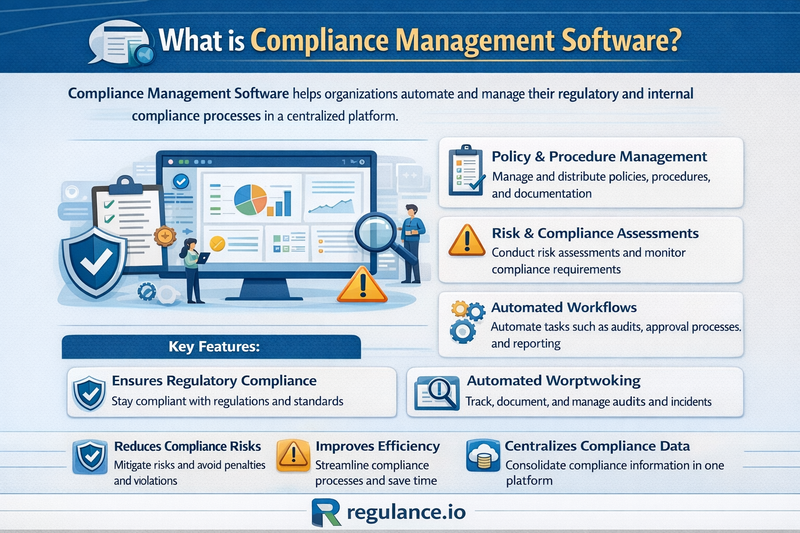
These sophisticated tools go far beyond simple checklists. Modern compliance management software typically includes features like automated risk assessments, policy management, audit trail tracking, vendor risk management, employee training modules, and reporting capabilities. They're built to reduce manual work, minimize human error, and ensure nothing falls through the cracks.
For small businesses, compliance management software is particularly valuable because it levels the playing field. You get enterprise-grade compliance capabilities without needing to hire expensive compliance specialists or build complex internal systems. The software essentially acts as your virtual compliance officer, guiding you through requirements, alerting you to deadlines, and keeping comprehensive records that prove your compliance efforts during audits.
The best compliance management software integrates seamlessly with your existing tools, adapts to your specific industry requirements, and scales as your business grows. It transforms compliance from a reactive scramble into a proactive, manageable process that protects your business while freeing you to focus on growth.
Top 5 Compliance Management Software
1. Regulance: The Gold Standard for Small Business Compliance
Regulance has earned its position at the top of this list by delivering exactly what small businesses need: powerful compliance capabilities wrapped in an intuitive, accessible package. Unlike enterprise-focused solutions that overwhelm small teams with unnecessary complexity, Regulance was purpose-built for businesses that need robust compliance without the enterprise price tag or learning curve.
Key Features:
- Intelligent Automation Engine: Regulance automatically tracks regulatory changes across multiple frameworks, alerting you to new requirements before they become problems
- Unified Compliance Dashboard: Monitor all your compliance frameworks (SOC 2, ISO 27001, GDPR, HIPAA, etc.) from a single, intuitive interface
- Continuous Control Monitoring: Real-time tracking of security controls with automated evidence collection
- Smart Policy Management: Create, distribute, and track policy acknowledgments with built-in templates for common frameworks
- Risk Assessment Automation: Conduct comprehensive risk assessments with guided workflows that simplify complex processes
- Vendor Risk Management: Streamlined vendor assessment and monitoring with automated questionnaires and risk scoring
- Audit-Ready Reporting: Generate comprehensive compliance reports instantly, with all supporting documentation organized and accessible
- Employee Training Hub: Deploy and track mandatory compliance training with automated reminders and completion tracking
- Integration Ecosystem: Seamless connections with popular business tools including AWS, Google Workspace, GitHub, Slack, and dozens more
Pros:
- Exceptional User Experience: The interface is clean, logical, and designed for people who aren't compliance experts
- Comprehensive Framework Coverage: Support for virtually every compliance standard a small business might need
- Outstanding Customer Support: Dedicated compliance experts available to guide you through implementation and ongoing questions
- Transparent Pricing: Clear, predictable pricing with no hidden fees or surprise charges
- Rapid Implementation: Get up and running in days, not months, with guided onboarding and pre-built templates
- Scalability: Grows seamlessly as your business expands, from startup to enterprise
- Continuous Updates: Regular feature releases and automatic framework updates keep you current without additional effort
Cons:
- Pricing May Be Higher Than Basic Solutions: While competitively priced for the value delivered, Regulance costs more than bare-bones compliance tools (though the comprehensive features justify the investment)
- Robust Feature Set Requires Initial Learning: The extensive capabilities mean there's a brief learning period, though the intuitive design minimizes this
Regulance stands apart because it understands the small business reality: you need enterprise-quality compliance without enterprise resources. The platform delivers sophisticated automation and comprehensive coverage while remaining accessible to teams without dedicated compliance staff. When your business's reputation and legal standing are on the line, Regulance provides the confidence that comes from knowing your compliance is handled properly.
2. Vanta: Automated Compliance for Tech Companies
Vanta has built a strong reputation in the compliance space, particularly among software-as-a-service companies and tech startups seeking SOC 2 compliance. The platform emphasizes automation and continuous monitoring, positioning itself as a solution that works in the background to maintain compliance.
Key Features:
- Automated Evidence Collection: Connects to your infrastructure to automatically gather compliance evidence
- SOC 2 Specialization: Strong focus on SOC 2 Trust Service Criteria with streamlined workflows
- Security Questionnaire Automation: AI-powered assistance for completing vendor security questionnaires
- Personnel Management: Track employee onboarding, offboarding, and access reviews
- Compliance Monitoring: Real-time alerts when systems drift from compliance requirements
- Multiple Framework Support: Coverage for SOC 2, ISO 27001, HIPAA, GDPR, and other standards
Pros:
- Strong Automation Capabilities: Excellent at reducing manual compliance work through intelligent automation
- Developer-Friendly: Appeals to technical teams with robust API and developer tools
- Continuous Monitoring: Provides ongoing compliance visibility rather than point-in-time assessments
- Growing Ecosystem: Expanding library of integrations with popular development and security tools
- Clean Interface: Modern, straightforward design that's easy to navigate
Cons:
- Primarily Tech-Focused: Less ideal for non-tech industries or businesses with diverse compliance needs
- Limited Customization: Pre-built workflows work well for standard use cases but offer less flexibility for unique requirements
- Pricing Can Escalate: Costs increase significantly as you add frameworks and integrations
- Customer Support Variations: Support quality can be inconsistent, with some users reporting slow response times
- Complexity for Small Teams: Some features may be overkill for very small businesses with simple compliance needs
Vanta works well for technology companies with straightforward compliance requirements, but businesses needing broader industry coverage or more personalized support may find it limiting.
3. Secureframe: Simplified Compliance Automation
Secureframe positions itself as the compliance automation platform for growing businesses, offering a balance between functionality and ease of use. The platform has gained traction among startups and small businesses looking to achieve their first compliance certification.
Key Features:
- Automated Compliance Monitoring: Continuous scanning of your systems for compliance gaps
- Guided Implementation: Step-by-step workflows guide you through achieving compliance
- Personnel Tracking: Manage employee access, training, and compliance responsibilities
- Vendor Risk Management: Basic vendor assessment and tracking capabilities
- Policy Templates: Pre-built policy templates for common compliance frameworks
- Audit Support: Tools designed to streamline the audit process and evidence submission
- Risk Management: Integrated risk assessment and remediation tracking
Pros:
- User-Friendly Interface: Intuitive design makes compliance accessible to non-experts
- Good Integration Coverage: Connects with many popular business and security tools
- Helpful Onboarding: Strong initial setup assistance to get you started quickly
- Transparent Roadmap: Company is open about upcoming features and improvements
- Responsive to Feedback: Actively incorporates user suggestions into product development
Cons:
- Limited Advanced Features: May lack depth for businesses with complex compliance requirements
- Reporting Limitations: Some users find reporting capabilities less comprehensive than competitors
- Growing Pains: As a newer platform, it sometimes lacks the polish and reliability of more established solutions
- Framework Depth Varies: Coverage is stronger for some frameworks than others
- Customer Support Scaling: As the company grows, maintaining personalized support has become challenging
Secureframe offers a solid foundation for small businesses beginning their compliance journey, though those with more sophisticated needs may eventually outgrow its capabilities.
4. Deli (formerly Tugboat Logic): Comprehensive GRC Platform
Deli has evolved from Tugboat Logic into a more comprehensive governance, risk, and compliance (GRC) platform aimed at businesses needing broader risk management capabilities alongside compliance. The platform appeals to organizations wanting an all-in-one solution for their security and compliance programs.
Key Features:
- Integrated GRC Approach: Combines governance, risk management, and compliance in one platform
- Extensive Framework Library: Support for numerous compliance frameworks and standards
- Risk Register: Comprehensive risk tracking and management capabilities
- Vendor Risk Management: Robust vendor assessment, monitoring, and risk scoring
- Control Testing: Tools for conducting and documenting regular control testing
- Audit Management: Complete audit workflow from planning through remediation
- Custom Framework Creation: Ability to build custom compliance frameworks for unique requirements
Pros:
- Comprehensive Functionality: Deep feature set covers nearly every aspect of GRC
- Maturity and Stability: Established platform with proven track record
- Strong Vendor Management: Particularly robust capabilities for managing third-party risks
- Flexible Customization: Adapts well to unique business requirements and workflows
- Professional Services: Offers consulting and implementation support for complex projects
Cons:
- Steeper Learning Curve: Comprehensive features mean more complexity and longer training time
- Higher Price Point: Generally more expensive than simpler compliance-focused tools
- Can Feel Overwhelming: Small teams may find the breadth of features daunting
- Interface Dated: User interface feels less modern compared to newer competitors
- Implementation Time: Full setup and configuration can take longer than simpler alternatives
Deli works best for businesses that need comprehensive GRC capabilities and have the resources to fully leverage its extensive features, though smaller businesses may find it more than they need.
5. Sprinto: Compliance Automation for Growing Teams
Sprinto rounds out our list as a solid compliance automation platform designed for companies scaling their security and compliance programs. The platform emphasizes automation and integration to reduce the manual burden of maintaining compliance.
Key Features:
- Automated Evidence Collection: Continuous gathering of compliance evidence from connected systems
- Multi-Framework Support: Handles SOC 2, ISO 27001, GDPR, HIPAA, and other frameworks
- Integrated Ticketing: Built-in task management for compliance activities
- Employee Lifecycle Management: Track compliance requirements throughout employee tenure
- Asset Management: Maintain inventory and tracking of devices and systems
- Access Reviews: Automated periodic access review workflows
- Compliance Health Score: Dashboard view of overall compliance status
Pros:
- Strong Automation Focus: Reduces manual work through intelligent automation
- Growing Integration Library: Expanding connections to popular business tools
- Responsive Development Team: Actively builds requested features and improvements
- Competitive Pricing: Generally more affordable than enterprise-focused alternatives
- Multiple Framework Efficiency: Handles multiple frameworks simultaneously without duplication
Cons:
- Limited Brand Recognition: Less established than some competitors, which may concern some buyers
- Documentation Gaps: Some features lack comprehensive documentation or guidance
- Support Availability: Limited support hours may challenge businesses in different time zones
- Feature Depth Varies: Some capabilities feel less developed than core features
- Customization Limitations: Less flexible than some alternatives for unique workflows
Sprinto offers good value for small to mid-sized businesses with straightforward compliance needs, though it may lack the polish and depth of more established platforms.
How to Choose Compliance Management Software
Selecting the right compliance management software is a critical decision that will impact your business for years to come. Here's a comprehensive framework to guide your evaluation:
Assess Your Specific Compliance Requirements Begin by identifying which regulations, standards, and frameworks apply to your business. Are you pursuing SOC 2 certification? Do you handle healthcare data requiring HIPAA compliance? Are you subject to GDPR for European customers? Different platforms excel at different frameworks, so understanding your specific needs is foundational. Also consider future compliance requirements as your business grows or enters new markets.
Evaluate Automation Capabilities The primary value of compliance management software lies in its ability to automate repetitive tasks. Look for platforms that automatically collect evidence, monitor controls, track changes, and alert you to issues. The more automation, the less manual work for your team. However, ensure the automation is intelligent and reliable—poorly implemented automation can create more problems than it solves.
Consider the Integration Ecosystem Your compliance software needs to connect with your existing business tools to be truly effective. Evaluate how well each platform integrates with your cloud infrastructure (AWS, Azure, Google Cloud), productivity tools (Google Workspace, Microsoft 365), development systems (GitHub, GitLab), HR systems, and other critical applications. Native integrations are far superior to manual data entry or custom API connections.
Examine User Experience and Accessibility Compliance is everyone's responsibility, not just the IT or legal team. Choose software that non-technical team members can understand and use. A clean, intuitive interface reduces training time, increases adoption, and minimizes errors. Request demos and trial periods to actually experience the platform before committing.
Understand the Total Cost of Ownership Look beyond the sticker price to understand true costs. Consider implementation fees, per-user charges, costs for additional frameworks, integration fees, support costs, and potential consulting expenses. Some platforms appear affordable initially but become expensive as you scale. Request transparent pricing that accounts for your expected growth.
Evaluate Vendor Support and Resources Compliance can be complex, especially when you're just starting. Look for vendors that provide strong customer support, comprehensive documentation, training resources, and ideally access to compliance experts who can answer your questions. The quality of support often matters more than specific features.
Check for Scalability Your compliance needs will grow as your business expands. Choose a platform that can scale with you, supporting additional frameworks, more employees, increased system complexity, and potentially multiple locations or subsidiaries. Switching compliance platforms is painful and disruptive, so selecting a scalable solution from the start saves headaches later.
Verify Security and Reliability It's ironic if your compliance management software itself has security issues. Verify that the vendor follows security best practices, maintains appropriate certifications (they should practice what they preach), provides reliable uptime, and has solid data backup and recovery processes. Review their security documentation and incident history.
Read Real User Reviews Look beyond marketing materials to understand actual user experiences. Review sites like G2, Capterra, and TrustRadius provide insights into what customers really think. Pay particular attention to reviews from businesses similar to yours in size and industry. Look for patterns in both positive and negative feedback.
Request References and Case Studies Reputable vendors will happily connect you with existing customers or provide case studies demonstrating successful implementations. Speaking with actual users provides invaluable insights into what working with the vendor is really like and whether the platform delivers on its promises.
Why Choose Regulance?
After examining the compliance management software landscape, Regulance emerges as the clear leader for small businesses serious about compliance. Here's why Regulance should be your choice:
Designed Specifically for Small Business Reality Regulance was built from the ground up with small business constraints and needs in mind. The platform delivers enterprise-grade compliance capabilities without requiring enterprise resources, budgets, or expertise. You get sophisticated automation, comprehensive framework coverage, and powerful features wrapped in a package that small teams can actually implement and manage.
Unmatched Ease of Use Compliance is complex enough without fighting your software. Regulance's intuitive interface makes sense the moment you log in. The platform guides you through compliance processes step-by-step, using plain language instead of confusing jargon. Your team can become productive quickly without extensive training or a steep learning curve.
Truly Comprehensive Framework Support While competitors specialize in specific frameworks or industries, Regulance provides robust support across the entire compliance spectrum. Whether you need SOC 2, ISO 27001, HIPAA, GDPR, PCI DSS, or any combination, Regulance handles them all within a unified system. As your business grows and compliance requirements expand, Regulance grows with you seamlessly.
Intelligent Automation That Actually Works Regulance's automation engine goes beyond simple task automation. The platform intelligently monitors your systems, automatically collects evidence, tracks regulatory changes, identifies compliance gaps, and alerts you to issues before they become problems. This is thoughtfully designed to genuinely reduce your workload while improving compliance outcomes.
Exceptional Support and Expertise Choosing Regulance means gaining a partner, not just a software vendor. The company provides outstanding customer support backed by actual compliance experts who understand the challenges you face. Whether you need implementation guidance, framework-specific advice, or help preparing for an audit, Regulance's team is there to help. This level of support is rare in the compliance software space and invaluable for small businesses.
Transparent, Fair Pricing Regulance offers straightforward pricing without hidden fees, surprise charges, or complex calculations. You know exactly what you're paying and what you're getting. The pricing structure scales fairly as your business grows, without punitive jumps that make expansion painful.
Continuous Innovation Regulance continuously evolves to meet emerging compliance challenges and regulatory changes. The platform regularly releases new features, framework updates, and improvements without requiring action on your part. You benefit from ongoing innovation while your compliance program remains current and effective.
Integration Excellence Regulance connects seamlessly with the tools your business already uses, creating a unified compliance ecosystem. The extensive integration library means evidence collection happens automatically, controls are monitored continuously, and your compliance program stays synchronized with your actual business operations.
Audit Confidence When audit time comes, Regulance makes you audit-ready instantly. All evidence is organized, documentation is complete, reports are comprehensive, and everything is accessible in seconds. This dramatically reduces the stress, time, and cost associated with audits while increasing your confidence in positive outcomes.
Choosing compliance management software entail finding a partner that understands your challenges and helps you succeed. Regulance delivers the complete package: powerful technology, exceptional support, fair pricing, and a genuine commitment to helping small businesses build effective compliance programs.
Frequently Asked Questions
What exactly does compliance management software do?
Compliance management software automates and streamlines the processes required to meet regulatory requirements and industry standards. It tracks obligations, manages policies, collects evidence, monitors controls, assesses risks, manages vendors, coordinates audits, and provides documentation proving your compliance efforts. Think of it as a centralized system that transforms compliance from a chaotic manual process into an organized, manageable program.
How much does compliance management software typically cost?
Pricing varies significantly based on features, frameworks supported, company size, and vendor. Basic solutions start around $1,000-$3,000 per year for very small businesses, while comprehensive platforms for growing businesses typically range from $10,000-$50,000 annually. Enterprise solutions can exceed $100,000 per year. Most vendors price based on factors like number of users, frameworks needed, and integrations required. Always request detailed pricing that accounts for your specific situation.
Can compliance management software guarantee our compliance?
No software can "guarantee" compliance because compliance ultimately depends on your business practices, not just technology. However, quality compliance management software dramatically improves your ability to achieve and maintain compliance by automating tasks, reducing errors, tracking requirements, collecting evidence, and providing visibility. Think of it as a powerful tool that makes compliance achievable, but your commitment to following processes and maintaining good practices remains essential.
How long does it take to implement compliance management software?
Implementation timelines vary based on platform complexity, your existing systems, business size, and chosen frameworks. Simple implementations can be completed in days or weeks, while complex enterprise deployments might take several months. Regulance is specifically designed for rapid implementation, with most small businesses becoming productive within 1-2 weeks. The key is choosing a platform with strong onboarding support and pre-built templates that accelerate setup.
Do we need technical expertise to use compliance management software?
The best compliance management software, including Regulance, is designed for non-technical users. While some technical knowledge helps with initial integrations, day-to-day usage should be accessible to anyone who can use standard business software. Look for platforms with intuitive interfaces, clear guidance, and strong support. Avoid solutions that require constant technical intervention or programming knowledge for basic tasks.
Can we switch compliance management software if we're unhappy?
Yes, though switching involves effort and some disruption. Most platforms allow you to export your data, though the format and completeness vary. The primary challenges are migrating evidence repositories, rebuilding integrations, and retraining your team. This is why selecting the right platform initially is so important. Choose a vendor with a strong track record and commitment to customer success to minimize the likelihood of needing to switch.
Which compliance frameworks does Regulance support?
Regulance provides comprehensive support for virtually all major compliance frameworks and standards including SOC 2 (all Trust Service Criteria), ISO 27001, HIPAA, GDPR, PCI DSS, NIST CSF, CCPA, and many others. The platform also supports industry-specific regulations and can accommodate custom frameworks for unique requirements. Multiple frameworks can be managed simultaneously within a unified system, eliminating duplication and streamlining overlapping requirements.
How does compliance management software integrate with existing tools?
Quality compliance management software connects to your existing business systems through APIs, authentication protocols, and direct integrations. These connections enable automated evidence collection, control monitoring, and data synchronization. Regulance offers extensive integrations with cloud platforms (AWS, Azure, Google Cloud), productivity tools (Google Workspace, Microsoft 365), development systems (GitHub, GitLab), HR platforms, endpoint management, and dozens more. This creates a unified compliance ecosystem that works with, not against, your existing workflows.
Conclusion
Compliance doesn't have to be the overwhelming burden that keeps business owners awake at night. With the right compliance management software, you can transform compliance from a reactive scramble into a proactive, manageable process that protects your business while supporting growth.
Throughout this comprehensive review, we've examined five leading compliance management platforms, each with distinct strengths and ideal use cases. Vanta excels for tech companies focused primarily on SOC 2, Secureframe offers simplicity for businesses just beginning their compliance journey, Deli provides comprehensive GRC capabilities for those needing broader risk management, and Sprinto delivers solid automation at competitive prices.
However, Regulance stands apart as the premier choice for small businesses that need comprehensive, reliable, user-friendly compliance management. The platform delivers the perfect combination of powerful features, exceptional ease of use, outstanding support, and fair pricing. Regulance understands that small businesses need enterprise-quality compliance without enterprise complexity or cost.
Choosing compliance management software is one of the most important decisions you'll make for your business. The right platform protects your reputation, enables growth opportunities, reduces risk, and provides peace of mind. The wrong choice leads to frustration, wasted resources, and potentially serious compliance gaps.
Your business deserves compliance management software that actually works—software that makes compliance achievable rather than adding complexity. Regulance delivers on this promise, helping businesses like yours achieve and maintain compliance efficiently and effectively.
Discover how Regulance can simplify your compliance journey, protect your business, and give you confidence in your compliance program.
Contact us today to schedule a personalized demo, speak with a compliance expert, and see how Regulance can work for your specific business needs. Your compliance solution is waiting, take the first step today.