Top 10 Security Vulnerabilities You Must Address Today


Introduction
Security vulnerabilities have become the Achilles' heel of organizations worldwide. Every day, cybercriminals exploit weaknesses in software, networks, and human behavior to steal sensitive data, disrupt operations, and cause financial havoc. The cost of these breaches? A staggering average of $4.45 million per incident, according to recent industry reports. Despite the mounting risks, many businesses remain dangerously unprepared, treating cybersecurity as an afterthought rather than a strategic priority.
The reality is: no organization is immune. From multinational corporations to small startups, from healthcare providers to e-commerce platforms, security vulnerabilities lurk in unexpected places: outdated software, misconfigured cloud services, weak passwords, and even well-intentioned employees clicking on the wrong link. The threat landscape evolves constantly, with attackers developing increasingly sophisticated methods to exploit these weaknesses before organizations can patch them.
What makes this challenge particularly urgent is the shift to remote work, cloud computing, and interconnected systems. Your attack surface has expanded exponentially, creating more entry points for malicious actors. A single unpatched vulnerability can serve as a gateway for ransomware attacks, data breaches, or complete system compromises.
This guide examines the top 10 security vulnerabilities threatening organizations today. We'll explore what makes each vulnerability dangerous, provide real-world context, and offer actionable strategies to protect your digital assets. Whether you're a CISO, IT professional, or business owner, understanding these vulnerabilities is your first line of defense in an increasingly hostile cyber environment.
What Are Security Vulnerabilities?
Security vulnerabilities are weaknesses or flaws in software, hardware, networks, or organizational processes that attackers can exploit to gain unauthorized access, steal information, or cause harm.
These vulnerabilities fall into several categories. Technical vulnerabilities include software bugs, coding errors, and system misconfigurations that create exploitable weaknesses. Human vulnerabilities involve social engineering tactics that manipulate people into compromising security. Process vulnerabilities stem from inadequate policies, procedures, or oversight that leave gaps in your security posture.
What distinguishes a vulnerability from a simple flaw is exploitability. Not every bug poses a security risk, but a vulnerability specifically represents a weakness that malicious actors can leverage. The severity depends on several factors: how easily it can be exploited, what level of access it provides, how many systems are affected, and whether patches or mitigations exist.
Security vulnerabilities emerge from various sources. They might be introduced during software development, created through misconfiguration, or result from outdated systems no longer receiving security updates. Sometimes they're discovered by security researchers and responsibly disclosed; other times, attackers find them first, creating "zero-day" vulnerabilities that organizations have zero days to fix before exploitation begins.
Understanding security vulnerabilities requires recognizing that they're inevitable in complex systems. The goal is maintaining visibility into your vulnerabilities, prioritizing remediation based on risk, and responding swiftly when new threats emerge. This proactive approach transforms vulnerability management from a reactive scramble into a strategic advantage.
Top 10 Security Vulnerabilities
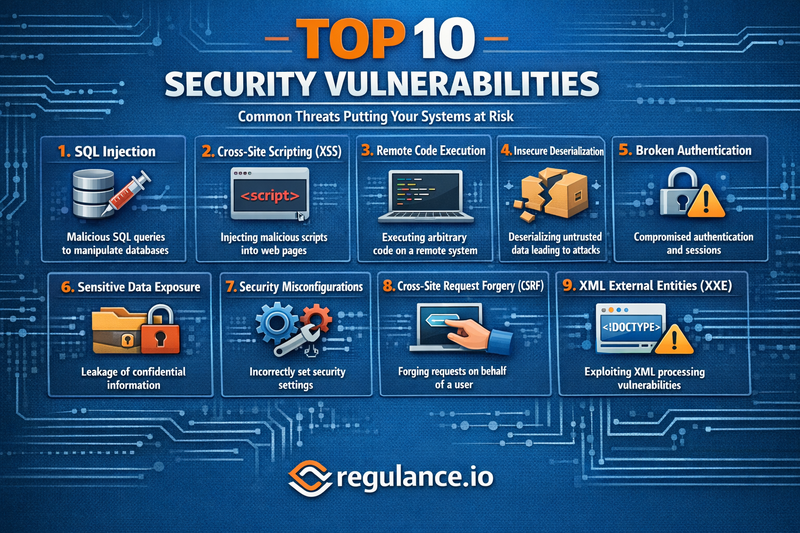
1. Injection Flaws (SQL, NoSQL, OS, and LDAP Injection)
Injection vulnerabilities occur when untrusted data gets sent to an interpreter as part of a command or query. SQL injection remains particularly devastating, allowing attackers to manipulate database queries to access, modify, or delete sensitive information. These attacks can expose customer data, financial records, and intellectual property with a single malicious input.
The danger lies in how common and impactful these vulnerabilities are. Attackers can bypass authentication, retrieve entire databases, or execute administrative operations on your systems. E-commerce sites, healthcare platforms, and financial applications are prime targets because they handle valuable data through database interactions.
Prevention requires treating all user input as potentially malicious. Implement parameterized queries, use prepared statements, validate and sanitize inputs, and employ least-privilege access controls for database accounts. Regular code reviews and automated security testing help identify injection points before attackers do.
2. Broken Authentication and Session Management
When authentication mechanisms are implemented incorrectly, attackers can compromise passwords, keys, session tokens, or exploit implementation flaws to assume other users' identities. This vulnerability encompasses weak password policies, predictable session IDs, exposed credentials, and improper session timeout configurations.
The consequences are severe: attackers gaining access to user accounts can steal personal information, conduct fraudulent transactions, or use compromised accounts as launching pads for broader attacks. High-profile breaches often trace back to broken authentication allowing initial access.
Strengthen authentication through multi-factor authentication (MFA), secure session management, strong password requirements, account lockout mechanisms, and regular credential rotation. Never store passwords in plain text, always use secure communication channels, and implement proper logout functionality across all sessions.
3. Sensitive Data Exposure
This vulnerability occurs when applications fail to adequately protect sensitive information like credit card numbers, health records, personal identification data, or authentication credentials. Data might be stored unencrypted, transmitted over insecure channels, or inadequately protected at rest.
Beyond regulatory penalties from GDPR, HIPAA, or PCI-DSS violations, data exposure destroys customer trust and brand reputation. The long-term business impact often exceeds immediate financial losses, as customers abandon platforms they no longer trust with their information.
Protect sensitive data through encryption at rest and in transit, secure key management, data classification policies, and minimization practices. Don't store data you don't need, apply encryption to backups, and ensure secure deletion of data no longer required. Regular audits help verify protection mechanisms remain effective.
4. XML External Entities (XXE)
XXE vulnerabilities emerge when XML processors parse external entity references within XML documents. Attackers exploit this to disclose internal files, execute remote requests, scan internal networks, or cause denial-of-service conditions. Many older XML processors are vulnerable by default.
While less publicized than other vulnerabilities, XXE can have devastating consequences. Attackers can retrieve sensitive configuration files, access cloud metadata services to steal credentials, or map your internal network infrastructure to plan sophisticated attacks.
Mitigation involves disabling XML external entity processing entirely when possible, using simpler data formats like JSON, keeping XML processors updated, implementing input validation, and using less complex data formats when XML isn't necessary. Static analysis tools can identify XXE vulnerabilities during development.
5. Broken Access Control
Access control vulnerabilities allow users to act outside their intended permissions. This includes viewing others' accounts, modifying data they shouldn't access, elevating privileges, or manipulating access control checks. Essentially, users can access resources or perform actions they're not authorized for.
These vulnerabilities enable horizontal privilege escalation (accessing other users' data) and vertical escalation (gaining administrative privileges). Attackers exploit broken access controls to access administrative functions, modify critical data, or steal information belonging to other users.
Implement robust authorization checks on every request, default to denying access, use centralized access control mechanisms, log access control failures, and regularly audit permissions. Never rely on client-side checks alone, and ensure access controls are consistently enforced across your entire application.
6. Security Misconfiguration
Security misconfiguration represents the most common vulnerability, occurring when security settings are incorrectly configured or left at insecure defaults. This includes unnecessary features enabled, default accounts unchanged, verbose error messages revealing sensitive information, or outdated software components.
The breadth of this vulnerability makes it particularly dangerous. Misconfiguration can occur at any level; application, framework, web server, database, cloud platform, or network. A single misconfigured setting can expose your entire infrastructure to attack.
Address misconfigurations through automated configuration management, secure baseline configurations, regular security audits, removal of unnecessary features and accounts, and keeping all components updated. Implement configuration as code, conduct security hardening, and regularly review cloud service configurations.
7. Cross-Site Scripting (XSS)
XSS vulnerabilities allow attackers to inject malicious scripts into web pages viewed by other users. These scripts execute in victims' browsers with the same privileges as the trusted site, enabling attackers to steal session cookies, redirect users to malicious sites, or modify page content.
Three types exist: stored XSS (permanently injected into the application), reflected XSS (immediately reflected back to users), and DOM-based XSS (occurring entirely client-side). All enable attackers to compromise user interactions with vulnerable applications.
Prevent XSS through proper output encoding, input validation, Content Security Policy headers, secure frameworks that automatically escape XSS, and treating all user input as untrusted. Modern frameworks provide built-in XSS protections, but developers must use them correctly.
8. Insecure Deserialization
Deserialization vulnerabilities occur when applications deserialize untrusted data without proper validation. Attackers can exploit this to execute remote code, perform injection attacks, or escalate privileges. This vulnerability is particularly dangerous because it often leads to complete system compromise.
The technical complexity makes insecure deserialization harder to exploit but no less dangerous. When successfully exploited, attackers gain the ability to execute arbitrary code on your servers, essentially taking complete control of vulnerable systems.
Mitigation strategies include avoiding deserialization of untrusted data, implementing integrity checks like digital signatures, isolating deserialization code in low-privilege environments, monitoring deserialization for anomalies, and restricting deserialization to specific allowed classes only.
9. Using Components with Known Vulnerabilities
Applications routinely incorporate third-party libraries, frameworks, and components. When these contain known vulnerabilities and aren't updated, your entire application becomes vulnerable. Attackers target these components because exploitation techniques are publicly documented.
The software supply chain creates cascading risks. A vulnerability in a widely-used component can affect thousands of applications simultaneously. Attackers increasingly target open-source libraries knowing that many organizations fail to keep dependencies updated.
Maintain an inventory of all components and versions, regularly scan for known vulnerabilities, remove unused dependencies, continuously monitor for security advisories, obtain components from official sources, and prefer components actively maintained with strong security track records.
10. Insufficient Logging and Monitoring
Without adequate logging and monitoring, organizations can't detect breaches in progress or investigate incidents after they occur. Attackers rely on this weakness, knowing that detection delays give them time to achieve objectives and cover their tracks.
Studies show that breaches often go undetected for months, allowing attackers prolonged access to sensitive systems. The longer attackers remain undetected, the more damage they inflict and the harder recovery becomes.
Implement comprehensive logging of authentication events, access control failures, input validation failures, and critical transactions. Establish effective monitoring and alerting, maintain tamper-proof log storage, develop incident response procedures, and conduct regular security reviews of logs for suspicious patterns.
Best Practices for Mitigating Security Vulnerabilities
Establish a Vulnerability Management Program
Create a structured, ongoing program rather than treating vulnerability management as a one-time effort. This includes regular vulnerability assessments, risk-based prioritization, defined remediation timelines, and tracking mechanisms. Assign clear ownership and accountability for vulnerability remediation across your organization.
Implement Defense in Depth
Layer security controls so that if one fails, others still provide protection. Combine network segmentation, firewalls, intrusion detection systems, endpoint protection, access controls, and encryption. This multilayered approach ensures no single vulnerability compromises your entire infrastructure.
Adopt Secure Development Practices
Integrate security throughout the software development lifecycle. Conduct threat modeling during design, perform security code reviews, implement automated security testing, and train developers in secure coding practices. Catching vulnerabilities during development costs exponentially less than fixing them in production.
Maintain a Robust Patch Management Process
Establish procedures for tracking, testing, and deploying security patches promptly. Prioritize patches based on vulnerability severity and asset criticality. Automate patching where possible while maintaining testing protocols to prevent disruption.
Conduct Regular Security Assessments
Perform periodic vulnerability scans, penetration testing, and security audits. Use both automated tools and manual testing to identify weaknesses. Engage third-party security experts for objective assessments and specialized expertise.
Implement Strong Access Controls
Follow least-privilege principles, implement role-based access control, enforce multi-factor authentication, regularly review and revoke unnecessary permissions, and monitor privileged account usage. Strong access controls limit the damage attackers can cause even if they gain initial access.
Educate and Train Your Team
Human error contributes to many security incidents. Provide regular security awareness training, conduct phishing simulations, establish clear security policies, and foster a security-conscious culture. Everyone in your organization plays a role in security.
Develop and Test Incident Response Plans
Prepare for inevitable security incidents with documented response procedures, defined roles and responsibilities, communication protocols, and recovery processes. Regularly test your incident response plan through tabletop exercises and simulations.
FAQs
How often should we scan for security vulnerabilities?
Continuous monitoring is ideal, but at minimum, conduct vulnerability scans monthly for external assets and quarterly for internal systems. High-risk assets should be scanned more frequently. Additionally, scan after any significant infrastructure changes, new deployments, or when critical vulnerabilities are announced publicly.
What's the difference between vulnerability assessment and penetration testing?
Vulnerability assessments identify and categorize known vulnerabilities in your systems using automated scanning tools. Penetration testing goes further, actively attempting to exploit vulnerabilities to determine actual risk and potential impact. Both are valuable: assessments provide breadth while penetration testing provides depth.
How do we prioritize which vulnerabilities to fix first?
Prioritize based on multiple factors: vulnerability severity (CVSS score), asset criticality, exploitability, exposure to the internet, availability of patches, and whether the vulnerability is actively being exploited. Critical vulnerabilities in internet-facing systems containing sensitive data should receive immediate attention.
Can we eliminate all security vulnerabilities?
No, complete elimination is impossible in complex systems. New vulnerabilities constantly emerge as software evolves and attackers discover novel exploitation techniques. The goal is maintaining a manageable risk level through continuous identification, assessment, and remediation of vulnerabilities.
What role does compliance play in vulnerability management?
Compliance frameworks like PCI-DSS, HIPAA, and GDPR mandate specific vulnerability management practices. While compliance shouldn't be your only motivation, these frameworks provide valuable baseline requirements. However, aim beyond compliance minimums, true security requires adapting to your specific threats.
How can small businesses with limited resources address security vulnerabilities?
Start with fundamentals: keep systems patched, use strong authentication, backup data regularly, and educate employees. Leverage cloud services that handle security at the infrastructure level. Consider managed security service providers for affordable expertise. Focus on protecting your most critical assets first.
What should we do if we discover a vulnerability being actively exploited?
Activate your incident response plan immediately. Contain the threat by isolating affected systems, assess the scope of compromise, preserve evidence for investigation, notify relevant stakeholders, and begin remediation. After containment, conduct thorough forensics to understand the full impact and prevent recurrence.
Conclusion
Addressing security vulnerabilities is essential for protecting your business's digital assets and ensuring long-term success. The top 10 vulnerabilities, including unpatched software, weak password policies, misconfigured security settings, insecure network protocols, and insufficient data encryption, represent significant threats that must be tackled proactively. By understanding these vulnerabilities and implementing best practices, organizations can enhance their security posture and reduce the risk of cyber threats.
Taking action against security threats requires a comprehensive approach that includes regular security assessments, robust patch management, strong access controls, and ongoing employee training. By staying informed about the latest security trends and continuously improving security measures, organizations can stay ahead of potential threats and protect their valuable data and resources. Prioritizing security is not just a technical necessity but a strategic imperative for ensuring business continuity and success in the digital age.
In today's interconnected world, the collective responsibility of organizations to address security vulnerabilities cannot be overstated. By working together to identify and mitigate potential threats, we can create a safer digital environment for everyone. Now is the time to take action and fortify your defenses against security vulnerabilities. Protect your assets, safeguard your data, and ensure the resilience of your business in the face of an ever-evolving threat landscape.
Partner with Regulance for Comprehensive Security Solutions. Contact Regulance today to schedule a comprehensive security assessment and take the first step toward a more secure future.