SOC 2 vs ISO 27001: Which Security Standard Fits Your Business?

Introduction
Data security has become both a technical requirement and a business imperative. As cyber threats grow more sophisticated and data breaches make headlines with alarming frequency, businesses face mounting pressure to prove they take security seriously. If you're a SaaS startup courting enterprise clients or an established company expanding into international markets, security certifications have become the golden tickets that open doors to new opportunities.
But here's where things get complicated: not all security standards are created equal. Two frameworks dominate the conversation; SOC 2 and ISO 27001. Both promise to strengthen your security posture, both require significant investment, and both signal to customers that you're serious about protecting their data. Yet they're fundamentally different in their approach, scope, and the doors they open.
Choosing between SOC 2 and ISO 27001 isn't a decision to take lightly. The wrong choice could mean wasting resources on a certification that doesn't serve your business goals, or worse, missing out on crucial market opportunities because you lack the credentials your prospects demand. Some businesses even find themselves needing both, doubling their compliance workload.
This article cuts through the confusion. We'll explore what each standard entails, dissect their key differences, examine the tangible benefits they offer, and help you determine which path or paths make sense for your business.
What is SOC 2?
SOC 2, which stands for Service Organization Control 2, is an auditing framework developed by the American Institute of Certified Public Accountants (AICPA). Unlike prescriptive security standards that tell you exactly what controls to implement, SOC 2 takes a principles-based approach, focusing on how well your organization protects customer data based on five trust service criteria.
These five criteria; security, availability, processing integrity, confidentiality, and privacy form the foundation of SOC 2 compliance. While security is mandatory for all SOC 2 audits, the other four criteria are optional and should be selected based on the services your organization provides. For instance, a cloud hosting provider would likely include availability, while a payment processor might emphasize processing integrity.
SOC 2 comes in two types: Type I and Type II. A SOC 2 Type I report provides a snapshot, verifying that your controls are properly designed at a specific point in time. Type II goes much deeper, examining whether those controls operated effectively over a period, typically six to twelve months. Most customers and partners consider Type II the gold standard, as it demonstrates sustained commitment rather than a one-time effort.
What makes SOC 2 particularly relevant is its focus on service providers especially technology and cloud computing companies that handle customer data. If you're a SaaS company, cloud service provider, data center, or any business that stores, processes, or transmits customer information, SOC 2 is likely on your radar. It's become almost mandatory for B2B tech companies seeking enterprise clients, as procurement teams regularly request SOC 2 reports before signing contracts.
What is ISO 27001?
ISO 27001 is an international standard for information security management systems (ISMS), published by the International Organization for Standardization (ISO) and the International Electrotechnical Commission (IEC). Unlike SOC 2's principles-based approach, ISO 27001 provides a structured framework for establishing, implementing, maintaining, and continually improving an organization's information security management system.
ISO 27001 requires organizations to take a systematic approach to managing sensitive information. This means identifying information security risks, implementing appropriate controls to mitigate those risks, and regularly reviewing and updating security measures to address evolving threats. The standard encompasses people, processes, and technology, ensuring a holistic approach to information security.
ISO 27001 includes Annex A, which lists 93 controls across four themes: organizational controls, people controls, physical controls, and technological controls. These controls cover everything from access management and cryptography to supplier relationships and incident management. However, not every organization needs to implement all 93 controls, you're required to assess which controls are applicable based on your risk assessment and document why you've excluded any deemed unnecessary.
What sets ISO 27001 apart is its international recognition and applicability across industries. Whether you're in healthcare, finance, manufacturing, retail, or technology, ISO 27001 provides a universally understood security framework. This makes it particularly valuable for organizations with global operations or those serving international markets, especially in Europe where ISO standards carry significant weight.
The standard also emphasizes continuous improvement through the Plan-Do-Check-Act cycle, meaning information security isn't a one-time project but an ongoing commitment embedded in your organizational culture.
Key Differences Between SOC 2 and ISO 27001
While both SOC 2 and ISO 27001 aim to improve information security, they differ significantly in origin, scope, audience, and implementation approach. Understanding these differences is crucial for making the right choice for your business.
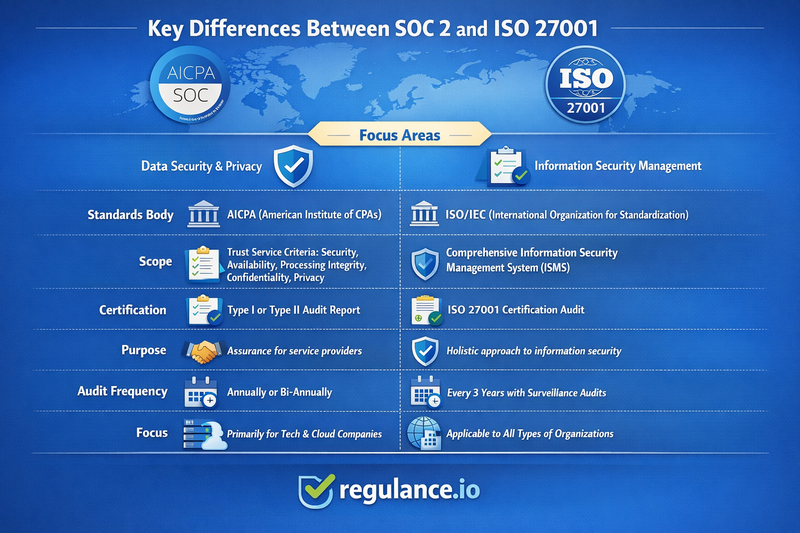
Geographic Origin and Recognition: SOC 2 is an American standard created by the AICPA and holds particular weight in North American markets. ISO 27001, conversely, is an international standard recognized globally, with especially strong acceptance in Europe, Asia, and other international markets. If your primary customer base is in the United States, SOC 2 might carry more weight, while ISO 27001 opens doors in global markets.
Audit Approach: SOC 2 follows an attestation model where an independent CPA firm examines your controls and issues a report describing their findings. This report is typically shared confidentially with customers under NDA. ISO 27001 uses a certification model where an accredited certification body audits your ISMS and issues a certificate that's publicly verifiable and can be displayed openly.
Prescriptive vs. Principles-Based: ISO 27001 is more prescriptive, requiring specific elements like documented risk assessments, statement of applicability, and defined ISMS scope. SOC 2 is principles-based, giving organizations flexibility in how they meet the trust service criteria. This means ISO 27001 provides clearer guidance on what to implement, while SOC 2 allows more customization based on your specific risks.
Scope and Focus: SOC 2 focuses specifically on service organizations that handle customer data, emphasizing the five trust service criteria. ISO 27001 has broader applicability across all types of organizations and addresses information security holistically, covering internal operations as well as customer-facing services.
Reporting and Transparency: SOC 2 reports are detailed documents (often 50-100+ pages) that describe your controls in depth and are shared privately. ISO 27001 certification is a binary outcome, you're either certified or not with the certificate publicly verifiable but without detailed public disclosure of specific controls.
Validity and Maintenance: SOC 2 reports are point-in-time (Type I) or cover a specific period (Type II), typically requiring annual renewals. ISO 27001 certification lasts three years with annual surveillance audits, though the ISMS itself requires continuous operation and improvement.
Cost and Timeline: SOC 2 audits often cost between $20,000-$100,000+ depending on scope and company size, with timelines of 3-6 months for initial readiness. ISO 27001 certification typically ranges from $30,000-$150,000+ including consultant fees, with 6-12 months for implementation and certification.
Benefits of SOC 2 Compliance
Pursuing SOC 2 compliance delivers tangible benefits that extend far beyond checking a box on a customer's security questionnaire. For many organizations, particularly in the technology sector, SOC 2 has become a business enabler rather than merely a compliance burden.
Unlocking Enterprise Sales: Perhaps the most immediate benefit is access to enterprise customers. Large organizations increasingly require SOC 2 reports before signing contracts with service providers. Without this certification, your sales team faces immediate disqualification from major deals, regardless of how strong your product is. SOC 2 compliance removes this barrier and signals that you're a serious, trustworthy partner.
Competitive Differentiation: In crowded markets, SOC 2 compliance sets you apart from competitors who lack formal security validation. It demonstrates maturity and commitment to security that can tip the scales when prospects evaluate similar solutions. This is particularly valuable for startups competing against established players or trying to move upmarket.
Streamlined Due Diligence: Customer security assessments and vendor questionnaires are time-consuming for both parties. A comprehensive SOC 2 Type II report answers most security questions upfront, dramatically shortening sales cycles. Instead of responding to hundreds of security questions for each prospect, you can share your report and move forward faster.
Improved Security Posture: The process of achieving SOC 2 compliance forces you to identify gaps in your security controls, implement necessary improvements, and document your processes. Many organizations discover vulnerabilities they didn't know existed and implement security measures they should have had all along.
Operational Efficiency: SOC 2 compliance requires documenting policies, procedures, and controls. This documentation becomes an operational asset, making onboarding new team members easier, ensuring consistency in security practices, and providing clear guidance when questions arise. What starts as a compliance exercise often evolves into valuable operational infrastructure.
Risk Management and Insurance: Demonstrating robust security controls through SOC 2 compliance can lead to better terms on cyber insurance policies and potentially lower premiums. Insurers view SOC 2-compliant organizations as lower-risk, recognizing that formal controls reduce the likelihood of costly breaches.
Building Trust and Brand Reputation: In an era of frequent data breaches, SOC 2 compliance signals to customers that you take data protection seriously. This builds trust and protects your brand reputation. Should a security incident occur, having SOC 2 compliance demonstrates you had reasonable controls in place, potentially reducing reputational and legal consequences.
Benefits of ISO 27001 Certification
ISO 27001 certification offers a distinct set of advantages, particularly for organizations with international ambitions or those operating in highly regulated industries. The benefits extend across commercial, operational, and strategic dimensions.
Global Market Access: ISO 27001's international recognition opens doors in markets where this certification is expected or even mandated. European organizations, in particular, often require their vendors to hold ISO 27001 certification. For businesses expanding internationally, this certification eliminates a significant barrier to entry and demonstrates commitment to globally recognized security standards.
Regulatory Alignment: ISO 27001 aligns well with various regulatory requirements including GDPR, HIPAA, and other data protection regulations. While certification doesn't automatically ensure regulatory compliance, it establishes a foundation of controls that satisfy many regulatory requirements. This can simplify compliance efforts and demonstrate due diligence to regulators.
Comprehensive Security Framework: Unlike narrower compliance frameworks, ISO 27001 addresses information security holistically. The standard covers not just IT security but also physical security, human resources security, supplier relationships, business continuity, and more. This comprehensive approach ensures no aspect of information security falls through the cracks.
Continuous Improvement Culture: ISO 27001's emphasis on the Plan-Do-Check-Act cycle embeds security into your organizational DNA. Rather than treating security as a one-time project, the standard requires ongoing risk assessments, management reviews, and continuous improvement. This creates a security-conscious culture that adapts to evolving threats.
Third-Party Risk Management: As businesses increasingly rely on vendors and partners, managing third-party risk becomes critical. ISO 27001 includes specific controls for supplier relationships and service delivery management, helping you ensure your supply chain meets appropriate security standards. When your organization is ISO 27001 certified, you also become a more attractive partner to other certified organizations.
Legal and Contractual Requirements: Some industries and contracts specifically require ISO 27001 certification. Government contracts, particularly outside the United States, frequently mandate this certification. Having it in place positions your organization to pursue opportunities that would otherwise be inaccessible.
Demonstrable Due Diligence: In the event of a security incident or breach, ISO 27001 certification demonstrates that your organization exercised reasonable care and due diligence in protecting information. This can be valuable in legal contexts, potentially reducing liability and demonstrating good faith efforts to secure data.
Internal Process Improvement: The discipline required to achieve and maintain ISO 27001 certification drives process maturity across the organization. Policies become formalized, responsibilities are clearly defined, and decision-making processes are documented. These improvements often deliver benefits beyond security, enhancing overall operational effectiveness.
Brand Value and Marketing: The ability to display the ISO 27001 certification logo on your website, marketing materials, and proposals carries significant marketing value. It's a universally recognized symbol of security commitment that enhances brand perception and builds customer confidence.
Which Compliance Standard is Right for Your Business?
Selecting between SOC 2 and ISO 27001 or deciding whether you need both depends on multiple factors including your target market, business model, resources, and strategic objectives. There's no universally correct answer, but these considerations will guide your decision.
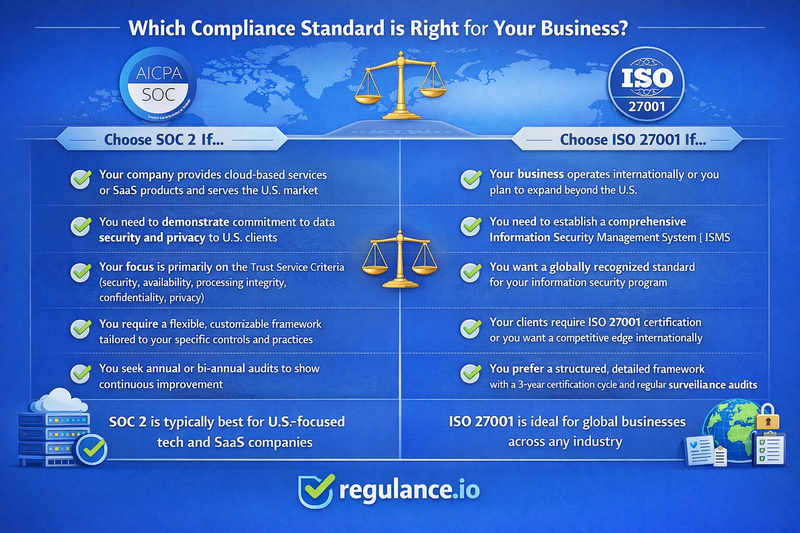
Consider SOC 2 if: Your primary market is North America, particularly if you're targeting US-based enterprise customers. If you're a SaaS company, cloud service provider, or technology firm selling to businesses, SOC 2 is likely expected by your prospects. It's especially critical if you're encountering SOC 2 requirements during enterprise sales processes. SOC 2 is also more appropriate if you want flexibility in designing controls specific to your services and risks, rather than following a more prescriptive framework.
Consider ISO 27001 if: You operate in international markets or plan to expand globally, particularly in Europe, Asia-Pacific, or markets where ISO standards carry significant weight. If your customers or contracts specifically require ISO 27001 certification, the choice is clear. Organizations in highly regulated industries, especially those dealing with government contracts often benefit more from ISO 27001's comprehensive approach. It's also advantageous if you want a public certification you can promote openly rather than sharing confidential reports under NDA.
Consider Both if: You're serving diverse markets with different expectations. Many global technology companies maintain both SOC 2 and ISO 27001 to satisfy the full spectrum of customer requirements. While this requires significant investment, it eliminates barriers in virtually any market. If you're pursuing enterprise customers in North America while also expanding internationally, dual compliance may become necessary.
Resource Considerations: Evaluate your organization's current security maturity and available resources. If you're starting from a lower baseline, SOC 2 might provide a more tailored pathway to implementing essential controls. If you prefer clear prescriptive guidance on what to implement, ISO 27001's comprehensive control set may be easier to follow. Consider available budget, personnel bandwidth, and timeline; rushing either certification is costly and can lead to superficial compliance that doesn't genuinely improve security.
Industry Norms: Research what competitors and industry leaders in your space have pursued. If all your competitors hold SOC 2 reports, lacking one puts you at a disadvantage regardless of whether you have ISO 27001. Conversely, if your industry standard is ISO 27001, particularly in sectors like manufacturing, logistics, or international finance, that's likely the path to take.
Customer Requirements: Talk directly to your customers, prospects, and sales team. What do they actually ask for? What certifications do they value? Sometimes the answer becomes clear when you realize 80% of your opportunities require one specific certification. Customer requirements often trump theoretical advantages of either framework.
Long-term Strategy: Think beyond immediate needs. Where will your business be in three to five years? If international expansion is on the horizon, investing in ISO 27001 now might save the effort of pursuing it later. If you're focused on dominating the North American market, SOC 2 should be the priority.
Complementary Approaches: Remember that SOC 2 and ISO 27001 aren't mutually exclusive, they're complementary. Many organizations start with whichever certification addresses their most pressing market need, then pursue the second as they grow. The work done for one certification often accelerates achieving the other, as many controls and processes overlap.
Steps to Achieve SOC 2 Compliance
Achieving SOC 2 compliance requires systematic planning, dedicated resources, and sustained effort. While each organization's journey is unique, these steps provide a roadmap for successful certification.
Step 1: Determine Your Scope and Trust Service Criteria: Begin by defining what systems, processes, and data will be included in your SOC 2 audit. Will you include only your production environment, or also development and staging? Which of the five trust service criteria; security, availability, processing integrity, confidentiality, and privacy apply to your services? Security is always required, but select additional criteria based on the promises you make to customers. This scope definition shapes everything that follows.
Step 2: Conduct a Gap Assessment: Evaluate your current security posture against SOC 2 requirements. This typically involves reviewing existing policies, technical controls, and operational procedures to identify gaps. Many organizations engage consultants for this assessment to ensure nothing is missed and to get realistic estimates of the work required. The gap assessment becomes your roadmap, prioritizing which areas need immediate attention.
Step 3: Design and Implement Controls: Based on your gap assessment, design controls that address identified weaknesses. This might include implementing new technical controls like multi-factor authentication or encryption, developing policies and procedures, establishing monitoring and logging practices, or creating vendor management processes. Document everything, SOC 2 auditors will want to see evidence that controls are not only implemented but also documented and communicated to relevant personnel.
Step 4: Establish Policies and Procedures: SOC 2 requires comprehensive documentation including information security policies, acceptable use policies, incident response procedures, change management processes, and business continuity plans. These documents must be more than shelf-ware; they should reflect how your organization actually operates. Ensure all policies are reviewed, approved by appropriate leadership, and communicated to employees.
Step 5: Operate Controls Consistently: For SOC 2 Type II (which most organizations pursue), you must demonstrate that controls operated effectively over time typically six to twelve months. This means consistently following your documented procedures, maintaining evidence of control operation, and addressing any exceptions or deviations. Create a compliance calendar to ensure regular activities like access reviews, vulnerability scans, and security training occur as scheduled.
Step 6: Select an Auditor: Choose a CPA firm experienced with SOC 2 audits, preferably one familiar with your industry. Get recommendations from peers, interview multiple firms, and ensure they understand your business model. The auditor becomes a partner in this process, so chemistry and communication matter. Lock in your auditor early, good firms book out months in advance.
Step 7: Prepare for the Readiness Assessment: Many organizations conduct a readiness assessment with their auditor before the official audit. This pre-audit identifies any remaining gaps or concerns, giving you time to address them before the formal examination. While optional, readiness assessments significantly increase the likelihood of a clean audit and can save time and money in the long run.
Step 8: Complete the Official Audit: During the official audit, your auditor will review documentation, interview personnel, observe processes, and examine evidence of control operation. Be prepared to provide extensive documentation demonstrating how controls functioned throughout the audit period. The audit typically takes several weeks, with the auditor requesting samples of various activities, reviewing system configurations, and testing controls.
Step 9: Remediate Findings: If the auditor identifies control deficiencies or exceptions, you'll need to remediate these issues. Depending on severity, remediation might delay receiving your final report. Work closely with your auditor to understand findings and implement appropriate corrective actions. Document all remediation efforts thoroughly.
Step 10: Maintain Compliance: Receiving your SOC 2 report is the starting line for continuous compliance. Continue operating controls consistently, collect evidence, and prepare for annual reaudits. Many organizations implement GRC (Governance, Risk, and Compliance) tools to automate evidence collection and streamline ongoing compliance activities.
Steps to Achieve ISO 27001 Certification
ISO 27001 certification follows a structured implementation and audit process. While the path requires significant effort, breaking it into clear phases makes the journey manageable.
Step 1: Secure Leadership Commitment and Define Scope: ISO 27001 requires top management commitment. Secure executive sponsorship and allocate necessary resources. Define your ISMS scope by determining which parts of your organization, which locations, which systems, and which information assets will be covered. Document the scope clearly, as this becomes the foundation for your certification.
Step 2: Establish Your Information Security Management System: Develop your ISMS framework including information security policies, objectives, roles and responsibilities, and governance structures. Appoint an ISMS manager or team responsible for implementation and maintenance. Create an information security policy approved by top management that establishes your organization's commitment and approach to information security.
Step 3: Conduct Risk Assessment and Treatment: ISO 27001 requires a systematic risk assessment identifying threats to information assets, evaluating vulnerabilities, assessing likelihood and impact, and determining risk levels. Document your risk assessment methodology and apply it consistently. Based on identified risks, determine risk treatment options,implement controls to mitigate risks, accept certain risks, avoid activities creating specific risks, or transfer risks through insurance or contracts. Document all decisions in a Risk Treatment Plan.
Step 4: Create Statement of Applicability (SoA): The SoA is a critical document listing all 93 controls from Annex A and indicating which are applicable to your organization based on your risk assessment. For each control, document whether it's included or excluded and justify your decision. For included controls, describe how you implement each one. This document demonstrates that you've considered all potential controls and made informed decisions about which to implement.
Step 5: Implement Controls and Develop Documentation: Based on your SoA, implement the selected controls. This includes technical controls like access management, encryption, and network security, as well as organizational controls like security training, vendor management, and incident response. Develop required documentation including policies, procedures, work instructions, and forms. ISO 27001 requires documented information for control operation and evidence of results.
Step 6: Conduct Security Awareness Training: Ensure all personnel understand their information security responsibilities through comprehensive security awareness training. Document training delivery, attendance, and effectiveness. ISO 27001 requires demonstrating that people are competent to perform security-related tasks and aware of their contributions to ISMS effectiveness.
Step 7: Operate Your ISMS: Run your ISMS for several months before pursuing certification, allowing controls to operate and generating evidence of effectiveness. Conduct internal audits to verify that your ISMS conforms to ISO 27001 requirements. Hold management reviews where top management evaluates ISMS performance, identifies improvement opportunities, and makes strategic decisions about information security. Document all ISMS activities, control operations, incidents, and changes.
Step 8: Select a Certification Body: Choose an accredited certification body recognized by appropriate accreditation organizations (like ANAB in the US or UKAS in the UK). Research certification bodies, compare costs and timelines, and ensure they have expertise in your industry. The certification body should be independent; they cannot provide consulting services for your implementation.
Step 9: Complete Stage 1 Audit: ISO 27001 certification involves a two-stage process. Stage 1 is a documentation review where auditors examine your ISMS documentation, verify that mandatory documents exist, and assess whether your ISMS is ready for Stage 2. Address any findings from Stage 1 before proceeding; significant gaps may delay your Stage 2 audit.
Step 10: Complete Stage 2 Audit: During Stage 2, auditors verify that your ISMS operates effectively in practice. They'll review evidence of control operation, interview personnel, observe processes, and test controls. The audit typically takes several days depending on your organization's size and complexity. Be prepared with evidence demonstrating how your ISMS has functioned over time.
Step 11: Address Non-Conformities and Obtain Certification: If auditors identify non-conformities (areas where your ISMS doesn't meet ISO 27001 requirements), you'll need to implement corrective actions. Once all non-conformities are resolved, the certification body issues your ISO 27001 certificate, valid for three years. Celebrate this achievement; it represents significant organizational commitment and effort.
Step 12: Maintain Certification Through Surveillance Audits: ISO 27001 requires annual surveillance audits during your three-year certification cycle. Continue operating your ISMS, conducting internal audits, holding management reviews, and continually improving your information security. Surveillance audits verify ongoing compliance and address any changes to your ISMS. At the end of three years, complete a recertification audit to renew your certificate.
FAQs
How long does it take to achieve SOC 2 compliance? The timeline varies based on your starting security posture, but most organizations should expect 3-6 months for initial preparation if they have reasonable security foundations in place. Organizations starting from scratch might need 6-12 months. For Type II reports, add another 6-12 months of operational history demonstrating consistent control operation.
Can a small business achieve ISO 27001 certification? Absolutely. ISO 27001 is designed to be scalable and applicable to organizations of any size. While the standard requires the same systematic approach regardless of company size, smaller organizations can implement proportionate controls that match their risk profile and complexity. Many small businesses successfully achieve certification, often with consultant support.
What does SOC 2 compliance cost? Costs vary widely depending on organization size, complexity, and scope. Expect audit fees ranging from $20,000 to $100,000+ annually. Additional costs include consultant fees ($15,000-$75,000+ for initial implementation), technology tools for compliance management ($5,000-$50,000+ annually), and internal resource time. Total first-year costs often range from $50,000 to $250,000+.
Is SOC 2 or ISO 27001 more difficult to achieve? Neither is inherently "easier"; they're different. SOC 2's flexibility can be a double-edged sword, requiring you to design appropriate controls without prescriptive guidance. ISO 27001's comprehensive control set provides clearer direction but requires implementing a more extensive ISMS. Organizations familiar with structured management systems may find ISO 27001 more straightforward, while those preferring flexibility may favor SOC 2.
Do I need both SOC 2 and ISO 27001? It depends on your market and customer requirements. Organizations serving primarily US-based enterprise customers often start with SOC 2. Those with international customers or specific ISO requirements pursue ISO 27001. Growing companies serving diverse markets may eventually need both. Evaluate your specific customer requirements and market positioning to make this decision.
How often do I need to renew these certifications? SOC 2 reports are typically renewed annually, though the audit period for Type II reports covers 6-12 months. ISO 27001 certification is valid for three years with mandatory annual surveillance audits. Both require continuous operation of security controls and ongoing compliance between audits.
Can I use the same controls for both SOC 2 and ISO 27001? Yes, many controls overlap between the two frameworks. Organizations pursuing both certifications often implement a unified control framework that satisfies both standards. However, each has unique requirements ; SOC 2's trust service criteria and ISO 27001's ISMS structure, so some distinct elements exist.
What happens if I fail a SOC 2 audit or ISO 27001 certification audit? For SOC 2, auditors typically identify exceptions or qualifications rather than outright "failures." Your report will describe these issues, and you'll need to remediate them for future audits. For ISO 27001, major non-conformities must be corrected before certification is granted. Both processes usually allow for remediation rather than immediate failure.
Conclusion
Choosing between SOC 2 and ISO 27001 involves aligning security compliance with your business strategy, market requirements, and organizational capabilities. Both frameworks deliver substantial value by strengthening security posture, building customer trust, and opening market opportunities.
SOC 2 excels for North American technology companies targeting enterprise customers, offering the flexibility to design controls matched to specific risks while meeting widely recognized US standards. ISO 27001 provides international credibility and comprehensive security management system structure, particularly valuable for global organizations or those in regulated industries.
The most successful approach starts with understanding your stakeholders' expectations, evaluating your resources honestly, and committing to genuine security improvement rather than mere compliance checkbox exercises. Whether you pursue SOC 2, ISO 27001, or both, the real value lies not in the certificate or report itself, but in the organizational maturity, process discipline, and security culture you build along the way.
Note that security compliance is a journey, not a destination. Markets evolve, threats change, and your organization grows, your compliance approach should evolve accordingly. Start with the framework that addresses your most pressing needs today, build a strong foundation, and expand your compliance program as your business grows.
Take the Next Step with Regulance
Ready to begin your compliance journey but unsure where to start? Regulance specializes in guiding organizations through SOC 2 and ISO 27001 certification processes, transforming compliance from an overwhelming challenge into a strategic advantage.
Contact us today to schedule a consultation and discover how we can help you choose the right path, implement effective controls, and achieve certification with confidence. Your security compliance journey starts here.