GDPR Compliance in 2026: What Do the New Rules Mean for Your Data Strategy?


Introduction
Eight years after the General Data Protection Regulation transformed how organizations worldwide handle personal data, GDPR compliance remains more critical. As we navigate through 2026, businesses face an increasingly complex privacy landscape where GDPR is a fundamental operational requirement that impacts everything from customer trust to competitive advantage.
With enforcement actions reaching record levels and consumer awareness at an all-time peak, organizations that view GDPR as merely a legal obligation are missing the bigger picture. Modern GDPR compliance has evolved into a strategic imperative that influences brand reputation, market access, and business sustainability. Whether you're a startup handling your first customer data or a multinational corporation managing millions of records, understanding the current state of GDPR compliance is essential for success in today's digital economy.
This comprehensive guide explores what GDPR compliance means in 2026, examines recent regulatory developments, addresses emerging challenges, and provides actionable insights to help your organization stay ahead of the curve.
What is GDPR?
The General Data Protection Regulation is the European Union's comprehensive data protection law that came into effect on May 25, 2018. At its core, GDPR establishes a framework for how organizations collect, process, store, and protect personal data of individuals within the European Economic Area. But GDPR's reach extends far beyond Europe's borders, applying to any organization worldwide that processes data of EU residents, regardless of where that organization is located.
Core Principles of GDPR:
GDPR is built on seven foundational principles that guide all data processing activities. Lawfulness, fairness, and transparency require organizations to process data legally, ethically, and openly. Purpose limitation means you can only collect data for specific, explicit purposes. Data minimization demands that you gather only what's necessary for those purposes. Accuracy requires keeping personal data correct and current. Storage limitation means retaining data only as long as needed. Integrity and confidentiality mandate appropriate security measures. Finally, accountability requires organizations to demonstrate compliance with all these principles.
Key Rights Under GDPR:
The regulation grants individuals substantial control over their personal information. The right to access allows people to know what data you hold about them. The right to rectification lets them correct inaccurate information. The right to erasure, often called the "right to be forgotten," enables data deletion under certain circumstances. The right to restrict processing allows individuals to limit how you use their data. Data portability gives people the ability to receive and transfer their data. The right to object lets individuals oppose certain types of processing, particularly for marketing purposes. Finally, rights related to automated decision-making protect people from solely automated profiling that significantly affects them.
Who Must Comply:
GDPR applies to data controllers who determine the purposes and means of processing personal data, as well as data processors who handle data on behalf of controllers. Whether you're an e-commerce business shipping products to Berlin, a SaaS company with European subscribers, or a marketing agency analyzing European consumer behavior, GDPR likely applies to your operations. The regulation's extraterritorial scope means geographic location doesn't exempt you from compliance obligations.
What Has Emerged Since 2024-2025?
The GDPR landscape has experienced significant evolution over the past two years, with regulatory authorities becoming increasingly sophisticated in their enforcement approaches and interpretation of the regulation.
Stricter Enforcement and Record Penalties:
European data protection authorities have demonstrated unprecedented vigor in GDPR enforcement throughout 2024 and 2025. Total fines levied during this period exceeded €4.5 billion, with several individual penalties surpassing the €1 billion mark. What's particularly notable is the shift toward penalizing fundamental compliance failures rather than just technical violations. Authorities are focusing on systemic issues such as inadequate data governance frameworks, insufficient consent mechanisms, and failures in vendor management. The message is clear: superficial compliance efforts no longer suffice.
AI and Automated Decision-Making Scrutiny:
The intersection of artificial intelligence and GDPR has emerged as a critical regulatory focus area. As organizations increasingly deploy AI systems for customer service, hiring, credit decisions, and personalized experiences, regulators have intensified scrutiny of these technologies. The European Data Protection Board issued comprehensive guidance in late 2024 clarifying how GDPR's provisions on automated decision-making and profiling apply to AI systems, including large language models and machine learning algorithms. Organizations using AI must now demonstrate transparent processing, provide meaningful information about the logic involved, and establish robust mechanisms for human oversight. The AI Act's implementation has further complicated this landscape, requiring organizations to navigate overlapping compliance obligations.
Enhanced Children's Data Protection:
Protecting children's privacy has become a top regulatory priority. Throughout 2024 and 2025, multiple jurisdictions introduced stricter requirements for verifying parental consent, limiting data collection from minors, and restricting targeted advertising to children. Several major technology platforms faced significant penalties for inadequately protecting children's data. Organizations targeting younger audiences or operating platforms accessible to minors must now implement age-appropriate design principles, strengthen age verification mechanisms, and severely limit data collection and processing activities involving children under 16.
Cross-Border Data Transfer Evolution:
The landscape for international data transfers has continued shifting. Following the adequacy decision for the EU-US Data Privacy Framework in 2023, organizations witnessed increased scrutiny of actual implementation rather than mere documentation. Regulators conducted targeted audits examining whether organizations genuinely implemented supplementary measures required under the Schrems II decision. Several companies faced enforcement actions for relying on standard contractual clauses without conducting proper transfer impact assessments. Meanwhile, new adequacy decisions expanded the list of approved countries, while political developments threatened existing arrangements with others.
Cookie Consent and Tracking Technologies:
Regulatory expectations around cookie consent have crystallized significantly. The "reject all" button is now effectively mandatory across EU member states, with authorities penalizing organizations that make refusing cookies more difficult than accepting them. Dark patterns in consent interfaces have come under particular scrutiny, with regulators challenging designs that nudge users toward data-sharing options. Cookie walls requiring consent as a condition for accessing services face increasingly hostile regulatory treatment. Organizations must ensure their consent mechanisms meet heightened standards for genuine choice, clear information, and easy revocation.
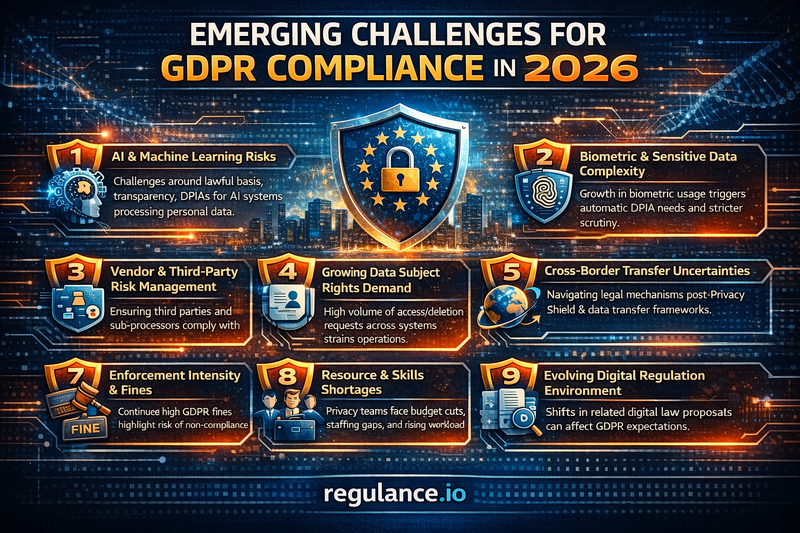
Emerging Challenges for GDPR Compliance in 2026
As GDPR compliance matures, organizations face increasingly sophisticated challenges that require strategic thinking and proactive approaches.
The AI Compliance Conundrum:
Artificial intelligence presents perhaps the most complex GDPR challenge today. Training large language models often involves processing vast datasets that may contain personal information, raising questions about lawful basis, data minimization, and purpose limitation. AI systems' inherent opacity conflicts with GDPR's transparency requirements and the right to explanation. Organizations deploying AI must grapple with how to conduct data protection impact assessments for systems whose behavior may be unpredictable, how to respond to access requests when data has been used for model training, and how to implement data deletion when information has been incorporated into model weights. The lack of clear regulatory guidance in many areas means organizations must make risk-based decisions with limited certainty about regulatory acceptance.
Vendor Ecosystem Management:
Modern businesses rely on complex networks of third-party vendors, creating significant GDPR compliance challenges. Organizations remain liable for their processors' data handling practices, yet many struggle to effectively oversee their vendor ecosystem. The challenge intensifies when vendors use sub-processors or when data flows through multiple jurisdictions. In 2026, regulators increasingly hold controllers accountable for their processors' failures, making vendor due diligence, contractual protections, and ongoing monitoring absolutely critical. Organizations must implement robust vendor management programs that include thorough initial assessments, comprehensive data processing agreements, regular audits, and clear procedures for addressing non-compliance.
Data Subject Rights at Scale:
As consumer awareness grows, organizations face increasing volumes of data subject requests that strain operational capacity. Responding to access requests becomes exponentially more complex when data is distributed across multiple systems, stored in various formats, and processed through numerous tools. The right to erasure poses technical challenges when data has been backed up, shared with third parties, or incorporated into AI systems. Organizations must balance fulfilling these rights promptly within GDPR's one-month deadline, with conducting necessary verification to prevent fraud and protecting others' rights. Building scalable, automated systems for managing data subject requests has become an operational necessity.
Privacy by Design in Legacy Systems:
Many organizations struggle to retrofit GDPR compliance into technology infrastructure built before privacy considerations were paramount. Legacy systems often lack the granularity needed for purpose limitation, the flexibility required for data minimization, or the technical capabilities necessary for timely deletion. Modernizing these systems requires significant investment and often involves complex migration projects that introduce their own risks. Organizations must prioritize which systems pose the greatest compliance risks, develop realistic remediation roadmaps, and implement compensating controls for systems that cannot be immediately upgraded.
Maintaining Consent Over Time:
GDPR requires that consent be freely given, specific, informed, and unambiguous and these standards have only become more stringent through enforcement actions. Organizations must now demonstrate not just that they obtained valid consent initially, but that they've maintained it appropriately over time. This includes refreshing consent when processing purposes change, making it easy for individuals to withdraw consent, and honoring withdrawal immediately. For businesses with large user bases and evolving offerings, maintaining compliant consent records has become a significant operational challenge requiring sophisticated consent management platforms and careful process design.
Cybersecurity and Breach Notification:
The 72-hour breach notification requirement continues to challenge organizations, particularly as cyberattacks grow more sophisticated. Determining whether a security incident constitutes a reportable breach, assessing risk to individuals' rights and freedoms, and notifying authorities within the required timeframe demands well-prepared incident response capabilities. Organizations must invest in security monitoring systems that enable rapid detection, establish clear internal escalation procedures, and develop relationships with data protection authorities before breaches occur. The increasing frequency of supply chain attacks adds complexity, as organizations must monitor not just their own systems but also those of critical vendors.
Metrics and KPIs for GDPR Compliance
Measuring GDPR compliance requires moving beyond binary "compliant or not" assessments to continuous monitoring of meaningful indicators that reveal program effectiveness.
Operational Metrics:
Tracking operational metrics provides insight into how well your compliance program functions daily. Monitor data subject request response time, aiming to respond within GDPR's one-month requirement but ideally much faster. Track the volume and types of requests you receive, as sudden increases may indicate issues with transparency or user experience. Measure your data breach detection and notification timeline, ensuring you can identify, assess, and report qualifying breaches within 72 hours. Calculate the percentage of third-party vendors with completed and current data processing agreements. Monitor the time required to onboard new vendors with appropriate privacy assessments. Track the percentage of new projects that complete data protection impact assessments before launch.
Awareness and Training Indicators:
Human factors remain critical to compliance success. Measure employee training completion rates, ensuring all staff receive baseline privacy training and those handling personal data receive role-specific instruction. Assess training effectiveness through testing rather than just tracking attendance. Monitor privacy-related incidents caused by employee error to identify training gaps. Track the number of privacy queries received by your data protection officer or privacy team, as this indicates employee awareness of when to seek guidance. Survey employees periodically to gauge their understanding of GDPR principles and organizational policies.
Technical Control Metrics:
Technical measures provide the foundation for GDPR compliance. Monitor the percentage of systems with data discovery and classification completed, enabling you to know what personal data you hold and where. Track encryption coverage for personal data at rest and in transit. Measure the percentage of applications implementing privacy by design principles from the development stage. Monitor backup and data retention practices, ensuring automated deletion aligns with retention schedules. Track the number of systems with appropriate access controls and the percentage of personal data accessible only to those with legitimate business needs.
Risk and Audit Findings:
Monitoring risk indicators helps prevent compliance issues before they become problems. Track the number of open privacy risk items and their average time to resolution. Monitor recurring audit findings, as repeated issues indicate systemic problems. Measure the percentage of high-risk processing activities with current data protection impact assessments. Track the number of data protection by design and by default requirements incorporated into technology procurement processes. Monitor the number of privacy incidents and near-misses, even those not rising to reportable breaches, as they reveal control weaknesses.
Stakeholder and Regulatory Metrics:
External perspectives provide valuable compliance insights. Track the number and nature of complaints received directly from individuals about data handling. Monitor data protection authority inquiries and the time required to respond. Measure customer trust metrics through surveys that include privacy-specific questions. Track media mentions and sentiment regarding your organization's privacy practices. Monitor privacy-related customer churn, particularly following changes to privacy policies or practices.
Compliance Program Maturity:
Beyond point-in-time metrics, assess your overall program maturity. Evaluate whether privacy considerations integrate into business decision-making or remain siloed within the legal or compliance function. Assess whether your organization views privacy as a risk management exercise or a trust-building opportunity. Monitor budget allocation to privacy initiatives relative to the organization's risk exposure. Track executive engagement with privacy topics, as leadership commitment directly influences program effectiveness.
GDPR and Global Privacy
GDPR's influence extends far beyond Europe's borders, shaping a complex global privacy landscape that organizations must navigate strategically.
The GDPR Ripple Effect:
GDPR has functioned as the template for privacy legislation worldwide, with dozens of countries adopting similar frameworks. Brazil's Lei Geral de Proteção de Dados (LGPD), South Africa's Protection of Personal Information Act (POPIA), and numerous other national laws draw heavily from GDPR's principles and structure. This convergence simplifies compliance for global organizations in some respects, as privacy programs built on GDPR foundations often address requirements in other jurisdictions. However, subtle differences between laws create complexity. Canada's PIPEDA emphasizes consent differently than GDPR, while California's CPRA includes unique requirements around sensitive personal information and risk assessments.
Navigating Diverging Requirements:
Despite broad alignment, meaningful differences exist between GDPR and other privacy frameworks that complicate global compliance. China's Personal Information Protection Law (PIPL) includes data localization requirements and government access provisions that differ substantially from GDPR. US state privacy laws vary significantly from each other and from GDPR in areas like private rights of action, applicability thresholds, and specific consumer rights. Organizations operating globally must map these differences carefully, determining where they can implement harmonized controls and where jurisdiction-specific approaches are necessary.
Strategic Approaches to Global Privacy:
Leading organizations adopt several strategies for managing global privacy compliance. Some implement GDPR as their baseline, applying its stringent requirements globally to simplify operations and position privacy as a competitive advantage. Others use a jurisdictional approach, tailoring practices to local requirements but maintaining common governance frameworks and technologies. Increasingly, companies adopt risk-based approaches that consider not just legal requirements but also cultural expectations, competitive dynamics, and stakeholder priorities in different markets.
Cross-Border Transfer Complexity:
International data transfers remain among the most complex aspects of global privacy compliance. GDPR's transfer restrictions interact with data localization requirements in countries like Russia, China, and India, creating scenarios where full compliance with all applicable laws may be impossible. Organizations must carefully map data flows, assess transfer mechanisms available under different frameworks, and potentially redesign processes to minimize international transfers. The patchwork of adequacy decisions, standard contractual clauses, binding corporate rules, and other transfer mechanisms requires sophisticated management to maintain both compliance and operational efficiency.
Preparing for Future Regulatory Developments:
The global privacy landscape continues evolving rapidly. Organizations should monitor legislative developments in key markets, participate in regulatory consultations where appropriate, and build flexibility into privacy programs to accommodate new requirements. Establishing relationships with privacy regulators in major markets, joining industry associations focused on privacy advocacy, and investing in adaptable privacy technologies position organizations to respond effectively as regulations evolve.
FAQs
How much can GDPR fines actually cost my organization?
GDPR fines can reach up to €20 million or 4% of annual global turnover, whichever is higher, for the most serious violations. For less severe infringements, the maximum is €10 million or 2% of turnover. Recent enforcement shows regulators increasingly impose fines at or near these maximums for systemic failures. Beyond monetary penalties, non-compliance can result in processing bans, mandated audits, reputational damage, and civil litigation. The true cost of non-compliance often far exceeds the direct fine amount.
Do small businesses need to comply with GDPR?
Yes, GDPR applies to organizations of all sizes if they process personal data of EU residents. However, the regulation incorporates proportionality, meaning expectations for a small business differ from those for multinational corporations. Small organizations may not need to appoint a dedicated data protection officer, conduct extensive impact assessments, or implement enterprise-grade systems. Nevertheless, they must understand what personal data they collect, have a lawful basis for processing, implement appropriate security, and respect data subject rights. Many small businesses benefit from using compliant third-party services rather than building custom privacy infrastructure.
How do I know if my organization needs a Data Protection Officer?
GDPR requires a DPO when: your core activities involve systematic and large-scale monitoring of individuals; your core activities involve large-scale processing of special categories of data or criminal conviction data; or you're a public authority or body. Even when not mandatory, appointing a DPO or privacy officer is advisable for organizations with significant data processing operations. The DPO serves as the point of contact with data protection authorities, monitors compliance, conducts training, and provides expert guidance on privacy matters.
What should I do if my organization experiences a data breach?
Immediately activate your incident response plan. Contain the breach and assess what personal data was affected, how many individuals, and what potential consequences they might face. If the breach poses a risk to individuals' rights and freedoms, notify your supervisory authority within 72 hours. If the risk is high, directly notify affected individuals without undue delay. Document everything about the breach, your investigation, and your response, as you'll need to demonstrate compliance with notification requirements. Use the breach as a learning opportunity to strengthen security controls and prevent recurrence.
Can I use Google Analytics, Facebook Pixel, and similar tools under GDPR?
Using these tools requires careful implementation to comply with GDPR. You need a valid lawful basis typically consent before activating tracking technologies. Your consent mechanism must meet GDPR standards: freely given, specific, informed, unambiguous, and easy to withdraw. Many organizations have faced enforcement actions for deploying these tools before obtaining valid consent or for transferring data to the US without appropriate safeguards. Consider privacy-friendly alternatives, implement tracking only after obtaining consent, configure tools to minimize data collection, and ensure appropriate transfer mechanisms are in place.
How long should we retain personal data?
GDPR requires retaining data only as long as necessary for the purposes for which it was collected. This varies by data type and processing purpose. Financial records may need retention for tax or regulatory reasons, often 6-10 years. Marketing data should be refreshed regularly, often annually, deleting data of individuals who haven't engaged. Employee records have specific retention requirements post-employment. Develop a data retention schedule that specifies retention periods for different data categories based on legal requirements, business needs, and privacy principles. Implement automated deletion where possible to ensure compliance.
Does GDPR apply if all my customers are outside the EU but I use EU-based servers?
Server location doesn't determine GDPR applicability; the location of data subjects does. If you don't process personal data of EU residents, GDPR doesn't apply, regardless of where your servers are located. However, if you later decide to target EU customers, you'll need to ensure compliance before processing their data. Note that "EU residents" includes temporary residents, so even occasional EU visitors to your website may trigger GDPR obligations if you process their personal data.
Conclusion
GDPR compliance in 2026 represents far more than avoiding fines. It's become a fundamental business practice that influences customer relationships, competitive positioning, and organizational resilience. As enforcement intensifies, technologies evolve, and consumer expectations rise, organizations that view privacy as a strategic asset rather than a compliance burden position themselves for sustainable success.
The challenges are AI integration, vendor management, cross-border data flows, and evolving regulatory expectations create complexity that can overwhelm resource-constrained teams. Yet these challenges also present opportunities. Organizations that embed privacy into their culture, invest in appropriate technologies and expertise, and genuinely respect individuals' data rights build trust that translates into customer loyalty and market differentiation.
Success requires moving beyond reactive compliance to proactive privacy governance. Establish clear accountability, measure meaningful metrics, invest in your people's privacy capabilities, and integrate privacy considerations into business decisions from the start. Whether you're just beginning your compliance journey or seeking to mature an established program, the key is continuous improvement guided by both regulatory requirements and ethical principles.
The GDPR landscape will continue evolving, with new enforcement priorities, regulatory guidance, and technological challenges emerging regularly. Organizations that build adaptable privacy programs grounded in fundamental principles rather than rigid checklists will navigate these changes most effectively.
Take Control of Your GDPR Compliance Journey with Regulance. Visit Regulance today to schedule a demo and discover how our privacy management platform can help your organization achieve and maintain GDPR compliance with confidence.