FOIA vs. GDPR: How Do They Work Together to Protect Information?


Introduction
Every day, organizations face a critical challenge that could make or break their operations: balancing the public's right to information with individuals' right to privacy. If you get it wrong, and you're looking at hefty fines, damaged reputation, and legal battles that drain resources and management attention.
The Freedom of Information Act (FOIA) and the General Data Protection Regulation (GDPR) sit at the heart of this challenge. FOIA opens the door to government transparency, giving citizens the power to request information from public authorities. GDPR slams that same door shut when personal data is at stake, protecting individuals from unauthorized disclosure of their information. When these two powerful frameworks collide, organizations must make split-second decisions that satisfy both legal requirements.
Understanding how FOIA and GDPR work together isn't optional anymore. Public authorities receive thousands of information requests annually, many containing personal data that triggers GDPR protections. Private companies contracting with government bodies find themselves caught in the crossfire. Even businesses not directly subject to FOIA need to understand these principles as data governance standards tighten globally.
GDPR violations can cost up to 20 million euros or four percent of global revenue. Mishandling FOIA requests damages public trust and invites regulatory scrutiny. Yet organizations that master this balance gain a competitive edge through superior data governance and stakeholder confidence.
This guide breaks down everything you need to know about FOIA and GDPR compliance, their critical intersection, and practical strategies for navigating both successfully.
What is FOIA?
The Freedom of Information Act, commonly known as FOIA, is legislation designed to promote transparency and accountability in government operations. While FOIA exists in various forms across different countries, the fundamental principle remains consistent: citizens have the right to access information held by public authorities.
In the United States, FOIA was enacted in 1966 and gives the public the right to request access to records from any federal agency. It operates on the principle that the government should be transparent and accountable to the people it serves. Every federal agency must disclose requested information unless it falls under one of nine exemptions, which protect interests such as national security, personal privacy, and law enforcement activities.
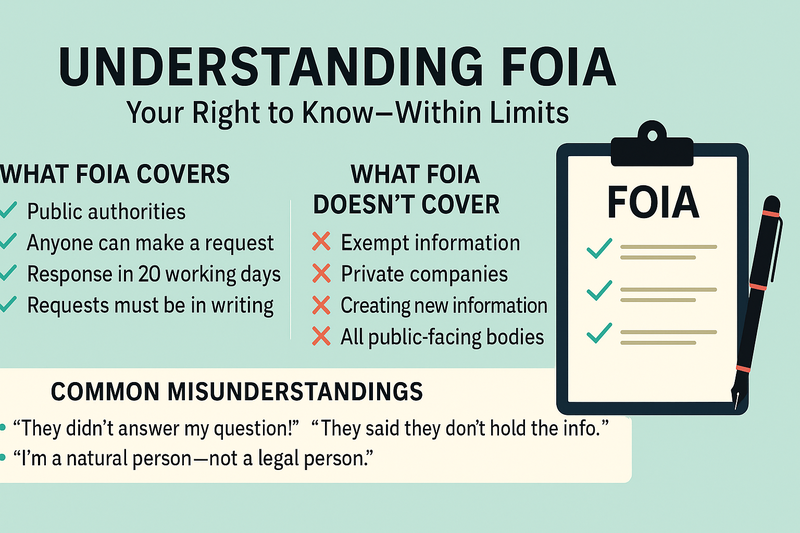
The UK has its own Freedom of Information Act 2000, which came into force in 2005. This legislation provides public access to information held by public authorities in England, Wales, and Northern Ireland. Scotland has separate but similar legislation through the Freedom of Information (Scotland) Act 2002. Under UK FOIA, any person can make a request for information, regardless of their nationality or location, and they don't need to explain why they want the information.
FOIA requests can cover virtually any topic. Citizens might request government spending records, environmental impact assessments, internal communications about policy decisions, or data about public services. The law empowers ordinary people to hold powerful institutions accountable by shining a light on how decisions are made and how public resources are used.
Public authorities must respond to FOIA requests within specific timeframes, typically 20 working days in the UK. If they refuse to provide information, they must cite a valid exemption and explain their reasoning. Requesters who are dissatisfied can appeal to independent bodies like the Information Commissioner's Office (ICO) in the UK or pursue legal remedies.
What is GDPR?
The General Data Protection Regulation (GDPR) represents one of the most comprehensive data protection frameworks in the world. Implemented on May 25, 2018, GDPR fundamentally changed how organizations must handle personal data for anyone in the European Union.
GDPR is about giving individuals control over their personal information. It establishes strict rules for collecting, storing, processing, and sharing personal data. Personal data under GDPR includes any information relating to an identified or identifiable person, from names and email addresses to IP addresses and biometric data.
GDPR operates on several key principles. Data must be processed lawfully, fairly, and transparently. Organizations can only collect data for specific, legitimate purposes and must limit collection to what's necessary. The data must be accurate and kept up to date, stored no longer than necessary, and protected with appropriate security measures. Crucially, organizations are accountable for demonstrating compliance with these principles.
The regulation grants individuals extensive rights over their data. These include the right to access their information, the right to correct inaccuracies, the right to erase (sometimes called the "right to be forgotten"), the right to restrict processing, the right to data portability, and the right to object to certain types of processing. Individuals also have rights regarding automated decision-making and profiling.
While GDPR is an EU regulation, its impact extends globally. Any organization that offers goods or services to people in the EU or monitors their behavior must comply, regardless of where the organization is based. This extraterritorial scope has made GDPR a de facto global standard for data protection.
The UK, following Brexit, has adopted UK GDPR, which mirrors the EU regulation but operates as domestic UK law. It works alongside the Data Protection Act 2018 to form the UK's data protection framework.
How Does the Freedom of Information Act Differ from the UK GDPR?
While both FOIA and GDPR deal with information rights, they serve fundamentally different purposes and sometimes pull in opposite directions. Understanding these differences is essential for organizations that must comply with both frameworks.
FOIA promotes transparency by granting access to information held by public bodies. Its primary goal is governmental accountability and ensuring that public authorities operate openly. GDPR, conversely, protects individual privacy by controlling how personal data is processed. Its focus is on protecting people's fundamental rights and freedoms regarding their personal information.
The scope of these regulations differs significantly. FOIA applies specifically to public authorities and certain bodies performing public functions. Private companies generally aren't subject to FOIA obligations unless they're contracted to provide public services. GDPR, however, applies to any organization processing personal data of individuals in the EU or UK, whether public or private, large or small.
Access rights work differently under each framework. Under FOIA, anyone can request any information held by a public authority without needing to justify their interest. Under GDPR, individuals can only access their own personal data, and they have a legitimate stake in that information.
The exemptions and protections also vary. FOIA includes exemptions for information that would prejudice law enforcement, national security, commercial interests, and personal data. GDPR provides detailed rules about lawful bases for processing and strict conditions under which personal data can be shared.
Timeframes for compliance differ too. FOIA requests must typically be answered within 20 working days in the UK. GDPR subject access requests must be fulfilled within one month, extendable by two additional months for complex requests.
Perhaps most importantly, these two frameworks can create tension. A FOIA request might seek information that contains personal data protected under GDPR. When this happens, public authorities must carefully balance transparency against privacy, applying exemptions appropriately to protect individuals while maximizing disclosure where possible.
How Does It Work?
Understanding how FOIA and GDPR operate in practice helps organizations prepare for compliance challenges. Let's explore the mechanics of each system and how they intersect.
The FOIA Process
When someone submits a FOIA request, they must provide enough detail for the public authority to identify the information sought. The request can be made in writing, including by email, and doesn't require any special format or mention of the Act itself.
Upon receiving a request, the public authority must confirm receipt and begin processing. They'll search for relevant information across their systems and consult with relevant departments or third parties who might be affected. The authority must then determine whether exemptions apply and conduct a public interest test where required. If withholding information, they must explain which exemptions they're relying on and why.
If the requested information contains personal data, authorities must consider GDPR before releasing it. They cannot disclose personal data unless they have a lawful basis under data protection law, which creates a built-in protection for privacy within the FOIA framework.
The GDPR Compliance Framework
GDPR compliance requires ongoing effort, not just one-time implementation. Organizations must establish lawful bases for all processing activities, typically consent, contractual necessity, legal obligation, vital interests, public tasks, or legitimate interests.
Data protection impact assessments (DPIAs) are required for processing that's likely to result in high risk to individuals' rights. Organizations must implement appropriate technical and organizational measures to ensure security, including encryption, pseudonymization, and access controls. They must also maintain detailed records of processing activities and appoint a Data Protection Officer (DPO) when required by the regulation.
When individuals exercise their GDPR rights, organizations must respond promptly and thoroughly. For subject access requests, they must provide a copy of all personal data being processed, information about the purposes of processing, the categories of data, recipients of the data, retention periods, and details about individuals' rights.
Where FOIA and GDPR Intersect
The intersection creates complexity. When a FOIA request seeks information that includes personal data, authorities must apply both frameworks simultaneously. They'll assess whether disclosure would breach GDPR principles and whether the personal data exemption under FOIA applies.
The ICO guidance emphasizes that personal data can sometimes be disclosed under FOIA if it's fair and lawful to do so. Factors to consider include whether the individual would reasonably expect disclosure, the nature of the information, the impact of disclosure, and whether legitimate interests in disclosure outweigh the individual's rights and freedoms.
This balancing act requires careful judgment. Organizations must document their reasoning, particularly when making decisions that could significantly impact individuals' privacy or the public's right to know.
Why Does It Matter in GDPR Compliance?
The relationship between FOIA and GDPR creates important implications for compliance that organizations cannot afford to ignore. Understanding why this intersection matters can prevent serious compliance failures and reputational damage.
Privacy Protection Within Transparency
GDPR fundamentally shapes how public authorities respond to FOIA requests. When someone requests information that contains personal data, GDPR acts as a critical safeguard. You cannot simply release personal information because someone asked for it. Each disclosure must meet GDPR's strict requirements for lawful processing.
This means that organizations subject to FOIA must build GDPR considerations into their transparency procedures from the ground up. Your FOIA response team needs GDPR expertise, and your data protection officers must understand FOIA obligations. Without this integrated approach, you risk either over-disclosing personal data in violation of GDPR or over-redacting information that could lawfully be released.
Legal Risk Management
Non-compliance with either framework carries serious consequences, but violating both simultaneously compounds your risk exponentially. Imagine releasing sensitive personal data in response to a FOIA request without proper GDPR authorization. You could face enforcement action from the ICO for the GDPR breach, complaints from affected individuals, potential litigation, and massive reputational damage.
Conversely, refusing a legitimate FOIA request by incorrectly claiming GDPR protection denies the public their transparency rights. This could result in ICO enforcement for FOIA non-compliance and damage public trust in your organization.
Understanding how these frameworks interact allows you to navigate this legal minefield confidently. You'll make defensible decisions that respect both transparency and privacy, backed by clear documentation of your reasoning.
Operational Excellence
Organizations that master the FOIA-GDPR intersection demonstrate sophisticated data governance. This mastery signals to regulators, stakeholders, and the public that you take your obligations seriously. It shows that you've invested in proper systems, training, and oversight.
This operational excellence pays dividends beyond compliance. When your teams understand how to balance competing legal requirements, they develop critical thinking skills that improve decision-making across the organization. Your information governance becomes more robust, your data management more disciplined, and your risk management more effective.
Accountability and Trust
Both FOIA and GDPR emphasize accountability. GDPR requires you to demonstrate compliance through documentation, policies, and practices. FOIA requires you to justify decisions about what to disclose and what to withhold. Together, they create a culture of accountability where decisions about information are made carefully and can withstand scrutiny.
This accountability builds trust. When citizens see that public authorities take both transparency and privacy seriously, they gain confidence in how their data is handled and how public institutions operate. For private organizations handling public contracts or working with public sector partners, demonstrating this dual competence is increasingly important for winning and maintaining business.
Why Is It Important in Your Business?
Even if your business isn't directly subject to FOIA, understanding its interaction with GDPR matters more than you might think. The principles underlying these frameworks affect how you should approach data governance and stakeholder relationships.
Public Sector Partnerships
If you contract with government agencies or public bodies, you're operating in the FOIA environment even as a private entity. Your contracts likely contain clauses about responding to FOIA requests related to the partnership. You might be asked to provide information that ends up being disclosed under FOIA, or you might need to justify why certain commercial information should remain confidential.
Understanding GDPR's role in FOIA compliance helps you protect sensitive information legitimately while supporting your public sector partners' transparency obligations. You'll know when to claim legitimate confidentiality and when disclosure is unavoidable, allowing you to structure contracts and information sharing accordingly.
Data Governance Best Practices
The FOIA-GDPR intersection exemplifies sophisticated data governance. It requires clear policies about what information exists, where it's stored, who has access, and under what circumstances it can be shared. These same principles benefit any organization, regardless of FOIA obligations.
By studying how public authorities balance transparency and privacy, private businesses can improve their own data governance. You'll develop better classification systems, clearer access controls, and more thoughtful information-sharing protocols. These improvements reduce risks across the board, from data breaches to regulatory violations to litigation exposure.
Transparency as Competitive Advantage
Modern consumers and business partners increasingly value transparency. They want to know how you use their data, what you do with their information, and how your organization operates. While you're not legally required to embrace FOIA-style transparency, doing so voluntarily can differentiate you in crowded markets.
Organizations that proactively disclose information about their practices, within GDPR constraints, build stronger relationships with stakeholders. You demonstrate that you have nothing to hide and that you respect people's right to understand how you operate. This transparency, balanced with appropriate privacy protection, creates trust that translates into customer loyalty and business success.
Regulatory Trend Awareness
GDPR represented a massive shift toward stronger data protection. FOIA embodies the parallel trend toward greater transparency. These aren't isolated regulatory quirks; they reflect fundamental societal expectations about how organizations should handle information.
By understanding both frameworks and their interaction, you position your business ahead of regulatory trends. You'll be prepared for new transparency requirements that may emerge in your sector. You'll have systems in place that can adapt to evolving data protection standards. This forward-thinking approach prevents the costly scramble that many organizations face when new regulations take effect.
Risk Mitigation in the Digital Age
We live in an era where information leaks are common, where social media amplifies every controversy, and where reputational damage spreads instantly. Organizations that understand both transparency obligations and privacy requirements are better equipped to navigate this environment.
When you have clear policies about what information can be shared and what must be protected, your teams make better decisions under pressure. When a journalist requests information, when a customer demands their data, or when a mistake occurs, your people know how to respond appropriately. This preparedness prevents the panicked responses that turn manageable situations into crises.
What Are the Consequences of Non-Compliance?
The stakes for getting FOIA and GDPR compliance wrong are substantial. Understanding the potential consequences should motivate organizations to invest in proper compliance frameworks and ongoing vigilance.
Financial Penalties
GDPR violations can result in severe financial penalties. The regulation allows fines up to 20 million euros or four percent of annual global turnover, whichever is higher. These aren't theoretical maximums; regulators have imposed substantial fines on organizations that failed to protect personal data adequately. Major companies have faced penalties in the hundreds of millions of euros for serious violations.
While FOIA itself doesn't carry direct financial penalties in the same way, non-compliance can lead to enforcement action by the Information Commissioner's Office. The ICO can issue enforcement notices requiring organizations to take specific steps to comply. Failure to comply with these notices can result in contempt of court proceedings and potential criminal prosecution.
Moreover, violating GDPR while responding to FOIA requests exposes you to the full weight of GDPR penalties. If you disclose personal data unlawfully in response to a transparency request, you've committed a data protection violation that could trigger maximum fines.
Legal Action and Compensation Claims
Individuals whose personal data is mishandled can bring legal action against organizations. Under GDPR, individuals have the right to compensation for material or non-material damage resulting from data protection violations. Courts have awarded damages for distress, loss of control over personal data, and other harms.
If personal data is disclosed inappropriately through a FOIA response, affected individuals might sue for privacy violations, data protection breaches, or other legal theories depending on the nature of the information and harm caused. These lawsuits can be costly to defend and may result in significant compensation awards.
Class actions and group litigation add another dimension of risk. When a single compliance failure affects many individuals, you could face coordinated legal action from hundreds or thousands of people, multiplying your potential liability.
Regulatory Enforcement and Oversight
Beyond financial penalties, regulatory enforcement can significantly disrupt business operations. The ICO has extensive powers, including conducting audits, requiring detailed reports, and imposing conditions on how you process data. Being under regulatory investigation consumes management time, requires expensive legal counsel, and distracts from core business activities.
For serious or repeated violations, regulators can order organizations to cease certain processing activities or impose operational restrictions. Imagine being prohibited from certain marketing activities, data analytics, or other data-driven operations critical to your business model. The business impact could far exceed any financial penalty.
Regulatory enforcement also becomes public, damaging your reputation and creating a permanent record of non-compliance that affects future business opportunities.
Reputational Damage
In many ways, reputational consequences exceed legal and financial penalties. When organizations mishandle personal data or inappropriately withhold information from the public, news spreads quickly. Media coverage of data breaches, privacy violations, or transparency failures can permanently damage how customers, partners, investors, and employees view your organization.
Trust, once lost, is extraordinarily difficult to rebuild. Customers may take their business elsewhere. Talented employees might seek opportunities with organizations that have better reputations. Investors could demand leadership changes or divest from your organization. Business partners might reconsider their relationships.
For public authorities, reputational damage undermines democratic legitimacy and public confidence in government institutions. For private companies, it directly affects the bottom line through lost customers and reduced market value.
Operational Disruption
Compliance failures trigger internal chaos. You'll need to conduct extensive investigations to understand what happened, implement remedial measures, notify affected individuals, coordinate with regulators, and potentially offer remedies like credit monitoring or compensation.
These activities consume enormous resources. Your teams will be pulled from normal responsibilities to manage the crisis. You may need to hire external consultants and legal advisors. Systems may need to be taken offline for investigation or remediation. Business operations can grind to a halt while you address the compliance failure.
The disruption continues long after the initial incident. You'll implement new controls, revise policies, retrain staff, and rebuild systems. These necessary improvements, while ultimately beneficial, represent unplanned costs and operational challenges that could have been avoided with proper compliance from the start.
Criminal Liability in Extreme Cases
While rare, serious GDPR violations can result in criminal prosecution in some jurisdictions. The UK Data Protection Act 2018 includes criminal offenses for knowingly or recklessly obtaining, disclosing, or retaining personal data without consent of the data controller. Individuals found guilty can face fines or imprisonment.
Similarly, deliberately destroying, altering, or concealing information subject to FOIA requests can constitute criminal offenses. These prosecutions send a strong message that information rights are fundamental and that deliberate violations will be treated with utmost seriousness.
FAQs
Can private companies be subject to FOIA requests?
Generally, private companies are not subject to FOIA unless they perform public functions or have specific contractual obligations. However, if you contract with public authorities, information about those contracts may be subject to FOIA requests directed to the public body. You might be consulted before disclosure and can argue that certain information should be withheld under commercial confidentiality exemptions, but the final decision rests with the public authority.
Does GDPR override FOIA when there's a conflict?
GDPR doesn't automatically override FOIA, and vice versa. Instead, they work together. FOIA includes exemptions for personal data, and public authorities must consider GDPR when responding to requests. The key is balancing transparency against privacy. Information can sometimes be disclosed under FOIA if it's fair and lawful under GDPR, considering factors like reasonable expectations of disclosure and public interest.
How long do we have to respond to FOIA and GDPR requests?
In the UK, FOIA requests must be answered within 20 working days, though this can be extended to 40 working days for qualified exemptions requiring a public interest test. GDPR subject access requests must be fulfilled within one calendar month, extendable by two additional months for complex requests if you notify the individual within the first month. Both frameworks emphasize prompt responses.
What's the difference between a FOIA request and a subject access request under GDPR?
A FOIA request can be made by anyone seeking any information held by a public authority. A subject access request under GDPR can only be made by an individual seeking their own personal data from any organization processing it. FOIA promotes institutional transparency; GDPR subject access requests enable individual data control. The scope, purpose, and applicable exemptions differ significantly between these two types of requests.
Can we charge fees for responding to these requests?
Under UK FOIA, public authorities can charge for disbursements like photocopying and postage but cannot charge for staff time in most cases. They can refuse requests that exceed the "appropriate limit" (currently £450 for central government and £600 for other public authorities). Under GDPR, you generally cannot charge fees for subject access requests unless they're manifestly unfounded or excessive, particularly if repetitive. Any fees charged must be reasonable and based on administrative costs.
What happens if we accidentally disclose personal data in a FOIA response?
Accidental disclosure of personal data constitutes a data breach under GDPR. You must assess the severity and, if it poses a risk to individuals' rights and freedoms, report it to the ICO within 72 hours. If the risk is high, you must also notify affected individuals. You should document the incident, take steps to contain the breach, and implement measures to prevent recurrence. Depending on severity and your response, you might face regulatory action or claims from affected individuals.
Do we need separate teams to handle FOIA and GDPR compliance?
While some organizations have separate teams, best practice involves close coordination between FOIA officers and data protection teams. Many organizations integrate these functions because of the significant overlap. Your FOIA team needs GDPR expertise to handle requests involving personal data, and your DPO should understand FOIA obligations. The specific structure depends on your organization's size and complexity, but collaboration is essential.
How do we balance staff privacy rights with transparency obligations?
Staff members have privacy rights under GDPR, but working for a public authority doesn't grant complete privacy. Information about staff performing public duties may be disclosable under FOIA, particularly for senior officials. The key factors include the seniority of the position, whether the information relates to public duties or private matters, and the nature of the information requested. Names and contact details of junior staff are typically protected, while information about senior officials' public activities is more likely to be disclosed.
Conclusion
Navigating the intersection of FOIA and GDPR represents one of the most challenging aspects of modern information governance. These frameworks embody fundamental values, transparency and privacy that organizations must balance daily. Getting this balance right helps in building trust, demonstrating accountability, and operating with integrity in an increasingly data-driven world.
The complexity of managing these dual obligations shouldn't be underestimated. Organizations need robust systems for handling requests, clear policies that reflect both frameworks, trained staff who understand the nuances, and leadership commitment to both transparency and data protection. The consequences of failure are too severe to treat these requirements as mere paperwork exercises.
Organizations that excel at balancing transparency and privacy demonstrate operational maturity that distinguishes them from competitors. They build stakeholder trust that creates lasting value. They develop information governance capabilities that reduce risks across the board. They position themselves ahead of regulatory trends rather than constantly playing catch-up.
The key is viewing FOIA and GDPR not as conflicting requirements but as complementary frameworks that, together, create a comprehensive approach to information rights. Transparency without privacy protection enables harmful disclosures. Privacy without transparency enables unchecked power. Together, they create the accountability and respect for individual rights that define ethical organizations.
As regulatory expectations continue evolving and public demand for both openness and data protection intensifies, organizations must invest in sophisticated compliance capabilities. This means going beyond minimum legal requirements to embrace the principles underlying these frameworks. It means building cultures where people understand why these rules matter and feel empowered to make sound decisions about information.
The journey toward FOIA and GDPR excellence is ongoing. Regulations change, technologies evolve, and new challenges emerge constantly. Organizations that commit to continuous improvement, that learn from incidents and near-misses, and that stay informed about regulatory developments will thrive in this environment.
Contact Regulance today to discover how we can help you build robust FOIA and GDPR compliance programs that protect your organization, respect individual rights, and demonstrate your commitment to transparency and accountability.