Cybersecurity in 2026: The Biggest Threats Facing Your Business and How to Stay Protected


Introduction
In 2026, cybersecurity is no longer a concern reserved for large corporations with dedicated IT departments, it's a pressing reality for every business, nonprofit, government agency, and individual operating online. From the corner bakery using a cloud-based point-of-sale system to the multinational bank processing billions in transactions daily, no one is immune.
Cybercrime is projected to cost the global economy over $10.5 trillion annually by 2025, and that figure is only climbing. Ransomware attacks have become more sophisticated, AI-generated phishing scams are nearly indistinguishable from legitimate emails, and the explosion of connected devices has created attack surfaces that security teams are struggling to monitor, let alone defend.
What makes 2026 particularly challenging is the convergence of several forces happening simultaneously. Artificial intelligence is being weaponized by both defenders and attackers. Geopolitical tensions are fueling state-sponsored hacking campaigns. Regulatory frameworks are tightening across every major economy. And the average organization is juggling a patchwork of legacy systems, remote workforces, and third-party vendors, each representing a potential vulnerability.
Understanding these dynamics is the first step toward building a resilient cybersecurity posture. If you're a business owner trying to protect customer data, a compliance officer navigating a maze of regulations, or an IT professional trying to stay one step ahead of threat actors, this guide breaks down what you're up against in 2026 and more importantly, what you can do about it.
Why Is Cybersecurity Important?
Cybersecurity is the practice of protecting systems, networks, and data from digital attacks, unauthorized access, and damage. But framing it purely as a technical discipline misses the point. In 2026, cybersecurity is fundamentally a business issue, a legal issue, and a trust issue.
When a company suffers a data breach, the consequences ripple far beyond the immediate financial loss. Customer trust erodes. Regulatory fines follow. Reputations built over decades can collapse in days. The average cost of a data breach globally now exceeds $4.5 million per incident, and that figure doesn't account for the intangible damage of lost customer loyalty and competitive disadvantage.
Cybersecurity also sits at the heart of regulatory compliance. Frameworks like GDPR, HIPAA, ISO 27001, SOC 2, and the NIS2 Directive all mandate that organizations implement robust security controls. Falling short is increasingly illegal, with fines that can reach tens of millions of dollars.
Beyond compliance, there's a strategic dimension. Businesses that demonstrate strong cybersecurity practices win contracts, attract investment, and build the kind of stakeholder confidence that translates into long-term growth. In industries like healthcare, finance, and critical infrastructure, cybersecurity competence is a prerequisite for operating.
Simply put, in 2026, cybersecurity is the backbone of business continuity, legal standing, and competitive relevance.
5 Main Cybersecurity Challenges in 2026
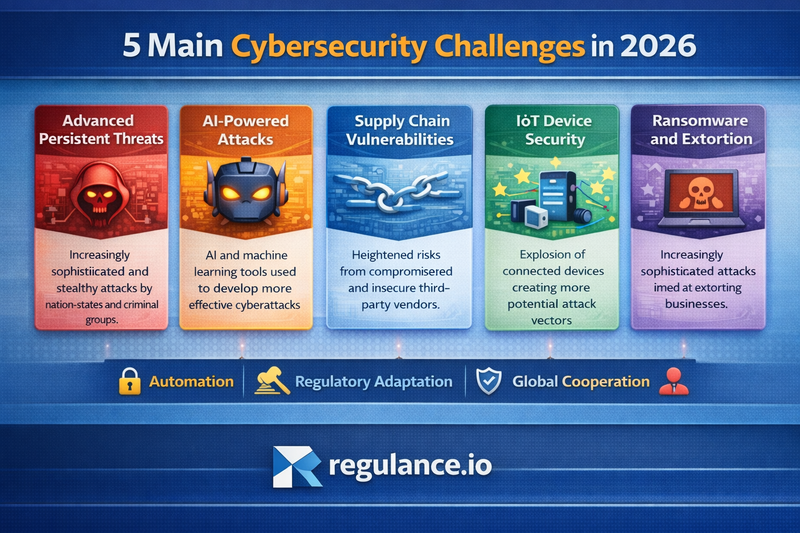
1. AI-Powered Cyberattacks
Artificial intelligence has been a double-edged sword for the cybersecurity world. While defenders use AI to detect anomalies and automate responses, attackers are leveraging the same technology to launch faster, smarter, and more targeted campaigns.
AI-generated phishing emails are now frighteningly convincing. They mimic the writing style of colleagues, reference real recent events, and bypass traditional spam filters with ease. Deepfake audio and video are being used in social engineering attacks, imagine receiving a video call from what appears to be your CEO authorizing a wire transfer.
Automated vulnerability scanning tools powered by AI can probe thousands of systems simultaneously, identifying weaknesses far faster than any human team could patch them. In 2026, the speed asymmetry between attackers and defenders has never been greater, and AI is the primary reason why.
2. Ransomware Evolution and Double Extortion
Ransomware has evolved. The modern ransomware attack in 2026 doesn't just encrypt your files and demand payment. It exfiltrates sensitive data first, then threatens to publish it publicly if the ransom isn't paid. This "double extortion" tactic has proven devastatingly effective because even organizations with solid backups have to reckon with the reputational fallout of exposed data.
Ransomware-as-a-Service (RaaS) platforms have lowered the technical barrier to entry dramatically. Criminal groups now operate like subscription businesses, licensing their malware tools to affiliates who carry out attacks and split the proceeds. This industrialization of ransomware means attack volumes continue to surge even as law enforcement makes periodic arrests.
3. Third-Party and Supply Chain Vulnerabilities
Modern businesses don't operate in isolation. They rely on dozens, sometimes hundreds of third-party vendors, software providers, and cloud services. Each of those connections represents a potential entry point for attackers.
Supply chain attacks, where hackers compromise a trusted software provider to reach downstream customers, have become one of the most feared threat vectors of the decade. A single compromised update pushed through a legitimate software channel can expose thousands of organizations simultaneously. In 2026, your cybersecurity is only as strong as the weakest link in your entire vendor ecosystem.
Vetting third-party security practices, enforcing contractual security requirements, and continuously monitoring vendor access are essential.
4. The Expanding Attack Surface of IoT and OT Systems
The Internet of Things continues to grow at an extraordinary pace. By 2026, there are estimated to be over 30 billion connected devices worldwide, from smart thermostats and industrial sensors to medical equipment and autonomous vehicles. The problem is that many of these devices were designed for functionality, not security. They run outdated firmware, use default credentials, and often lack the ability to receive security patches.
Operational Technology (OT) systems, the machinery that runs factories, power grids, and water treatment plants present an especially alarming target. These systems were historically air-gapped from the internet, but increased connectivity has eliminated that buffer. A successful attack on OT infrastructure can have real-world, sometimes life-threatening consequences.
Securing this sprawling, heterogeneous landscape demands a fundamentally different approach than traditional endpoint security.
5. The Human Factor and Insider Threats
Technology can only do so much. The majority of successful cyberattacks still involve a human element; a clicked phishing link, a reused password, a misconfigured cloud bucket, or an employee who fell for a social engineering scheme.
Insider threats whether malicious or accidental remain one of the most difficult cybersecurity challenges to address because they originate from within the trusted perimeter. Disgruntled employees, careless contractors, and well-meaning staff who simply don't know better all pose legitimate risks.
In 2026, the shift to hybrid and remote work has made this challenge even more acute. Employees access corporate systems from personal devices on home networks, blurring the lines between personal and professional digital environments and creating new opportunities for credential theft and data leakage.
How Can Your Business Overcome These Challenges?
Acknowledging the threat landscape is one thing. Building a practical, resilient cybersecurity strategy is another. Here's how forward-thinking businesses are tackling these challenges head-on.
Adopt a Zero Trust Architecture. The old model of "trust but verify" is dead. Zero Trust assumes that no user, device, or network segment should be inherently trusted; every access request must be authenticated, authorized, and continuously validated. Implementing Zero Trust reduces the blast radius of any single compromised credential or device.
Invest in Security Awareness Training. Since humans remain the primary attack vector, continuous education is non-negotiable. Regular phishing simulations, cybersecurity hygiene workshops, and clear reporting protocols empower employees to be your first line of defense rather than your biggest vulnerability. Training should be ongoing, not a once-a-year checkbox.
Conduct Regular Risk Assessments and Penetration Testing. You can't defend what you don't know about. Periodic risk assessments help you identify gaps in your security posture before attackers do. Penetration testing where ethical hackers simulate real attacks against your systems reveals vulnerabilities in context, giving you a realistic picture of your exposure.
Tighten Third-Party Risk Management. Implement a formal vendor risk management program. This means assessing the security practices of every vendor with access to your systems, requiring contractual security commitments, and continuously monitoring third-party activity. Don't wait for a supply chain attack to discover your gaps.
Build an Incident Response Plan. When not if a security incident occurs, the speed and quality of your response determines how much damage you sustain. A well-documented, regularly tested incident response plan ensures your team knows exactly what to do, who to call, and how to communicate, both internally and to regulators and customers.
Stay Ahead of Compliance Requirements. Regulatory requirements are evolving rapidly. Maintaining compliance with frameworks relevant to your industry provides a structured foundation for building genuinely effective security controls.
How Regulance Can Help You With Compliance Needs
Navigating the complex, ever-shifting world of cybersecurity compliance is overwhelming for most organizations. That's where Regulance comes in.
Regulance specializes in helping businesses of all sizes achieve and maintain compliance with the frameworks that matter most to their industry; whether that's ISO 27001, SOC 2, GDPR, HIPAA, NIS2, or emerging regional regulations. Rather than treating compliance as a one-time audit event, Regulance takes a continuous, risk-based approach that keeps your organization audit-ready at all times.
What sets Regulance apart is its ability to translate complex regulatory language into actionable steps your team can actually implement. Their platform provides real-time compliance monitoring, automated evidence collection, and gap analysis reporting, so you always know exactly where you stand and what needs attention.
Regulance also understands that compliance and security aren't the same thing, but they should reinforce each other. Their advisory team works alongside your organization to ensure that your compliance program doesn't just satisfy regulators on paper but genuinely strengthens your cybersecurity posture in practice.
For businesses facing multiple overlapping frameworks, Regulance's cross-mapping capabilities eliminate redundant work by showing exactly how controls satisfied in one framework apply to another, saving your team significant time and resources.
In 2026, compliance is table stakes. Regulance makes sure you meet that bar and then some.
Ready to simplify your compliance journey? Contact Regulance today and take the guesswork out of cybersecurity compliance, so you can focus on growing your business with confidence.
FAQs
What is the biggest cybersecurity threat in 2026?
AI-powered attacks and ransomware remain the most pervasive and damaging threats. The combination of automation, sophistication, and accessibility through Ransomware-as-a-Service platforms makes these two categories particularly dangerous for businesses of all sizes.
How much does a data breach cost the average business?
The global average cost of a data breach in recent years has exceeded $4.5 million per incident, factoring in investigation, remediation, regulatory fines, legal costs, and reputational damage. Costs vary significantly by industry and geography.
What is Zero Trust and does my business need it?
Zero Trust is a security model that requires all users and devices to be continuously verified before accessing any system or data, regardless of whether they're inside or outside the corporate network. In 2026, it's considered a best practice for organizations of virtually any size, given the prevalence of remote work and cloud-based infrastructure.
How often should my business conduct cybersecurity training?
Security awareness training should be continuous rather than annual. At minimum, organizations should run quarterly training sessions and regular simulated phishing campaigns to keep employees sharp and responsive to evolving tactics.
What compliance frameworks should my business prioritize?
This depends heavily on your industry and geography. Healthcare organizations typically need to focus on HIPAA. Businesses operating in Europe must comply with GDPR. Companies seeking to work with enterprise clients often pursue SOC 2 or ISO 27001. A compliance partner like Regulance can help you identify which frameworks apply to your specific situation.
Conclusion
Cybersecurity in 2026 is a continuous discipline that demands attention, investment, and adaptability in the face of an ever-changing threat landscape. AI-powered attacks, sophisticated ransomware, supply chain vulnerabilities, IoT sprawl, and the enduring human factor all conspire to make this one of the most complex operational challenges businesses face today.
But complexity doesn't have to mean paralysis. Organizations that take a proactive, layered approach to cybersecurity combining strong technical controls with a culture of security awareness and a structured compliance program are far better positioned to absorb and recover from attacks when they inevitably occur.
The cost of inaction has never been higher. The reputational, financial, and legal consequences of a major security incident can be existential, particularly for small and mid-sized businesses that lack the resilience of larger enterprises. Getting ahead of these challenges now, while your organization still has the initiative, is infinitely preferable to scrambling in the aftermath of a breach.
Cybersecurity is a journey, not a destination. And the businesses that treat it that way, with ongoing investment, honest self-assessment, and trusted partners in their corner are the ones that will thrive in 2026 and beyond.
Don't leave your business exposed. Partner with Regulance to build a compliance and cybersecurity strategy that works. Reach out today and let's get started.