Authorized Representatives in the EU AI Act: Who Are They and How Do They Protect Your AI Compliance?


Introduction
The European Union's Artificial Intelligence Act represents a groundbreaking moment in technology regulation. As the world's first comprehensive legal framework specifically designed to govern artificial intelligence systems, the EU AI Act sets new standards for how AI developers, deployers, and distributors must operate within the European market. But here's the challenge: what happens when your AI company operates outside the EU but wants to serve European customers?
This is where authorized representatives come in. They are your company's official liaison with EU authorities, a bridge between your non-EU business and European regulatory requirements. Understanding the role of authorized representatives under the EU AI Act entails maintaining market access, building trust with European customers, and avoiding potentially devastating penalties.
It doesn’t matter if you're a Silicon Valley startup, an Asian tech giant, or a company from anywhere outside the EU looking to deploy AI systems in European markets, grasping what authorized representatives do and why they matter could be the difference between thriving in the EU or facing regulatory roadblocks. Let's dive deep into this critical compliance role.
What is an Authorized Representative?
An authorized representative is a natural or legal person established within the European Union who acts on behalf of a non-EU provider of AI systems. Essentially, they serve as the official point of contact between your company and EU authorities responsible for enforcing the AI Act.
The concept isn't entirely new to EU regulation. Similar roles exist under the General Data Protection Regulation (GDPR) and the Medical Device Regulation. However, the EU AI Act tailors this function specifically to the unique challenges and requirements of artificial intelligence governance.
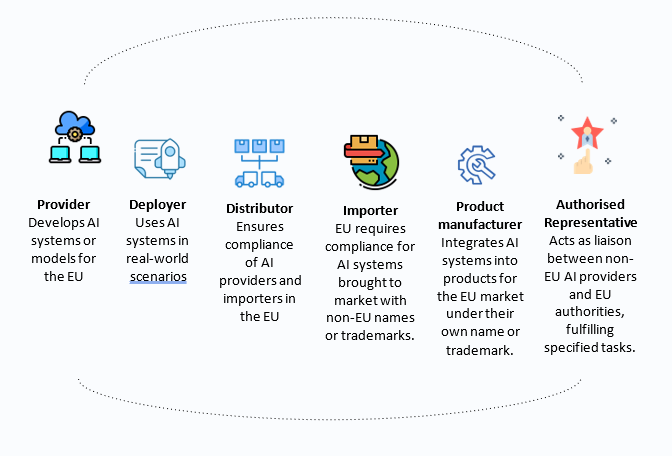
When you appoint an authorized representative, you're designating someone who can speak for your organization, receive communications from regulatory bodies, and ensure that your AI systems meet all necessary compliance standards. They carry real responsibilities and must have genuine authority to act on your behalf.
The authorized representative becomes your company's face in the EU for AI Act matters. They need to be accessible, knowledgeable, and empowered to make decisions or take actions required by EU market surveillance authorities. This relationship is formalized through a written mandate that clearly defines their powers and responsibilities.
Compliance Roles Introduced by the EU AI Act
The EU AI Act establishes a comprehensive ecosystem of compliance roles, each with distinct responsibilities. Understanding where authorized representatives fit within this framework helps clarify their specific function.
Providers are entities that develop AI systems or have AI systems developed for them with the intention of placing them on the EU market under their own name or trademark. Providers bear the primary responsibility for ensuring their AI systems comply with the Act's requirements before market placement.
Deployers are entities that use AI systems under their own authority, except when the use occurs in the course of personal non-professional activity. Deployers have their own compliance obligations, particularly for high-risk AI systems, including conducting fundamental rights impact assessments in certain cases.
Distributors make AI systems available on the EU market without altering their properties. While their compliance burden is lighter than providers, distributors must verify that AI systems bear required conformity markings and are accompanied by necessary documentation.
Importers are the first entities to place AI systems from non-EU providers onto the EU market. They serve as a critical checkpoint, verifying that providers have completed required conformity assessments and established technical documentation.
Authorized representatives sit alongside these roles as the designated EU-based contact for non-EU providers. They don't replace the provider's obligations but facilitate compliance by serving as an accessible point of contact for authorities and maintaining necessary documentation within the EU.
This ecosystem creates accountability at every stage of an AI system's lifecycle, from development through deployment, with authorized representatives ensuring non-EU providers remain connected to and compliant with the European regulatory framework.
Who Should Appoint Authorized Representatives?
The EU AI Act makes it clear: if you're a provider of AI systems established outside the European Union, and you're placing AI systems on the EU market or putting them into service within the EU, you must appoint an authorized representative.
This requirement applies regardless of your company's size, industry, or the specific type of AI system you're offering. Whether you're offering a high-risk AI system used in critical infrastructure or a more limited-risk application, if you're based outside the EU and serving European customers, the authorized representative requirement applies to you.
Let's break down the specific scenarios:
Non-EU AI developers and providers who want to sell or deploy their AI systems in European markets are the primary group required to appoint authorized representatives. This includes software companies, AI platform providers, and technology firms from countries like the United States, United Kingdom (post-Brexit), Canada, Australia, China, India, and everywhere else beyond EU borders.
Companies placing high-risk AI systems on the market face particularly stringent requirements. High-risk systems include those used in critical infrastructure, educational or vocational training, employment management, essential public and private services, law enforcement, migration and border control, administration of justice, and democratic processes. For these providers, having a properly appointed authorized representative is mandatory for legal market access.
International corporations with no EU establishment need authorized representatives even if they're well-known global brands. Your reputation or market presence doesn't exempt you from this requirement. Without an EU-based authorized representative, you cannot legally place AI systems on the European market.
However, there's an important exception: if you're a non-EU provider but you've already designated an importer who accepts responsibility for compliance verification and maintaining technical documentation, you might not need a separate authorized representative. The importer can effectively fulfill this bridging function. But this arrangement must be explicitly agreed upon and documented.
What Are The Roles and Responsibilities of an Authorized Representative?
Authorized representatives under the EU AI Act carry substantial responsibilities that go far beyond simply receiving mail. Their mandate creates real obligations that directly impact your company's compliance status and market access.
Primary point of contact with authorities: The authorized representative serves as the go-to person for all communications from national competent authorities and market surveillance bodies. When regulators have questions, concerns, or requests regarding your AI systems, they'll contact your authorized representative first. This means your representative must be genuinely accessible and responsive.
Documentation management: One of the most critical functions is maintaining and providing access to documentation. Your authorized representative must keep copies of all technical documentation, EU declarations of conformity, and other required records. When authorities conduct market surveillance activities, they'll request these documents from your representative, who must provide them promptly.
Cooperation with market surveillance: The EU AI Act requires authorized representatives to cooperate fully with market surveillance authorities. This includes responding to requests for information, facilitating inspections, and providing access to premises where documentation is stored. They must be proactive in addressing regulatory concerns and queries.
Compliance verification support: While the provider remains ultimately responsible for compliance, authorized representatives often help verify that AI systems meet all applicable requirements before market placement. They can identify potential compliance gaps and work with the provider to address them before problems arise.
Communication channel: Your authorized representative serves as a two-way communication bridge. Not only do they receive information from authorities, but they also convey important regulatory developments, compliance deadlines, and enforcement actions back to you. This ensures you stay informed about the European regulatory landscape even while operating from abroad.
Mandate execution: The specific powers granted to your authorized representative should be clearly defined in your written mandate. Typically, this includes authority to represent the company in AI Act matters, respond to regulatory inquiries, provide documentation, and take corrective actions when necessary. The mandate should be comprehensive enough to enable effective representation but can exclude commercial or contractual matters unrelated to regulatory compliance.
Incident reporting: When serious incidents or malfunctions occur involving your AI systems, your authorized representative may need to report these to relevant authorities on your behalf, ensuring timely notification as required by the Act.
Post-market monitoring: For high-risk AI systems, providers must establish post-market monitoring systems. Your authorized representative can facilitate this by collecting feedback, monitoring incidents, and ensuring information flows between EU users and your organization.
It's crucial to understand that appointing an authorized representative doesn't diminish your own responsibilities as a provider. You remain fully accountable for compliance. The authorized representative facilitates compliance and regulatory interaction but doesn't replace your obligations.
Qualifications of Authorized Representatives
Not just anyone can serve as an authorized representative under the EU AI Act. The regulation establishes specific criteria to ensure representatives can effectively fulfill their role.
EU establishment requirement: The most fundamental qualification is that the authorized representative must be established within the European Union. This means having a physical presence, an actual office or business location within EU territory. A post office box or virtual office typically won't suffice. Authorities need to know they can reach someone at a genuine location if necessary.
Legal capacity: Authorized representatives can be either natural persons (individuals) or legal entities (companies). Many non-EU providers prefer appointing specialized compliance firms or legal practices that understand the AI regulatory landscape. However, an individual with appropriate expertise can also serve in this capacity.
Mandate from the provider: The authorized representative must receive a written mandate from the provider, explicitly authorizing them to perform tasks related to AI Act compliance. This mandate should clearly specify the representative's powers, responsibilities, and limitations. It forms the legal basis for the representative's authority to act on behalf of the provider.
Expertise and competence: While the EU AI Act doesn't specify formal educational or professional requirements, practical competence is essential. Your authorized representative should understand AI technology, the specific requirements of the AI Act, EU regulatory procedures, and compliance documentation standards. They need to communicate effectively with both technical teams and regulatory authorities.
Language capabilities: Since the authorized representative must communicate with various EU national authorities, language skills matter. At minimum, they should be fluent in English and ideally in the language of the primary EU markets where your AI systems are deployed.
Accessibility and responsiveness: Authorities expect timely responses to their inquiries. Your authorized representative should have systems in place to receive communications promptly and respond within reasonable timeframes. This often means maintaining business hours aligned with European time zones.
Resources and infrastructure: Effective representatives need proper infrastructure, secure document storage systems, communication tools, and potentially staff to handle multiple clients or complex compliance matters. For companies with extensive AI deployments across the EU, the representative role may require significant resources.
Conflicts of interest: While not explicitly prohibited, your authorized representative should be free from conflicts that could compromise their ability to represent your interests effectively. Transparency about any potential conflicts is essential.
Many non-EU providers engage specialized legal or compliance firms that offer authorized representative services as part of broader EU AI Act compliance support. These firms bring established EU presence, regulatory expertise, and infrastructure designed specifically for this purpose.
What Are Non-Representatives?
Understanding what authorized representatives are not is just as important as understanding their proper role. The EU AI Act creates specific obligations for authorized representatives, but these shouldn't be confused with other related concepts or functions.
Not an importer: Authorized representatives and importers serve different functions under the EU AI Act. An importer is the first entity that places a non-EU AI system onto the European market. Importers have their own distinct compliance obligations, including verifying conformity assessments and ensuring proper documentation accompanies imported AI systems. While an importer can sometimes fulfill the representative function through agreement with the provider, these remain distinct roles with different primary responsibilities.
Not a distributor: Distributors make AI systems available on the market without altering their properties. They're part of the supply chain but don't represent providers in regulatory matters. An authorized representative's role is specifically about regulatory compliance and authority interaction, not commercial distribution.
Not a deployer: Deployers are the end users of AI systems—organizations that actually put AI systems into operation under their own authority. While deployers have significant compliance obligations under the Act, particularly for high-risk systems, they're not representing providers. The relationship flows in the opposite direction.
Not merely a mailbox service: Some companies mistakenly believe they can satisfy the authorized representative requirement by simply designating a mail forwarding service or virtual office in the EU. This fundamentally misunderstands the role. Authorized representatives must have genuine capacity to interact with authorities, understand compliance issues, and take meaningful action on behalf of providers. A passive forwarding arrangement doesn't meet these requirements.
Not a general EU representative: The authorized representative's mandate is specifically limited to matters related to the AI Act. They don't necessarily represent the provider for other regulatory frameworks, commercial contracts, litigation, or general business matters. Their authority should be clearly scoped to AI compliance issues.
Not a shield from liability: Appointing an authorized representative doesn't transfer or reduce the provider's ultimate responsibility for compliance. If your AI system violates the Act's requirements, you remain liable regardless of whether you have an authorized representative. The representative facilitates compliance but doesn't assume your obligations.
Not an optional arrangement: For non-EU providers placing AI systems on the EU market, appointing an authorized representative (or ensuring an importer accepts this role) isn't a suggestion, it's a legal requirement. Treating it as optional or merely advisable misses the mandatory nature of this obligation.
Not a substitute for genuine EU presence: Some international companies wonder whether appointing an authorized representative allows them to avoid establishing their own EU operations. While it provides a pathway to market access without full establishment, it's not equivalent to having your own EU subsidiary with complete operational capabilities. Companies with substantial European business often eventually establish their own EU entities.
Understanding these distinctions helps clarify what authorized representatives actually do and prevents confusion about compliance responsibilities under the EU AI Act.
Frequently Asked Questions
How much does appointing an authorized representative cost?
Costs vary significantly depending on the complexity of your AI systems, the number of products you're placing on the market, and whether you engage a specialized firm or an individual. Typical annual fees range from several thousand to tens of thousands of euros. Specialized compliance firms often charge based on the scope of services required, number of AI systems covered, and intensity of regulatory interaction expected.
Can one authorized representative serve multiple non-EU providers?
Yes, absolutely. Many compliance firms and legal practices specialize in serving as authorized representatives for multiple companies simultaneously. This can actually be advantageous, as these specialized representatives develop deep expertise in AI Act compliance and maintain established relationships with EU authorities. However, each provider must have their own written mandate clearly defining the representative's authority and responsibilities for their specific AI systems.
What happens if I don't appoint an authorized representative?
Failing to appoint an authorized representative when required violates the EU AI Act's market placement requirements. This can result in your AI systems being prohibited from the European market, administrative fines up to certain percentages of your global annual turnover, and reputational damage. National market surveillance authorities can take enforcement action against non-compliant providers, potentially including product recalls and injunctions preventing further sales.
Can my authorized representative be based in any EU country?
Yes, your authorized representative can be established in any EU member state. You might choose based on factors like language capabilities, proximity to your main European markets, costs, or existing business relationships. However, remember that your representative should be accessible to authorities across the EU, not just in their country of establishment.
How do I terminate an authorized representative relationship?
Termination should be handled carefully and in accordance with your mandate agreement. You'll need to notify both your current representative and relevant authorities, and if you're continuing to place AI systems on the EU market, immediately appoint a replacement representative. There shouldn't be any gap in representation while your products remain available in the EU.
Does my authorized representative need technical AI expertise?
While deep technical expertise isn't legally required, practical understanding of AI technology helps significantly. Your representative needs to comprehend your AI systems well enough to discuss them with authorities, understand compliance documentation, and identify potential issues. Many effective representatives combine regulatory expertise with sufficient technical knowledge to function effectively.
Can my EU distributor serve as my authorized representative?
Technically, an entity can hold multiple roles under the AI Act, but this must be clearly documented and each role's obligations must be fulfilled. If your EU distributor has the capacity, expertise, and willingness to also serve as your authorized representative, this arrangement is possible. However, the distinct obligations of each role must be clearly understood and properly executed.
Conclusion
The EU AI Act's authorized representative requirement reflects the regulation's sophisticated approach to global AI governance. By requiring non-EU providers to maintain an accessible EU-based contact for regulatory matters, the Act ensures that European authorities can effectively oversee AI systems regardless of where their providers are located.
For companies outside the European Union, understanding and properly implementing the authorized representative requirement is about securing sustainable access to one of the world's most important markets for technology. The European Union represents hundreds of millions of potential customers and some of the world's most advanced economies. Losing access to this market due to inadequate compliance would represent a significant strategic setback for any AI company with global ambitions.
The authorized representative role creates a bridge between your organization and the European regulatory framework. When properly implemented, this relationship facilitates smooth market access, helps prevent compliance issues, and demonstrates your commitment to meeting European standards for responsible AI development and deployment.
As the EU AI Act moves from legislation to active enforcement, the quality and effectiveness of your authorized representative relationship will directly impact your European operations. This isn't an area where cutting corners makes sense. Invest in finding a qualified, competent representative who understands both the regulatory landscape and your specific AI systems. Ensure your mandate clearly defines responsibilities and authority. Maintain open communication channels so your representative can effectively advocate for your interests and address regulatory concerns promptly.
The global AI regulatory landscape is evolving rapidly, with many jurisdictions looking to the EU AI Act as a model. Understanding compliance roles like authorized representatives today prepares your organization for the increasingly regulated future of artificial intelligence worldwide.
Contact Regulance today to learn how we can help you navigate the EU AI Act requirements, appoint qualified authorized representatives, and build a robust compliance program that protects your market access while supporting responsible AI innovation.