Are You Ready for These AI Risks? Top 10 Threats Facing Organizations in 2026


Introduction
Artificial intelligence is no longer a distant buzzword reserved for tech conferences and science fiction novels. In 2026, it sits at the heart of how businesses operate, automating workflows, driving decisions, personalizing customer experiences, and processing sensitive data at a scale that was unimaginable just a decade ago. But with that power comes a reality that many organizations are still slow to confront: AI risks are real, growing, and increasingly costly.
According to recent industry reports, over 77% of enterprises have integrated some form of AI into their core operations. Yet fewer than 30% have a formal AI risk management strategy in place. That gap is where things get dangerous.
AI risks span regulatory, ethical, operational, and cybersecurity dimensions meaning that a single blind spot can result in data breaches, regulatory fines, reputational damage, or flawed decisions that hurt customers and employees alike. And as AI systems become more autonomous and deeply embedded in critical infrastructure, the stakes only get higher.
This article breaks down the top 10 AI risks organizations face in 2026, explains why these risks exist at a fundamental level, and outlines what your organization can do to stay ahead of them.
Why Is AI Risk? Understanding AI Attack Vectors
AI is a system that learns from data, makes predictions, and takes actions often with minimal human oversight. Each of those three elements introduces potential vulnerabilities. Data can be poisoned or biased. Predictions can be manipulated. Actions can be exploited.
AI attack vectors are the specific pathways through which bad actors or even well-intentioned systems can cause harm. These include:
Adversarial inputs — carefully crafted data designed to confuse or mislead an AI model into making wrong decisions, like misclassifying a stop sign or bypassing a fraud detection system.
Data poisoning — corrupting the training data that an AI model learns from, so that it develops flawed or malicious behavior from the outset.
Model inversion attacks — reverse-engineering an AI model to extract sensitive information from its training data, which is a serious privacy concern for healthcare and financial organizations.
Prompt injection — a newer and growing threat where malicious instructions are embedded into user inputs to manipulate large language models (LLMs) into ignoring their safety guidelines.
Supply chain vulnerabilities — third-party AI tools and APIs your organization uses may carry embedded risks you didn't build and can't fully audit.
Understanding these vectors matters because AI risks don't always come from outside. Sometimes the most dangerous threats are internal, a biased model that quietly discriminates, or an automated system making high-stakes decisions no human is reviewing.
Top 10 AI Risks in 2026
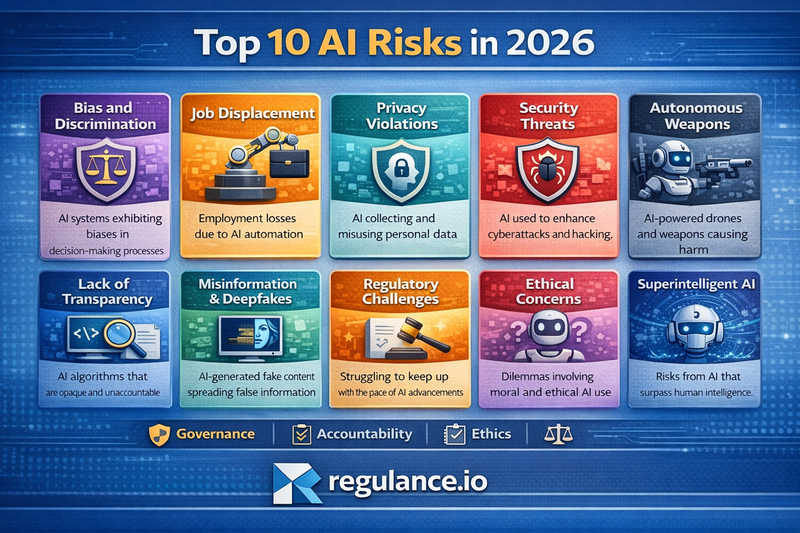
1. AI-Powered Cyberattacks
Cybercriminals are now using AI to launch faster, smarter, more personalized attacks. AI-generated phishing emails have become nearly indistinguishable from legitimate communications, deepfake audio is being used for voice fraud, and automated malware can adapt in real time to evade detection. Organizations that relied on traditional cybersecurity tools are finding themselves outpaced.
2. Bias and Discrimination in AI Models
AI systems trained on historical data often inherit the biases baked into that data. In hiring, lending, healthcare triage, and criminal justice applications, biased AI can produce discriminatory outcomes at scale affecting thousands of people before anyone notices. In 2026, regulators are paying close attention, and organizations can face legal liability for discriminatory algorithmic decisions.
3. Data Privacy Violations
AI systems consume enormous volumes of personal data. When that data is mishandled, whether through inadequate security, excessive collection, or non-compliant processing; organizations face violations under GDPR, CCPA, and a growing wave of new AI-specific privacy regulations. The risk is amplified when AI is used for profiling or behavioral prediction.
4. Lack of Explainability and Transparency
Many modern AI models, particularly deep learning systems, operate as "black boxes." They produce outputs without offering any understandable reason for their decisions. This is a major compliance risk in regulated industries. If your AI denies someone a loan or flags an employee for termination, you need to be able to explain why and many organizations simply can't.
5. AI Hallucinations and Misinformation
Large language models can confidently generate false information fabricating citations, inventing facts, and producing misleading outputs that look credible. When organizations deploy these tools for customer-facing applications, legal research, or medical information without adequate guardrails, the consequences can range from embarrassing to genuinely dangerous.
6. Regulatory Non-Compliance
The AI regulatory landscape in 2026 is more complex than ever. The EU AI Act is in full enforcement mode, new frameworks are emerging across the US, UK, and Asia, and sector-specific rules for finance, healthcare, and critical infrastructure are tightening. Organizations using AI without a compliance strategy are walking into a minefield of potential violations.
7. Intellectual Property and Copyright Infringement
Generative AI tools can unknowingly reproduce copyrighted content, create IP ownership ambiguity, or violate licensing agreements. Legal battles over AI-generated content are increasing, and organizations using these tools without clear policies are exposed to costly litigation.
8. AI Supply Chain Risk
When organizations integrate third-party AI tools, APIs, or pre-trained models, they inherit the risks embedded in those systems. A vulnerability in an AI vendor's model or a compromised update to a widely-used AI library can cascade across every organization that depends on it and many won't even know until damage is done.
9. Over-Reliance on AI Decision-Making
Automation bias; the tendency to trust AI outputs even when they're wrong is a growing organizational risk. When humans stop questioning algorithmic recommendations, errors amplify at scale. This is particularly dangerous in high-stakes domains like medical diagnosis, financial risk assessment, and public safety applications.
10. Workforce Displacement and Insider Threat
AI-driven automation is reshaping workforces faster than organizations can manage the transition. Displaced employees can become disengaged, resentful, or in extreme cases, malicious insiders who exploit their access to AI systems for sabotage or data theft. Managing this human dimension of AI risk is an area many organizations underestimate.
How Can These Risks Impact Your Organization?
The risks listed above translate into very concrete organizational consequences that affect your bottom line, your reputation, and your legal standing.
From a financial perspective, AI-related incidents are expensive. Regulatory fines under frameworks like the EU AI Act can reach up to €35 million or 7% of global annual revenue. Data breaches enabled by AI attacks carry average costs well above $4 million. Legal settlements from discriminatory AI decisions are climbing as case law develops.
From a reputational standpoint, trust is extraordinarily difficult to rebuild once a high-profile AI failure goes public. A biased hiring algorithm, a hallucinating chatbot giving dangerous medical advice, or a deepfake fraud incident tied to your brand can do lasting damage to customer and stakeholder confidence.
On the operational side, over-reliance on AI systems creates single points of failure. If your AI-powered supply chain management, customer service platform, or fraud detection system goes down or produces systematically wrong outputs, the downstream disruption can halt business operations entirely.
From a compliance and legal perspective, organizations that can't demonstrate responsible AI governance are increasingly finding themselves shut out of certain markets, unable to secure enterprise contracts, or subject to mandatory audits. In 2026, "we didn't know" is not a defensible position for boards or executives.
How Regulance Can Help You With Compliance Needs
Regulance is a compliance intelligence platform built for organizations that take AI governance seriously. Rather than leaving your team to manually track an exploding landscape of AI regulations, frameworks, and enforcement actions, Regulance centralizes and automates the compliance process so nothing falls through the cracks.
Here's what Regulance brings to the table for AI risk management:
Regulatory Mapping — Regulance continuously monitors AI regulations across jurisdictions including the EU AI Act, NIST AI RMF, ISO/IEC 42001, and emerging national frameworks and maps them directly to your organization's AI use cases and risk profile.
Risk Assessment Workflows — Instead of ad hoc spreadsheets, Regulance provides structured workflows for identifying, classifying, and documenting AI risks across your organization's AI inventory.
Policy and Documentation Management — From bias impact assessments to data processing records, Regulance helps you build and maintain the documentation portfolio that regulators and auditors expect to see.
Real-Time Compliance Alerts — When regulations change or new enforcement guidance is issued, Regulance keeps your team informed immediately not months later when it's already a problem.
Audit Readiness — Regulance organizes your compliance evidence in audit-ready formats, dramatically reducing the time and cost of responding to regulatory inquiries.
Ready to take control of your AI compliance posture? Visit Regulance today and book a free discovery call.
FAQs
What are AI risks?
AI risks are potential harms that arise from the development, deployment, or use of artificial intelligence systems. They include cybersecurity threats, bias, privacy violations, regulatory non-compliance, and operational failures.
Why are AI risks increasing in 2026?
AI adoption has accelerated dramatically, creating more attack surfaces, more regulatory scrutiny, and more high-stakes applications where AI failures have serious consequences.
What is the EU AI Act and does it apply to my organization?
The EU AI Act is a comprehensive regulatory framework that classifies AI systems by risk level and imposes obligations on organizations that develop or use AI within the EU. It can apply to non-EU organizations if they serve EU customers or markets.
How do I start managing AI risks in my organization?
Start with an AI inventory catalog of every AI system in use. Then assess each one for potential risks including bias, data privacy, explainability, and regulatory compliance. From there, build governance policies and monitoring processes, or use a platform like Regulance to streamline the entire process.
What is an AI risk framework?
A structured methodology for identifying, assessing, and mitigating AI-specific risks. Common frameworks include the NIST AI Risk Management Framework and ISO/IEC 42001.
Conclusion
AI risks in 2026 are a present reality that is already affecting organizations across every industry and every geography. From sophisticated AI-powered cyberattacks to regulatory landmines, from biased models to hallucinating chatbots, the challenge isn't identifying that risks exist. The challenge is building the organizational maturity to manage them systematically before they turn into crises.
The organizations that will lead in this environment are those that treat AI governance not as a compliance checkbox, but as a strategic capability. That means investing in visibility, accountability, and the right tools to stay ahead of a landscape that will continue evolving faster than any manual process can track.
The good news is that you don't have to figure this out alone. With the right framework, the right expertise, and the right platform in your corner, AI risk management becomes a competitive advantage. It signals to customers, partners, regulators, and employees that your organization takes its responsibilities seriously and that's a message worth sending loudly in 2026.
Take the first step. Explore how Regulance can help your organization build a resilient, audit-ready AI compliance program.